

-May-28-2026-09-07-20-0739-PM.png)

Restaurant operators across the US are hiring constantly. The average restaurant employee turnover rate topped 75% in 2025. In QSR, annual turnover can exceed 130%. That means you're not just hiring to grow. You're hiring to stay even. And if your sourcing strategy isn't built for speed and proximity, you're already behind.
The Real Cost of Hiring the Wrong Candidate (From Too Far Away)
Here's a pattern most operators recognize: you post a job, you get applicants, you hire someone who looks decent on paper. Three weeks later, they're gone. One of the most common and overlooked reasons for early attrition is simple geography. 42% of restaurant employees say a convenient commute was a top reason they accepted their most recent job.
That number matters more than people give it credit for. A server or line cook who lives 45 minutes away will almost always deprioritize your location the moment something closer comes up. Proximity isn't just a perk, it's a retention variable.
And yet, most restaurant operators don't actively filter for it at the sourcing stage.
You're Probably Posting in the Right Places, But Not the Right Way
The go-to channels - Indeed, ZipRecruiter, Craigslist - all have location-based filters. But posting a job and hoping nearby people find it is not a strategy. 38% of candidates apply outside regular work hours, and that number rises to 54% when you include nights and weekends, according to hiring platform data cited by the National Restaurant Association.
Your job posting needs to reach people when they're on their phones, in their neighborhoods, not when they're sitting at a desktop at 9am. If your posting isn't optimized for mobile and local search, you're missing the bulk of your applicant pool.
The Qualified-But-Far Problem
65% of restaurant operators describe the current labor market as "tight" or "very tight." That pressure pushes hiring managers to take what they can get, including candidates who are farther away than ideal. Short-term, it fills a shift. Long-term, it creates a churn cycle.
The average hard cost to replace a single hourly employee is now $2,305. (Source: Black Box Intelligence, 2024) Multiply that by even a handful of early departures per quarter, and the economics of lazy sourcing get very ugly very fast.
How to Build a Local-First Hiring Strategy!
1. Start With Where Local Candidates Already Are
Your best nearby candidates aren't necessarily browsing job boards at 2pm on a Tuesday. Think about where people who live within a few miles of your location actually spend time online.
1. Nextdoor is underused in restaurant hiring. It's hyperlocal by design and lets you post job openings directly to neighborhood feeds. Someone who lives two streets away and wants a flexible part-time job may never see your Indeed posting, but they'll scroll Nextdoor.
2. Facebook Groups tied to your neighborhood or city also drive real local applicant volume. Look for groups like "[City Name] Jobs" or "[Neighborhood] Community Board." A well-written post with your address, the role, the pay rate, and a simple apply link gets traction.
3. Handshake is worth calling out specifically. It's the leading career platform for college students in the US, with a network that allows local employers to post jobs directly to students at nearby colleges and universities. If your restaurant is within a few miles of a campus, and many are, you have access to a pipeline of people who need flexible schedules, want nearby work, and are often very motivated. Part-time and hourly jobs are actively searched on Handshake.
2. Make the Application So Easy It Takes Less Than Two Minutes
This is where a lot of operators lose people who are genuinely interested. Long applications with uploaded resumes and cover letters are built for corporate hiring. Hourly candidates, especially younger ones, will drop off.
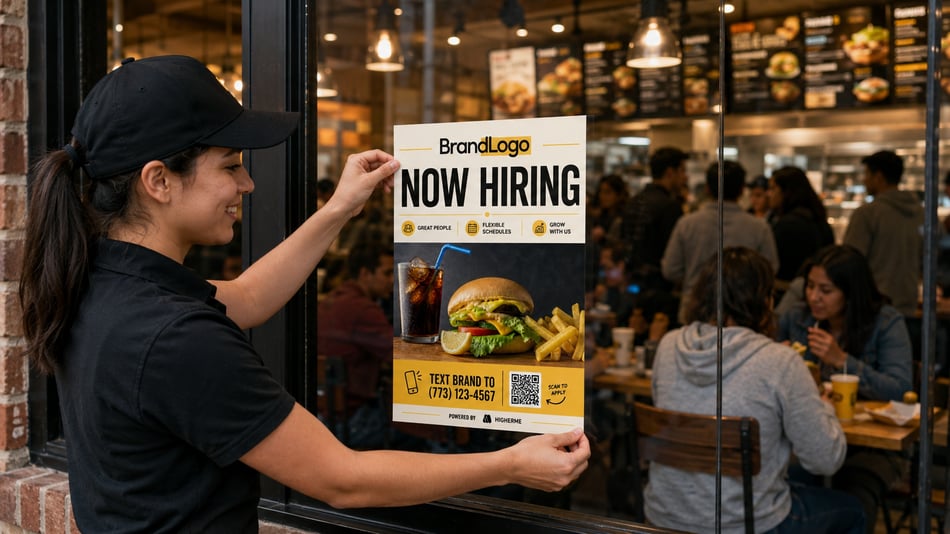
Candidates want flexibility, and that includes the application process itself. A QR code on a window sign, a short SMS keyword people can text to apply, a one-page mobile form, these convert. A five-page form with references and work history does not.
Text-to-apply in particular works well for restaurant locations because it meets candidates where they already are: on their phones, in your neighborhood, maybe standing outside your front door.
3. Write Job Postings That Speak to Someone Nearby
Generic job descriptions don't attract local candidates. Mention the neighborhood. Name the nearest transit stop. Include the actual address, not just the city. Say "we're in the heart of [neighborhood]" or "two blocks from [landmark]." This small shift signals to applicants that location matters to you, and it helps your listing show up in proximity-based searches.
Also, be explicit about the commute benefit. If your location is walkable from a residential area or near public transit, say so. Convenient commute is a top deciding factor for restaurant workers, so make it part of the pitch.
4. Prioritize Speed of Response
Local hiring windows are short. A candidate who applies on Monday and hears back Thursday may have already taken a job at the place down the street. Same-day or next-day outreach makes a real difference.
Automating the initial outreach: a confirmation text, an interview invite, a scheduling link, keeps your pipeline moving without requiring a manager to sit at a computer all day. That's time they don't have.
5. Don't Sleep on Physical Sourcing
Window clings, counter cards, and bag stuffers at your location are still effective. The person standing in your line waiting to order might be exactly the candidate you're looking for. A simple "We're hiring — text [KEYWORD] to [NUMBER] to apply in 2 minutes" placed at eye level converts.
This approach targets the most local possible candidate pool: people who are already physically present at your location.
How HigherMe Helps You Hire Closer, and Faster
HigherMe is built around the specific way hourly restaurant candidates behave. The platform's Candidate Score factors in distance from your location as a ranking signal, so you're automatically surfaced to applicants nearby, not just anyone who searched for "restaurant jobs."
The Text-to-Apply feature lets you put a short keyword and number on any physical or digital touchpoint- your storefront, your receipts, your social posts - and candidates can start an application from their phone in under two minutes. No account creation, no resume upload required.
Once applications come in, automated interview scheduling and availability matching reduce the back-and-forth that slows down hiring. Managers get a shortlist. Candidates get a fast experience. Both sides win.
For operators running multiple locations, HigherMe centralizes applicant management by location so you're not wading through a single pile of applications trying to figure out who lives near which store.
Hiring Locally Is a Strategy, Not a Default
Proximity hiring isn't about being picky. It's about being smart. The candidates closest to you are the most likely to stay. They're easier to reach, faster to respond to local outreach, and less likely to ghost an interview because the commute became inconvenient.
Stop treating local hiring as an afterthought to a broad job board strategy. Build for it from the start, and you'll spend less time refilling the same seat every six weeks.
Visit higherme.com to see how HigherMe helps restaurant operators source, screen, and hire nearby applicants faster.
Frequently Asked Questions
1. What is local restaurant hiring and why does it matter?
Hiring locally for your restaurant means that you make a conscious effort to find employees that live in the area of your restaurant. It matters because proximity is directly correlated to retention. The presence of employees who live close to work impacts retention in that they are more likely to show up consistently, less likely to seek out a job closer to home, and less burdened by the costs of commuting.
2. What are the best platforms for hiring restaurant workers locally?
For local reach, a combination of Indeed Nextdoor, local Facebook Groups, and Handshake (if you're near a college campus) gives you solid coverage. But all those channels used alone are slow. Platforms like HigherMe layer on top of that, distributing your job posts to multiple boards simultaneously while also ranking incoming applicants by distance from your location, so the most local candidates surface first. Physical text-to-apply signage at your location is also one of the highest-converting local sourcing tools available.
3. How does Text-to-Apply work for restaurant hiring?
Text-to-apply lets candidates start a job application by sending a keyword to a designated number from their phone. It removes friction from the process, works on any device without an app or account, and is particularly effective when placed on window signs, receipts, or in-location displays where nearby candidates will see it. HigherMe's Text-to-Apply tool sends automated reminders to candidates who start but don't finish, which brings completion rates up without any manual follow-up from your team.
4. How far should restaurant workers live from their workplace?
There's no universal rule, but convenience matters. Industry data shows that commute convenience is a top reason restaurant workers accept a job offer. For hourly and part time staff in particular, a commute longer than 20-30 minutes becomes a retention risk. In your sourcing, look for candidates that live within a few miles of your location to reduce early turnover. HigherMe’s Candidate Score ranks applicants considering distance so you don’t have to filter for it manually.
5. How can Handshake help restaurants hire local hourly workers?
Handshake is primarily known as a college career platform, but it also supports part-time and hourly job postings. If your restaurant is near a university or community college, posting on Handshake lets you reach students who need flexible work and are actively looking for nearby opportunities. It's an underused channel for local restaurant sourcing. Platforms like HigherMe can help you manage and track applications coming in from Handshake alongside your other sourcing channels, all in one place.
Book a Demo
We'll contact you as soon as possible to better understand how we can help you!