

How to Create a Hotel Hiring Playbook for Every Property in Your Portfolio


Hotels are trying to fill six to seven open positions per property on average, according to AHLA's most recent survey on open roles. In a 30-property portfolio, that's about 200 hires in progress at any given time. In most portfolios, each one runs a little differently, depending on which GM is in charge. A hotel hiring playbook fixes that. It writes down how your company hires, once, so every property follows the same process and corporate can see where it breaks. Here's what to put in it, who should own each part, and how to make it stick.
Why Every Property Ends Up Hiring Differently
1. Hiring Know-how Lives in the GM's Head
Your best GMs have a system. They know which job boards work in their market, which interview questions predict a good room attendant, and which local college sends reliable banquet staff. None of it is written down. When that GM transfers or leaves, the system leaves with them, and the new GM starts from scratch while the property is short-staffed.
2. Brand and State Rules Live in a Few People's Memory
Every flag has its own standards. Every state has its own forms and rules about what you can ask candidates and when. In most portfolios, these rules are known by a few people in corporate HR and a handful of experienced GMs. Everyone else learns them by making mistakes, and some of those mistakes are compliance mistakes.
3. Corporate Can't Fix a Process that Isn't the Same Anywhere
If every property uses different screening questions, different response times and different definitions of "time to fill," you can't compare them. You can't tell whether a property is struggling because of its local labor market or because of how it hires. A shared process is what makes the comparison possible, and the comparison is what tells you where to act.
What to Put in Your Hotel Hiring Playbook
A playbook only works if GMs actually use it, so keep it short. These seven sections cover what matters. For each one, the principle is the same: corporate sets the standard, and the property runs it.
1. Role Profiles by Brand and Property
What goes in: Approved job descriptions for each core role (housekeeping, front desk, food and beverage, maintenance), brand-specific requirements, pay ranges by market and typical shift patterns.
Who owns it: Corporate HR writes the templates. GMs fill in local details, such as shifts and pay within the approved range.
Accurate postings attract candidates who know what they're signing up for, which means fewer early quits. Check pay transparency rules in the states where you operate, since some require pay ranges in job postings.
2. Sourcing Plan
What goes in: Which channels to use for each role (job boards, text-to-apply signs at the property, employee referrals, a rehire list of former employees who left in good standing) and the budget for each.
Who owns it: Corporate sets budgets and tracks which sources produce hires. GMs run the local channels, like posters, job fairs and referrals.
Review cost per hire by source every quarter, and move budget toward the channels that produce hires who stay. Don't rely on referrals alone. The EEOC warns that word-of-mouth recruiting can violate the law if it results in a workforce drawn almost entirely from one group.
3. Screening Standards
What goes in: The same knockout questions for every candidate in a given role, a structured interview guide with five or six questions, and a simple scoring scale.
Who owns it: Corporate HR writes the questions. GMs and hiring managers use them without improvising.
Keep every question tied to the job. The EEOC advises that information requested during the hiring process should be limited to what's essential for deciding whether someone is qualified for the job. Asking every candidate the same job-related questions is fairer, easier to defend and easier to compare across properties.
4. Speed Standards
What goes in: Response-time targets for each step. For example: acknowledge every application automatically within minutes, review within 24 hours, and interview qualified candidates within 48 hours.
Who owns it: GMs are accountable for hitting the targets. Corporate monitors them across properties.
Speed is where most candidates are won or lost. In Cronofy's 2024 survey of 12,000 job candidates, 42% said they had left a hiring process because scheduling an interview took too long.
Read: How Hotel Operators Can Reduce Candidate Drop-Off Between Application and Interview
5. Offer and Onboarding Checklist
What goes in: An offer template, onboarding packets by brand, role and state, background check steps where you use them, and your Form I-9 process.
Who owns it: Corporate owns the packets and templates. Each property owns the in-person parts, like I-9 document review.
Spell out the I-9 steps precisely. New hires complete Section 1 no later than their first day of work. The employer must complete Section 2 within three business days of the employee's first day of work for pay, and the person who examines the documents is the one who must sign it (USCIS).
6. Compliance Guardrails
What goes in: A one-page list of rules every hiring manager follows, no exceptions:
- Ask only job-related questions, and ask every candidate for a role the same ones.
- Never ask about disability before making a job offer. The EEOC states that employers are explicitly prohibited from making pre-offer inquiries about disability.
- Get consent before sending automated texts to candidates, and honor opt-outs. Text messages count as calls under the Telephone Consumer Protection Act (FCC).
- Follow the I-9 steps in your onboarding checklist exactly.
- Check state and local rules on salary history questions, criminal history questions, pay transparency and automated hiring tools, which vary by location.
Who owns it: Corporate HR, reviewed with employment counsel at least once a year.
7. Metrics and Review Rhythm
What goes in: Three or four metrics every property tracks the same way, such as time to review applicants, interview show rate, time to fill and 90-day retention, plus a monthly review where properties are ranked against each other.
Who owns it: Corporate runs the review. GMs own their numbers.
The monthly ranking is what turns the playbook from a document into a habit. The properties at the bottom of each metric tell you exactly where to focus.
How to roll it out
A playbook written only by corporate tends to get ignored by the properties. These steps make adoption much more likely:
- Draft it with two or three GMs, including at least one of your strongest hiring managers. Their system is the starting point.
- Pilot it at two or three properties across different brands and states for about 60 days. Fix the gaps they find before going wider.
- Train every GM and hiring manager, and make the playbook part of how new GMs are onboarded.
- Build it into your hiring system, not a PDF. When the job templates, screening questions and onboarding packets live in the system, following the playbook becomes the default instead of extra work.
- Review it every quarter, and update it whenever brand standards, laws or your metrics change.
How HigherMe Puts the Playbook Into Practice
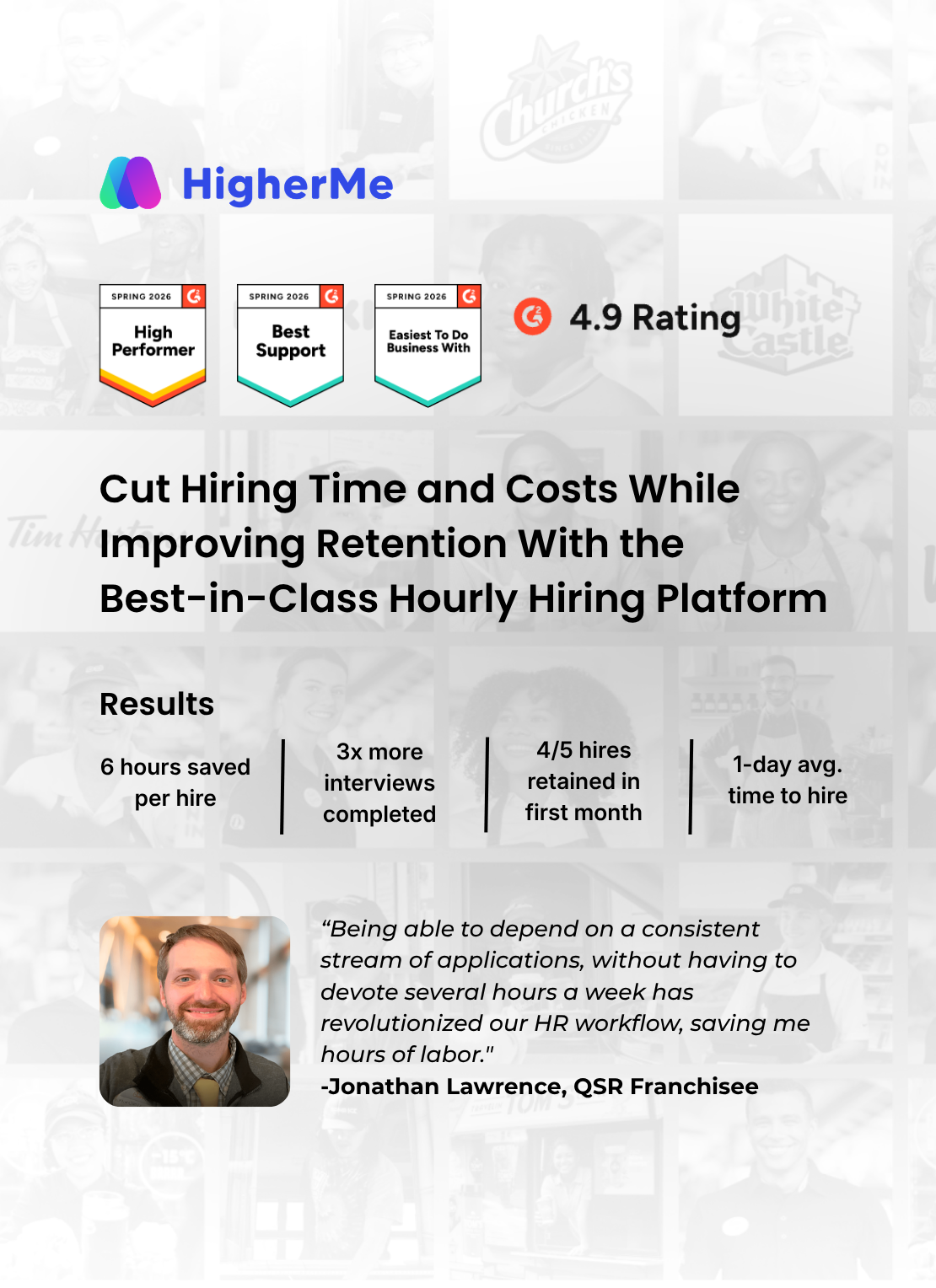
HigherMe is an hourly hiring platform used across 20,000+ locations, including hospitality. It turns a written playbook into the way every property actually works:
- Custom job applications and screening questions, so every candidate for a role answers the same questions.
- NextMatch AI with role-specific interviews, customizable questions and summaries for managers.
- Interview scheduling where managers set their availability and candidates book with one click, with automatic reminders.
- Paperless onboarding that sends the right documents by role or location, with Form I-9 and E-Verify and Checkr background checks built in.
- One dashboard to oversee hiring and onboarding across every location.
A hiring playbook isn't paperwork. It's how you stop losing your best hiring practices every time a GM moves on. Our view: the portfolios that hire well aren't the ones with the most detailed playbook. They're the ones where following the playbook is easier than ignoring it. To see how HigherMe helps operators run the same hiring process at every property, visit HigherMe.
Frequently Asked Questions
1. What is a hiring playbook?
A hiring playbook is a written, standard process for how your company attracts, screens, hires and onboards employees. For a hotel portfolio, it means every property follows the same steps, timelines and rules, adjusted only for local details like pay and shifts. HigherMe helps operators build that process into one hiring system, so the playbook runs the same way at every location.
2. What should a hotel hiring playbook include?
A hotel hiring playbook should include role profiles by brand, a sourcing plan, screening standards, response-time targets, an offer and onboarding checklist, compliance guardrails, and the metrics you'll review each month. Each section should name who owns it at corporate and at the property. HigherMe supports the screening, scheduling and onboarding sections directly with custom screening questions, self-scheduled interviews and onboarding packets by role or location.
3. How do you standardize hiring across multiple hotel properties?
Write one set of job templates, screening questions and timelines, run every property on the same hiring system, and review the same metrics monthly with properties ranked against each other. Let GMs adjust local details, like shifts and pay within approved ranges, but not the core process. HigherMe gives multi-location operators one dashboard across every property, so corporate can see whether each location is following the process.
4. How often should you update a hiring playbook?
Review it at least once a quarter, and update it whenever brand standards, employment laws or your hiring metrics change. Have employment counsel review the compliance section at least once a year. Keeping templates and questions inside a hiring system like HigherMe means updates reach every property at once instead of waiting for someone to read a new PDF.
5. How do you get GMs to actually follow a hiring playbook?
Involve them in writing it, keep it short, and make it the easiest way to hire. Build the templates, questions and onboarding packets into your hiring system so following the playbook takes less effort than working around it. Then review the numbers monthly so GMs see the results. HigherMe automates the screening, scheduling and reminders, which removes much of the manual work that tempts GMs to cut corners.
Test
Book a Demo
We'll contact you as soon as possible to better understand how we can help you!