More than half of U.S. hotels are still somewhat or severely understaffed, and that’s after 70% of them raised wages, according to AHLA’s March 2026 survey. So pay isn’t the whole story. For hotel management companies running properties across multiple brand flags, a big part of the problem sits inside the hiring process. Picking the right ATS for hotel management companies has little to do with feature lists. What matters is whether the system was built for hourly hiring across a whole portfolio. Most weren’t.
Where Hotel Hiring Breaks at Scale
Hourly hotel roles turn over all the time. Accommodation and food services averaged a 4.2% monthly quit rate in 2025, according to BLS JOLTS data. At that rate, hiring is a permanent operating function. These are the five places it usually fails.
1. Running Hourly Hiring on a Corporate ATS
Many management companies end up with an ATS designed for salaried recruiting. It asks applicants to create a login, upload a resume and fill out a full work history. A housekeeping applicant applying from a phone on a lunch break won’t get through all that. Corporate recruiting software is built to go deep on a few candidates. Hotel hiring needs speed across hundreds of them.
2. Applications Built for Desktops
According to research, 68% of hospitality workers have abandoned a job application, the highest rate of any frontline sector it surveyed. You paid a job board to bring each of those candidates in, and then lost them on the form.
3. Leaving Screening and Scheduling to the GM
Your GMs already run the building. When screening and scheduling are also on their plate, applicants end up waiting. A research found that 59% of hospitality applicants expect an interview invitation within four days. In the same study, hiring managers said the interview and scheduling stages are where they lose the most candidates. 26% of hospitality candidates skipped interviews altogether.
4. A Different Process at Every Property
When each property posts and screens in its own way, corporate HR can’t see what’s happening. You don’t know which GM is slow to review applicants, which job board produces actual hires, or why one hotel fills front desk roles in a week while another takes a month. These problems usually show up as overtime costs before anyone sees them in a report.
5. Hiring that Stops at the Offer
Data shows 18% of hiring managers lose the most candidates at onboarding. Paper I-9s, payroll data typed in twice and a slow first-day setup all give a new hire time to take the other offer.
What the Right ATS for Hotel Management Companies Actually Does
The operators who hire well treat hiring like revenue management: one system, shared standards and local execution. Here’s what that looks like in practice.
1. Centralize the Standards, Localize the Decisions
Corporate HR should own job templates, screening questions, pay ranges and brand-specific job descriptions. Each GM should own the interview and the final call. That split means a Hilton property and a Marriott property in your portfolio can each advertise their own brand while running on the same back end.
The trade-off is that some GMs will push back on losing their own way of doing things. Get them involved in building the templates. They’ll accept a standard they helped write much faster than one handed to them.
2. Make Applying Take Two Minutes on a Phone
Remove the login, the resume requirement and the twelve-field work history. Let candidates apply by text message or by scanning a QR code on a lobby sign or a job ad.
Shorter applications do mean you collect less information up front. That’s fine as long as the screening step that comes next asks the right questions.
3. Let AI Handle First-round Screening and Scheduling
This is where most management companies win back the most time. AI prescreening can ask the questions that decide most hourly hires:
- Can you work weekends?
- Do you have reliable transportation to this property?
- Which shifts can you cover?
Qualified candidates then book an interview directly into time slots the GM has already blocked off, and they get automatic reminders before the interview. Your GMs stop chasing applicants and only meet the ones worth meeting.
Be careful with how far you take it. AI should sort and schedule, while hiring decisions stay with people. Check that your screening questions are tied to the job, and review them against any local rules on automated hiring tools before you roll them out.
4. Connect Hiring to Onboarding and Payroll
An offer letter is only halfway through the process. The new hire should be able to complete I-9, W-4, state tax forms and policy acknowledgments on their phone before their first shift. That data should then flow straight into payroll so nobody types it in again.
This matters more for management companies than for single-property owners. Your portfolio probably crosses state lines, and each state has its own forms, rules and new-hire reporting requirements. A connected system handles that consistently. A pile of spreadsheets doesn’t.
5. Measure the Portfolio, Not the Property
If you can’t compare properties, you can’t manage them. Track these by property and by GM:
- Time to review applicants
- Time to hire
- Interview show rates
- Cost per hire by source
Job advertising is getting more expensive, too. Appcast’s benchmark data shows both cost per application and cost per hire went up in 2025. When you know which sources produce hires that stay, you can move budget away from the ones that only produce clicks.
6. Build a Talent Pool Before You Need It
Seasonal surges, new property openings and acquisitions all create hiring spikes. An ATS that keeps past applicants, strong runners-up and eligible rehires gives you a list to call on day one instead of an empty pipeline. It also means a property you just took over can be live in your system in days, not months.
How HigherMe Helps Hotel Management Companies Hire at Scale
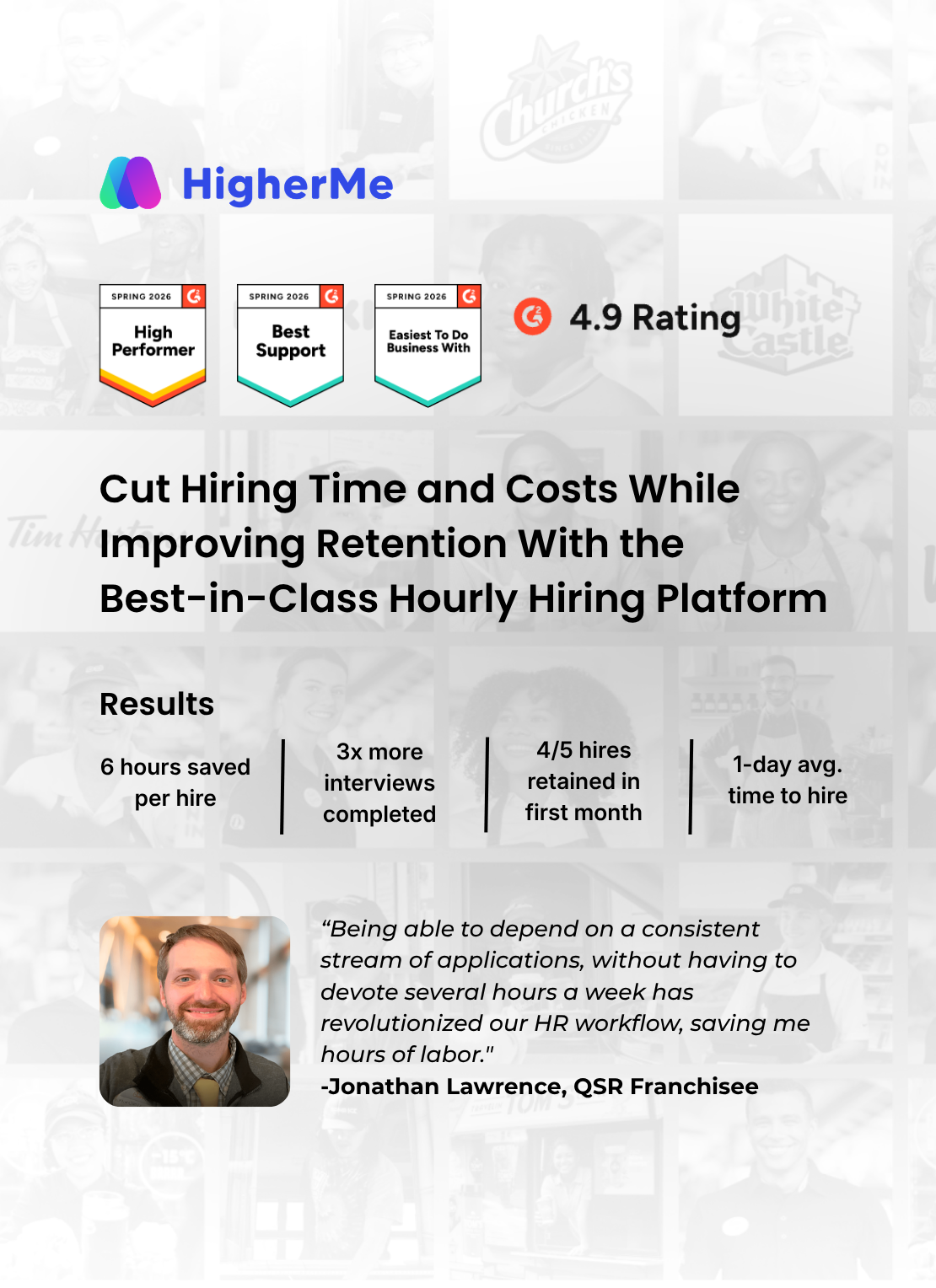
HigherMe is an hourly hiring platform used across 20,000+ locations in hospitality, QSR, retail, healthcare and service. It covers each of the problems above:
- Text to Apply and mobile applications to stop the drop-off at the application stage.
- AI prescreening and automated interview scheduling to take that work off your GMs.
- Paperless onboarding so new hires are set up before their first shift.
- Optional payroll, so hiring data doesn’t get re-entered.
- Portfolio-level reporting that shows every property in one view.
The Bottom Line
The hotels winning hourly talent didn’t necessarily outspend anyone. They responded faster, made applying easier and could see every property at once. Our view: a hotel management company that still treats hiring as each property’s problem will keep paying for it in overtime and empty shifts. To see what a portfolio-level hiring system looks like, visit HigherMe.
Frequently Asked Questions
1. What is the best ATS for hotel management companies?
The best ATS for hotel management companies is one built for hourly, high-volume hiring across multiple properties. That means mobile and text apply, AI prescreening, automated interview scheduling, connected onboarding, and reporting by property and brand. Corporate ATS platforms usually fall short on speed and mobile experience. HigherMe was built specifically for multi-location hourly hiring and covers all of these in one platform.
2. Why do hotel job applicants drop off before getting hired?
Most drop off because the application is too long, it doesn’t work well on a phone, or nobody responds quickly. Short mobile applications and fast automated follow-up fix most of this. HigherMe’s Text to Apply and AI prescreening are built for exactly that.
3. How fast should hotels respond to hourly job applicants?
Within four days at most, and same day is better. Most properties can only hit that consistently with automated screening and scheduling. HigherMe screens applicants as they come in and lets qualified candidates book their own interviews, so nobody waits on a busy GM.
4. How do multi-property hotel operators manage hiring across locations?
They set job templates, screening questions and reporting centrally, and leave interviews and final hiring decisions to each property’s GM, all within one system. That way corporate can compare time to hire and source performance across the portfolio. HigherMe gives management companies a single dashboard across every property while keeping each brand’s jobs and career pages separate.
5. What is the turnover rate for hourly hotel employees?
Turnover is among the highest of any industry. Accommodation and food services averaged a 4.2% monthly quit rate in 2025, according to BLS JOLTS data. With turnover that high, hotels need an always-on hiring pipeline rather than one-off job posts. HigherMe keeps past applicants and rehires in a reusable talent pool, so properties can refill roles quickly when someone leaves.


-1.png)