

.png)

Let's be honest. If you're a hiring manager at a Domino's, Dunkin', or Tim Hortons, you're not just hiring people. You're filling a leaking bucket. You hire Monday, train Wednesday, and by Friday you're posting the job again. Sound familiar?
You're not alone, and you're not doing it wrong. The restaurant industry is structurally hard to staff. But there's a right way and a very wrong way to hire hourly workers at scale, and the difference shows up fast in your time-to-fill, your no-show rates, and honestly, your sanity.
Let's get into it.
The Data: Why High-Volume Hiring Breaks Down?
The math of modern restaurant staffing is, quite frankly, wild. Average restaurant turnover hit 75% in 2025, while fast-food segments saw rates climb over 130%. This means managers are effectively replacing their entire staff - and then some - every single year, with each lost employee costing between $1,056 and $2,300 in replacement costs and lost productivity.
Despite 70% of operators struggling to fill roles, the industry suffers from a fundamental "response gap" that causes hiring at scale to fail in four specific ways:
-
.gif?width=307&height=340&name=giphy%20(1).gif) The "Night and Weekend" Trap: 54% of candidates apply on nights and weekends when managers are off-desk. Because reaching out within the first hour increases hire probability by 25%, waiting until Monday morning means you've already lost the best talent to faster competitors.
The "Night and Weekend" Trap: 54% of candidates apply on nights and weekends when managers are off-desk. Because reaching out within the first hour increases hire probability by 25%, waiting until Monday morning means you've already lost the best talent to faster competitors. - The Application Friction: Most candidates apply on mobile devices between shifts. If an application takes longer than 3 minutes, abandonment rates soar toward 60%. High-volume hiring breaks when "corporate-style" long forms meet "mobile-first" hourly seekers.
- The Communication Mismatch: While 89% of applicants prefer texting, only 31% of restaurants use it. Sending emails into an unmonitored inbox is a recipe for the "ghosting" epidemic, where 42% of candidates walk away simply because scheduling took too long.
- Manager Burnout: Currently, managers spend 15 to 20 hours a week on hiring. When a human is forced to manually screen 50 applicants for a single dishwasher role, the process becomes a bottleneck rather than a pipeline.
This gap between when a candidate is ready to work and when a manager is ready to hire, is where restaurants bleed talent.
To stop the leak, you have to move away from manual "desktop" thinking and toward an automated, mobile-first operation.
How to Actually Fix It: The Best Methods for Hiring Hourly Staff at Scale
1. Go Mobile-First, Not Desktop-First
Your applicants are on their phones. Your hiring process should meet them there. That means a job application that takes under 3 minutes to complete on a mobile screen, no resume required for entry-level roles, and communication that happens via text, not a portal they need to log back into.
QR code applications are genuinely useful here. Post one in your window, on your receipts, in your break room for referrals. Anyone who walks past your location and wants a job should be able to apply in the time it takes to finish a coffee.
2. Automate the First Response
This is probably the highest-ROI change you can make. Set up automated acknowledgement texts the moment someone applies. A short, warm message that says "Got your application! We'll be in touch shortly" keeps the candidate warm and signals that you're a responsive employer.
Better yet, use a conversational AI tool that can screen candidates and schedule interviews automatically, even at 11 PM on a Saturday. Restaurant chains like Wendy's and Chipotle are already doing this at scale. One group operating 74 McAlister's Deli locations reduced application time from 15 minutes to 3 minutes and dramatically cut interview no-shows by switching to an AI-assisted hiring flow.
Speed is your competitive advantage. Whoever gets to the candidate first usually wins.
3. Use an Applicant Tracking System Built for Hourly Hiring
A generic ATS built for corporate recruiting is not the right tool for a QSR hiring manager. You need something that understands shift work, high volume, and the fact that you're evaluating 50 applications for a dishwasher role, not 10 applications for a product manager.
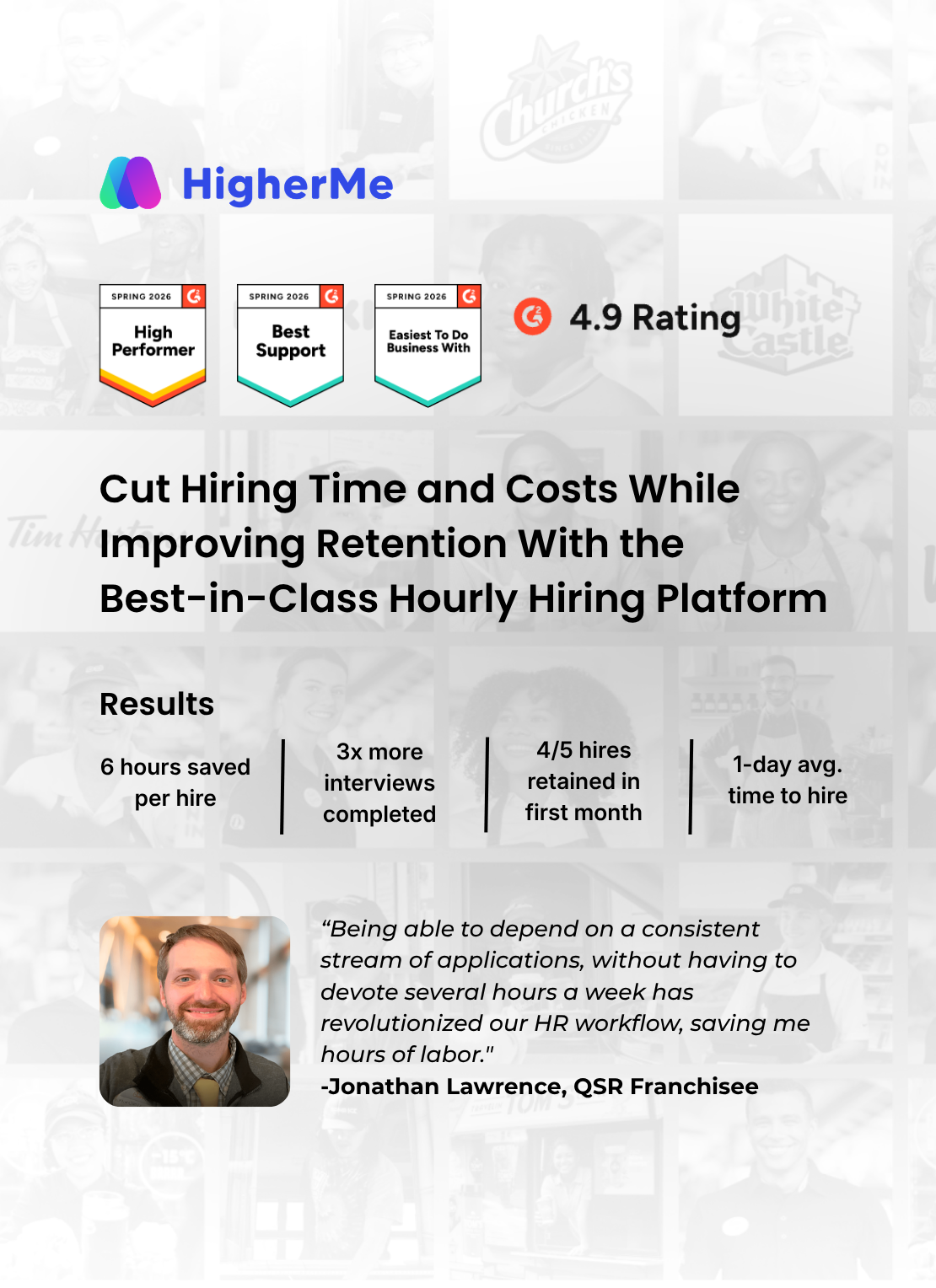
Platforms like HigherMe are purpose-built for hourly hiring in restaurants. They handle job posting across multiple boards at once, automated candidate communication, interview scheduling, and digital onboarding paperwork, all in one place. No more toggling between Indeed, your email, a spreadsheet, and a text thread.
.png?width=900&height=503&name=Blog%20Banners%20(3).png)
A good ATS for hourly hiring should save you a minimum of 5 to 10 hours per week per location. Across a multi-unit operation, that adds up fast.
4. Multi-Post, Don't Just Post on One Board
Posting only on Indeed is like putting one flyer up and hoping it rains. At scale, you need to be everywhere your candidates are, and that's not one place.
Spread your postings across Indeed, Google Jobs, Snagajob (specifically built for hourly work), and any local community boards. Most modern hiring platforms will auto-post to multiple boards from a single submission, so this doesn't have to mean more manual work.
For younger candidates, don't underestimate social media. Instagram and TikTok job posts work for restaurant roles. Short, authentic videos of your actual team can outperform a formal job listing when you're targeting 18 to 25-year-olds.
5. Turn Your Current Team Into a Recruiting Engine
A majority of restaurant leaders say their own employees are their best source of new hires. That's a huge, underused pipeline.
A simple referral program works. Give your team a real incentive for referring people who get hired and stick around for 30 days. Free meals, a gift card, a small cash bonus. Make it easy to refer (a shareable link, a QR code, a text they can forward). The best hires often come from people who already know the culture and are vouching for someone they trust.
6. Hire for Values, Not Just Availability
Here's one that trips up a lot of high-volume operations. When you're desperate to fill shifts, you hire whoever shows up. That tends to backfire fast.
Research consistently shows that hasty, values-mismatched hiring is the root cause of early turnover, not pay or scheduling. When someone doesn't fit your team's culture, no amount of training makes them stay.
Even for hourly roles, spend two minutes in the screening process figuring out if the person is a fit. Are they reliable? Do they work well with people? Have they had similar roles before? A short, structured set of screening questions built into your application or ATS can filter for this before you ever schedule an interview.
Hiring well is slower than hiring fast, but it's faster than hiring twice.
7. Make Onboarding Fast But Not Thin
Once someone says yes, don't lose them in the onboarding paperwork. Digital onboarding tools let new hires complete their forms before day one, so their first shift is about the actual job, not filling out tax documents in the break room.
Research also shows that 74% of restaurant staff receive two weeks or less of training, but two weeks is actually the sweet spot for new hire satisfaction and retention. Invest in a real onboarding structure. It pays back in lower 30-day turnover, which is where most hourly restaurants hemorrhage people.
8. Build a Talent Pipeline, Not Just a Reactive Queue
High-volume hiring works best when you're not always starting from zero. Keep a warm database of past applicants who weren't hired but were good candidates. Reach out when a role opens. Check in with seasonal workers before the busy period. Stay connected with former employees who left on good terms.
This sounds like a lot, but it's mostly automation. A good ATS keeps these records and lets you re-engage with a few clicks.
The Bottom Line
Hiring hourly restaurant staff at scale is hard. But it doesn't have to be the chaos loop most operators are stuck in.
The restaurants winning this game have one thing in common: they treat hiring as an operation, not an afterthought. They have systems that respond fast, communicate through the right channels, screen for fit, and move candidates through the process before someone else does.
The good news is the tools are there. The process is learnable. And every improvement you make to your hiring flow directly reduces the cost and time you spend in this loop.
Are You Ready to Hire Smarter?
HigherMe is purpose-built for hourly hiring in restaurants and hospitality. Whether you're running one location or fifty, we help you cut hiring time, reduce no-shows, and keep your applicant pipeline full without the manual chaos.
Talk to our experts or visit our website to see how it works.
Book a Demo
We'll contact you as soon as possible to better understand how we can help you!