



High-volume hourly hiring is not one problem. It is several. For a logistics company processing ten thousand applications a month, the challenge is funnel management and automation at scale. For a franchise restaurant group running fifty locations with constant turnover, the challenge is speed, mobile candidate experience, and onboarding efficiency. Fountain was designed primarily for the first scenario. The operators who look for alternatives are usually in the second. QSR labor costs rose 6.3% in 2024, and filling open positions faster directly affects whether those costs stay manageable. (Bank of America Restaurant Industry Report, 2025) If Fountain's implementation complexity or enterprise scope is more than your operation needs, these seven alternatives are worth your time.
Why Operators Look Beyond Fountain
Fountain is genuinely powerful for what it was built to do. Stage-based workflow automation, high-volume funnel management, SMS-driven candidate communication, for large frontline employers with dedicated HR teams and the budget to configure the platform properly, it delivers.
The friction for franchise restaurant operators tends to come from a few places. Fountain is not franchise-specific. The configuration required to get it working for a QSR operation is meaningful, and without a dedicated implementation team, that setup can take weeks. Post-hire onboarding is limited, you will need additional tools, which means more integrations to manage and more places for data to fall through the cracks. And for operators running ten to fifty locations rather than hundreds, the enterprise complexity often exceeds the actual problem.
The 7 Best Fountain Alternatives for High-Volume Hourly Hiring
1. HigherMe: Best for Franchise and QSR High-Volume Hiring
HigherMe solves high-volume hourly hiring from a franchise perspective rather than an enterprise logistics one. That distinction matters because the actual workflow is different. You are not processing applications for a warehouse. You are filling crew positions across multiple restaurant locations simultaneously, with managers who are also running shifts, and candidates who move on if they do not hear back quickly.
The platform was built by former franchise operators, and that background shows in how the hiring flow actually works. Text-to-Apply via QR codes means a candidate walking into your store can be in your pipeline in under a minute. NextMatch AI pre-screens automatically, scores candidates by proximity, availability, and experience, and gives managers a ranked shortlist instead of a raw pile of applications. The whole sequence runs without manual steps from the hiring team.
At 20,000-plus franchise locations across brands like Domino's, Dunkin', Tim Hortons, Chick-fil-A, and Wendy's, HigherMe handles real franchise hiring volume every week.
What makes it work for high-volume hiring specifically:
- Text-to-Apply and QR sourcing with Indeed Platinum Partnership for 98% job listing visibility. Sourcing is always on, whether your managers are actively recruiting or not.
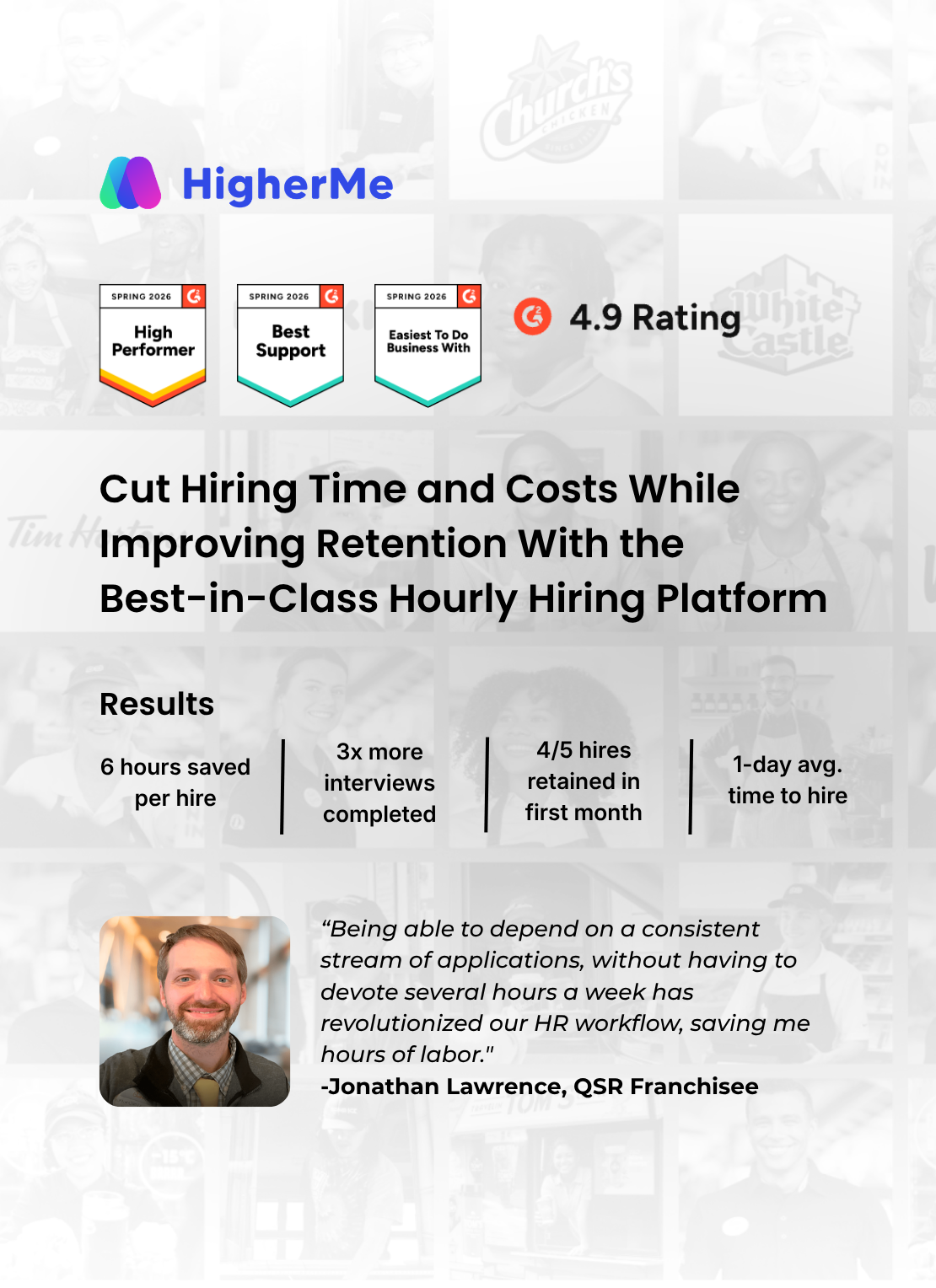
- NextMatch AI pre-screening that handles the volume without adding headcount. Operators report saving 30 minutes per candidate and achieving 3x more completed interviews versus manual job board management.
- Automated interview scheduling with text-based rescheduling to manage the no-show problem that comes with volume hiring
- Branded careers pages per location, with 88% application completion rates, which directly affects how much of your applicant volume actually converts
- Paperless onboarding inside the same platform, so high application volume does not create a separate onboarding backlog
- Hiring Hub for centralized oversight across all locations
- Integrations with ADP, Paychex, 7Shifts, Checkr, and Wizardline
- Optional payroll for operators looking to reduce vendor count
The case study numbers: a Tim Hortons franchisee reached 25x more applicants per week post-switch. A 36-location Domino's operation brought hiring down to 72 hours. Average time-to-hire across the platform is one day.
Setup under 24 hours. No IT involvement. For operators who have watched a Fountain implementation stretch across multiple months, that is a meaningful difference.
Best for: Multi-unit franchise and QSR operators running consistent high-volume hiring who need a solution that is fast to deploy and built for their specific context.
2. Harri: For Full-Service Hospitality High-Volume
Harri handles high-volume hiring within a broader HCM context built for hospitality. Recruiting, scheduling, labor optimization, and engagement are all inside the platform, designed for hotels, full-service restaurants, and resorts. They serve over 5 million employees across 600-plus clients.
For full-service restaurant operators replacing Fountain, Harri offers workforce management depth alongside hiring. For QSR and franchise operators, the fit is less direct. The hiring flow is not optimized for the fast, mobile-first behavior of QSR candidates, and the broader platform scope adds complexity that franchise operators typically do not need day to day.
Good for: Full-service restaurants and hotel groups that need workforce management depth alongside high-volume hiring.
3. Paradox: AI Screening at Enterprise Volume
Paradox's Olivia AI chatbot powers McDonald's global hiring. At enterprise scale, with 100-plus language support and deep HRIS integration, it handles candidate screening volume that no manual team could match. For large brands running millions of interactions annually, it is a proven tool.
The constraint is implementation. Paradox is an enterprise product - cost, timeline, and IT requirements reflect that. It is primarily a screening and engagement layer, not a full hiring and onboarding system. For operators who need something running quickly across franchise locations, it is not the right starting point.
Good for: Enterprise restaurant brands with large implementation budgets and millions of annual hires.
4. Hireology: Process Consistency at Scale
The Hireology system is about structured hiring in franchised organizations. It provides franchisors the ability to see what each location is doing through standardized processes, approval hierarchies, documentation for compliance and centralized reporting. This is true for QSR, automotive and health care organizations.
Hireology’s structured nature is a roadblock in a world where it’s important to quickly recruit many candidates. The same compliance structure that adds so much value to Hireology in environments that require intensive monitoring hurts it for quick hourly hiring.
Good for: Compliance-oriented franchise systems with dedicated HR teams. This isn’t great if speed/volume is your main bottleneck.
5. TalentReef: Established Hourly Hiring Infrastructure
TalentReef (now part of Mitratech) has been in the hourly hiring space for years. ATS, onboarding, compliance, WOTC screening, and performance management are all in the platform. For service industry employers with established HR infrastructure, it covers the basics.
The friction points that drive operators to look for alternatives are real: the interface is dated compared to newer platforms, onboarding can create candidate drop-off through portal access issues, and the Mitratech acquisition has oriented the product more toward compliance than hiring speed. It is not the wrong choice for every operator, but for teams evaluating new options in 2026, there are cleaner solutions available.
Good for: Mid-to-large service industry employers with established HR processes who need reliable ATS and compliance tooling.
6. SmartRecruiters: Enterprise Multi-Use Recruiting
The SmartRecruiters solution covers both corporate and hourly recruitment in one enterprise solution, with SAP SuccessFactors integration available. The features such as AI-driven resume screening, recruiting software tools, and full HRIS integration cater for enterprises requiring one solution for any type of recruiting worldwide.
The enterprise design of the application is not advantageous for the independent restaurant franchising business model. Features like Text-to-Apply and mobile sourcing through QR do not represent core functions of the product.
Good for: Large enterprises managing corporate and frontline hiring in one unified system.
7. StaffedUp: Simple, Accessible for Smaller Operators
StaffedUp is an AI-assisted hiring platform built for restaurants and hospitality, focused on independent and smaller multi-unit operators. One-click job distribution, automated scheduling, one-way video interviews, and paperless onboarding cover the core hiring workflow without enterprise complexity.
It works well at the scale it was designed for. Independent restaurants and small multi-unit operators get a functional, affordable tool that does not require a long setup or dedicated HR support. The ceiling is visible when you hit ten-plus locations with consistent hiring volume - the franchise-specific depth and multi-location management capabilities are limited.
Good for: Independent and small multi-unit restaurant operators who need simple, affordable hiring tools.
Quick Comparison
-Jun-02-2026-02-27-30-5477-PM.png?width=950&height=441&name=Blog%20Banners%20(6)-Jun-02-2026-02-27-30-5477-PM.png)
Conclusion
Fountain built a real product for a real use case. But the operators looking for alternatives in 2026 are mostly franchise restaurant groups and QSR operators who found the enterprise complexity, limited onboarding, and non-franchise-specific design working against them rather than for them.
HigherMe is where most of those operators land. It was built for the franchise restaurant context specifically - fast sourcing, AI pre-screening, same-platform onboarding, and a setup timeline measured in hours rather than months.
Visit higherme.com to know more.
Frequently Asked Questions
1. What is the main reason franchise operators look for Fountain alternatives?
The most common reasons are implementation complexity, limited post-hire onboarding, and a platform architecture that was designed for enterprise logistics operations rather than franchise restaurant environments. Franchise operators typically need faster deployment, franchise-specific workflows, and onboarding built into the same system as hiring.
2. Can HigherMe handle the same application volume as Fountain?
HigherMe handles franchise-scale high-volume hiring across 20,000-plus locations. For operators running continuous multi-location QSR hiring, the platform is built for that volume. For logistics or gig economy employers processing millions of applications monthly across global operations, Fountain or Paradox handle a different scale of problem entirely.
3. Does HigherMe require a long implementation like Fountain?
No. HigherMe is configured in under 24 hours without IT involvement. Careers pages, Text-to-Apply, and job board connections are set up through the platform itself. It is designed for franchise operators, not enterprise IT departments.
4. Which Fountain alternative is best for full-service restaurant groups?
In terms of restaurants that require a full-service approach where staffing management and hiring complement each other, Harri is the best choice. For QSR establishments and franchises where the key focus is to hire fast, HigherMe is better suited.
5. What makes HigherMe better than Fountain for franchise restaurant operators specifically?
Franchise DNA is the core difference. HigherMe was built by franchise operators for franchise operators. The Candidate Score, Text-to-Apply QR workflow, NextMatch AI screening, and same-platform onboarding all reflect how franchise hiring actually works. Fountain was built for enterprise funnel management. The operational assumptions behind the two products are fundamentally different.
Book a Demo
We'll contact you as soon as possible to better understand how we can help you!