

-May-14-2026-07-01-13-7117-PM.png)

The U.S. accommodation and food services sector consistently posts one of the highest turnover rates of any industry, hovering around 73% annually according to the Bureau of Labor Statistics. Meanwhile, the American Hotel & Lodging Association's 2024 State of the Hotel Industry report found that 67% of hotels were still operating understaffed.
Most franchise hotel operators read those numbers and assume the labor market is just broken. Some of it is. But a significant portion of the problem is self-inflicted: a hiring process that's slow, fragmented, and built for a different era. There's a difference between a staffing problem and a hiring problem. One is about supply. The other is about execution. Here's how to tell which one you're actually dealing with.
1. You're Always Reactive, Never Ahead
You only post a job when someone quits. There's no pipeline, no warm bench, no outreach to previous applicants. Every open role starts from zero. That's not a market problem. That's a process problem.
2. Your Application Takes More Than Five Minutes on a Phone
The majority of hourly hospitality applicants apply on mobile, often between shifts or on a lunch break. If your application requires a resume upload, a cover letter, or more than a handful of questions, most people won't finish it. Application abandonment rates spike sharply beyond the three-to-five minute mark.
3. You're Not Responding to Applicants Within 24 Hours
Hourly candidates don't wait. They apply to multiple jobs at once and accept the first offer that comes back. If your process routes applications to an inbox that managers check twice a week, you're handing candidates to your competitors. Speed of response is one of the clearest predictors of whether you convert an applicant to a hire.
4. Your Managers Are Spending 15+ Hours a Week on Hiring Admin
Screening resumes manually, chasing candidates by phone, coordinating interview times back and forth over email: this is what happens when hiring has no infrastructure behind it. Research on hourly hiring consistently shows managers spending 15 to 20 hours weekly on recruitment tasks that could be automated. That's time off the floor. In a hotel, that's a cost you feel immediately.
5. Interview No-Shows Are Routine
If more than 20–25% of your scheduled interviews result in no-shows, that's a signal about your candidate experience, not just candidate quality. Candidates ghost interviews when the communication leading up to it is poor, when the process feels disorganized, or when a competing offer arrived first. A structured confirmation and reminder process cuts this significantly.
6. You're Hiring the Same Role Every 60–90 Days
Constant rehiring of the same position is a retention problem disguised as a staffing problem. And retention problems often start in hiring, specifically when you're screening for availability and showing up rather than screening for fit. If housekeeping staff are routinely leaving within the first 30 days, look at what you're communicating (and not communicating) in the hiring process about the actual job.
7. Your Job Postings Are Generic
"Competitive pay. Great team. Apply now." That describes nothing. Hourly job seekers in hospitality want to know the actual pay range, the shift hours, which property they're working at, and what a typical day looks like. Vague postings attract mismatched applicants and inflate your screening time. They also lower offer acceptance rates because candidates feel surprised by details they should have known upfront.
8. Your Hiring Process Looks Different Across Your Locations
If you operate more than one hotel franchise property and each property manager runs hiring however they want: different tools, different response timelines, different screening questions. You have no consistent hiring standard. You can't diagnose what's working or fix what isn't. Multi-location franchise operators need standardization across locations, not just effort.
9. New Hires Arrive on Day One With Nothing Ready
If your new hire's first day includes sitting in the back office filling out tax forms, completing I-9 paperwork by hand, and waiting for system access, that's an onboarding failure that directly impacts early retention. According to SHRM, organizations with a strong onboarding process improve new hire retention drastically. The inverse is also true: a disorganized first day sends people back to the job boards fast.
10. You Attribute All of This to "The Labor Market"
This is the hardest one. When every problem: high turnover, low applicant volume, bad no-show rates, early attrition, gets written off as "it's tough out there," nothing gets fixed. Some of it is market conditions. A lot of it isn't. Franchise hotel operators who have tightened their hiring process consistently report shorter time-to-fill, better quality hires, and lower 90-day turnover. Not because the market improved, but because they stopped waiting for it to.
What a Better Hiring Process Actually Looks Like
The fix isn't complicated, but it does require treating hiring as an operation, not a task.
That means a mobile-first application built for hourly candidates. Automated outreach so candidates hear from you within minutes, not days. Pre-screening built into the application so your managers only review candidates who already qualify. Self-scheduled interviews with automated reminders. And digital onboarding that starts before day one so new hires walk in ready to work.
None of this is aspirational. These are table-stakes capabilities for franchise hotel operators who hire at any real volume.
How HigherMe Helps Franchise Hotels Hire Better
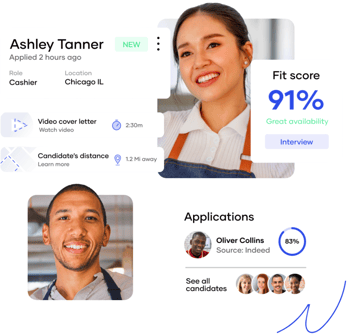
HigherMe is built specifically for hourly hiring at scale. For franchise hotel operators, that means a full hiring platform with a mobile-first ATS and pre-screening built in, automated candidate communication at every stage, and interview scheduling that removes the back-and-forth entirely. The platform also includes Text-to-Apply. Candidates can start an application from a QR code or a text number, directly from a lobby poster or social post.
Once a hire is made, paperless onboarding collects tax documents, I-9 forms, direct deposit info, and employee handbook acknowledgments before day one. For multi-location operators, the Hiring Hub gives you visibility across all your properties from a single dashboard, so you always know where you have open roles, where candidates are in the process, and where things are stalling.
HigherMe's AI prescreening tool (NextMatch AI) screens candidates with a short voice-based interview, so your managers get a ranked shortlist rather than a pile of applications. It doesn't replace your judgment. It removes the grunt work so your judgment gets applied faster.
The Bottom Line
Most franchise hotel operators don't have a people problem. They have a process problem. The candidates are out there. What's failing is the system that's supposed to get them from "I'm interested" to "I'm starting Monday."
Fix the process. The staffing problem gets a lot smaller.
Ready to see what a structured hiring operation looks like for franchise hotels? Visit higherme.com for more info.
Frequently Asked Questions
1. What is the difference between a staffing problem and a hiring problem in hotels?
A staffing problem is a supply issue. Not enough qualified people in the labor market for the roles you need. A hiring problem is a process issue: your recruitment workflow is too slow, too complicated, or too inconsistent to convert available candidates into employees. Most franchise hotels dealing with chronic understaffing have a hiring problem, not just a staffing problem.
2. What is a healthy turnover rate for franchise hotels?
According to BLS data, the hospitality industry averages around ~70% annually, but that doesn’t make it ok as a benchmark. Franchise hotel operators who are willing to invest in structured hiring and onboarding often see significant improvements in 30-day and 90-day retention. The goal is not to match industry average. And to beat it you shut your process down.
3. How do franchise hotels mitigate interview no-shows?
No-shows largely happen because of poor communication between scheduling and the date of the interview. Automated text reminders (not email), self-scheduling that puts the candidate in control of timing and a clear confirmation process all help significantly to lower no-show rates. Operators who use HigherMe’s interview scheduling tools see a 67% reduction in no-shows.
4. What should a franchise hotel's hiring process look like from application to first day?
At minimum: a mobile-friendly application under five minutes, automated response within an hour of applying, pre-screening questions built into the application flow, self-scheduled interview with text reminders, same-day or next-day hiring decision for strong candidates, and digital onboarding paperwork completed before day one. The entire process should be trackable from a single platform.
5. How AI recruitment systems can help hotel franchising?
The standard procedure for hotel AI recruiters is pre-screens where candidates answer pre-determined questions through chat or voice interaction. Candidates are ranked on certain parameters like their availability, experience and location near the facility. By automating the screening process for managers and speeding up candidate response times.
Book a Demo
We'll contact you as soon as possible to better understand how we can help you!