



In today’s restaurant operations, the grill isn’t the only thing that’s hot. The competition for talent is, too. If you are a hiring manager, you know the drill. You need a dishwasher by Friday, a line cook for the weekend rush, and three delivery drivers yesterday.
But as we head further into 2026, the old ways of hiring are feeling more like a burnt crust than a secret sauce. Let’s explore and dive right into why the restaurant hiring landscape has changed and how a dedicated hourly hiring system can save your sanity.
The 2026 State of the Hourly Hustle
Here’s what the latest data tells us about hiring in the restaurant industry:
- Quick-service restaurants can experience annual turnover rates as high as 130 percent, meaning many teams are replacing their entire workforce plus more every year.
- Managers under pressure to hire fast often juggle posting jobs, sorting applications, scheduling interviews, and onboarding, eating into valuable operations time.
- Labor shortages continue to pressure restaurants, forcing hiring managers to rethink how they attract and retain hourly workers.
These figures paint a clear picture: hourly hiring is not just busy work — it’s a bottleneck with real financial and operational consequences.
But why? The answer lies partly in the tools most restaurants still use.
So What are Restaurants Using Now?
Most restaurants fall back on Applicant Tracking Systems (ATS) to manage hiring.
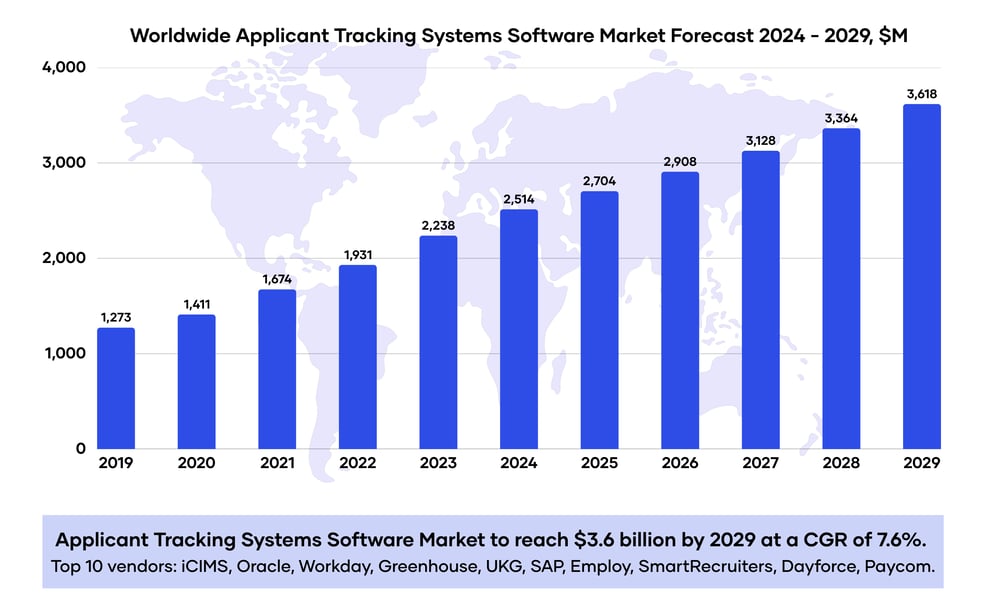
Application Tracking Systems or ATS are hiring platforms originally designed for salaried roles in corporate HR departments. In fact, as per a research conducted in 2025, it has been found that the global ATS software market size was $2.5 billion in 2024 and is still rising at a rapid pace.
Achievement like that sounds impressive. So, what makes these solutions fail to address restaurant hiring problems?
What an ATS Actually Does?
At its heart, an ATS is a tool that helps employers manage the collection and organization of applicants for a given job. The major features of an ATS include:
- Posting jobs to boards
- Sorting applications
- Sending interview invitations
- Centralizing candidate data
This can be thought of like a digital filing system for resumes and job listings.
For many businesses, especially corporate departments with low-volume hiring, ATS make sense.
But restaurants hiring hourly staff operate in a very different world.
Why Legacy ATS Fails in Restaurant Hiring?
Here’s where traditional ATS systems fall short for restaurants:
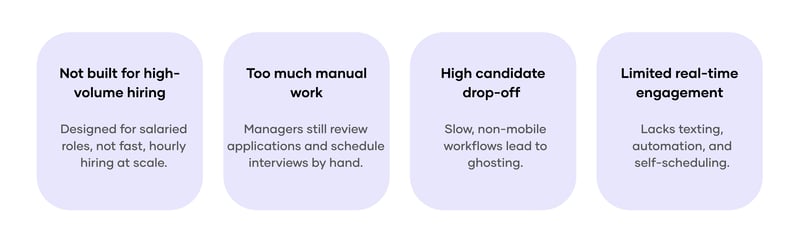
The result? Managers spend more time hiring and less time running the restaurant.
The Solution: Hourly Hiring Software
So, what’s the fix? It’s a system designed specifically for the hourly workforce. Compared to a standard Applicant Tracking System which "tracks" people, an hourly hiring system is an active hiring engine that drives people from "Applied" to "Onboarded" in record times.
How does it work? It flips the script with its emphasis on speed, mobile-first design, and automation.
- One Click Job Syndication: Publish posts to multiple job boards, aggregators, and social media applications.
- Mobile First Applications: The candidates can apply through their smartphone with ease.
- Automated Screening & Knockout Questions: Instant pre-qualification of applicants based on their availability, skills, or experience.
- Bulk Communication Tools: Sending texts, emails, or reminders to the entire group of applicants.
- Self-Scheduling: Let candidates pick interview slots directly without manager involvement.
- Centralized Hiring Dashboard: See all roles, locations, and applicants at a glance.
The Benefits Over Legacy ATS
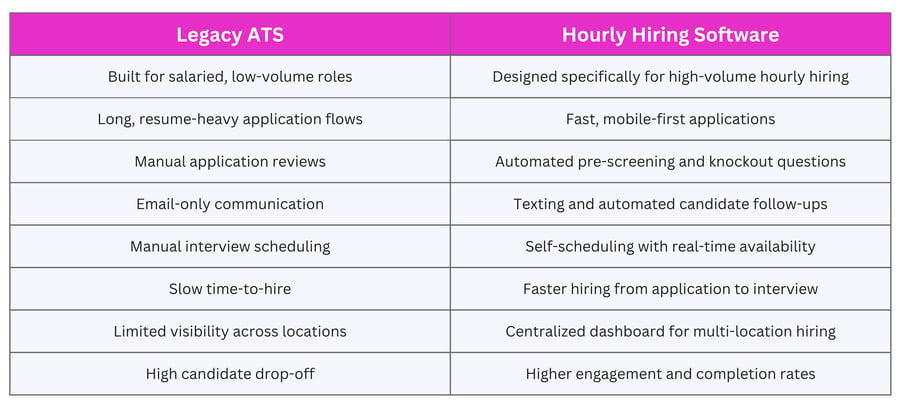
The difference is night and day. While a legacy ATS acts as a barrier, hourly hiring software acts as a bridge. You get higher candidate volume because the application takes seconds. You get better quality because the software screens for specific restaurant needs like certifications and shift flexibility. Most importantly, you get your time back. Modern hiring technology delivers a 25% to 35% reduction in cost-per-hire and significantly reduces management time investment.
A Real-World Example: HigherMe
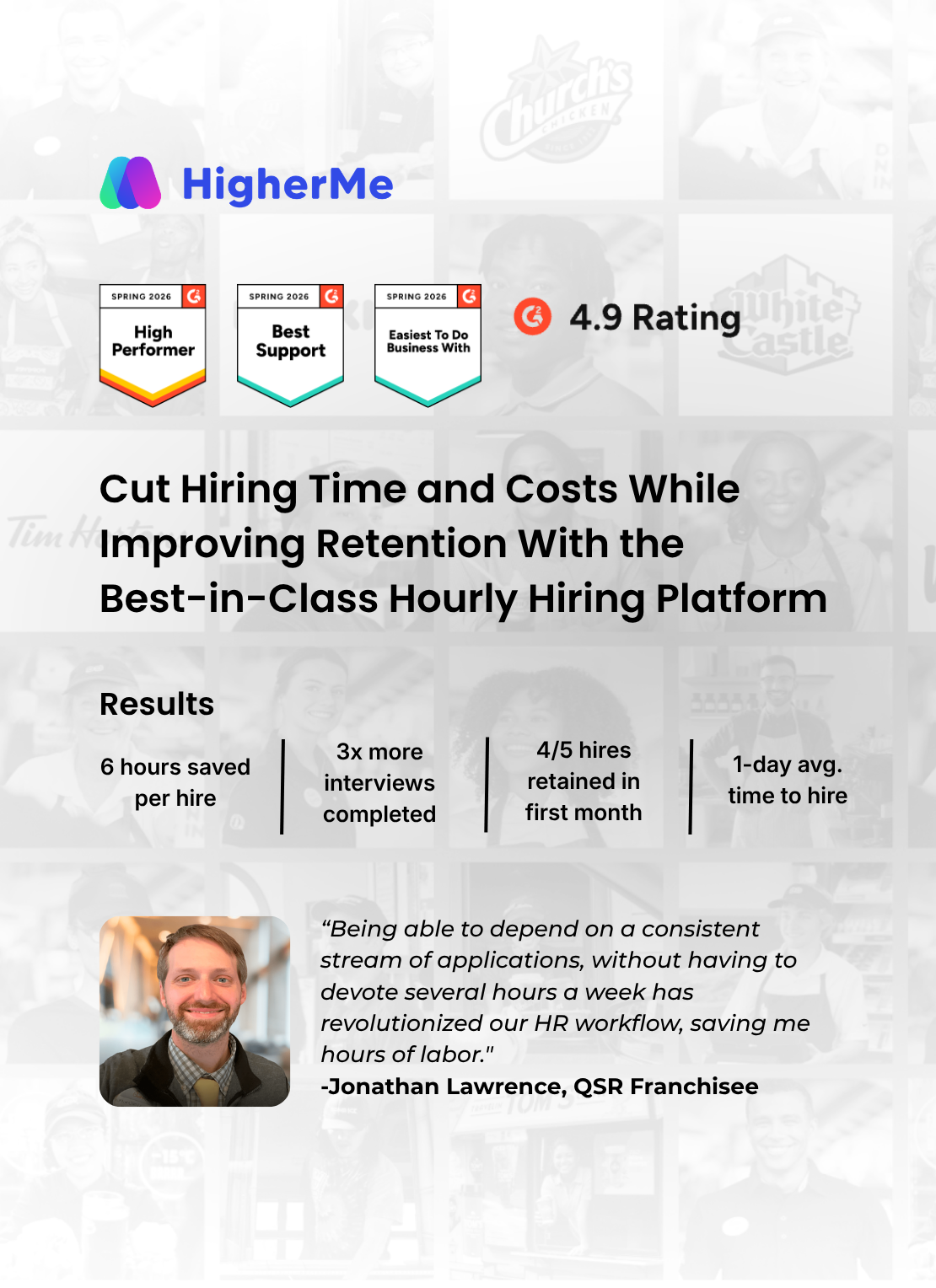
If you are seeking an applicant platform that “gets” the restaurant world like no other does, look no further than HigherMe. Created by former franchise owners, HigherMe is an hourly hiring software built specifically for hourly hiring needs in the restaurant space and other hourly-focused industries. Its hiring process is optimized with job ad distribution, applicant engagement, and hiring that mirrors the way hourly job seekers actually act: mobile-first, fast-paced, and conversation-oriented.
It features a unique "Candidate Score" that uses data to rank candidates based on their distance from the store, their availability, and their past experience. With features like Text-to-Apply and Automated Interview Scheduling, it ensures your managers spend less time on paperwork and more time on the floor. It’s a full-cycle recruitment and onboarding suite that makes sure your newest team member is ready to work on day one.
This is in addition to features like auto outreach, availability matching, and mobile onboarding. What they offer is especially advantageous to restaurants who need to lower time-to-hire, drop-off, and increase employee retention. It is a great example of what the future looks like in hourly hiring technology that moves past ATSes.
Traditional ATS were a leap forward for corporate hiring, but they simply do not match the pace, scale, and candidate experience needed for hourly restaurant hiring. Hourly hiring software is different. It is built for high turnover, high volume, and today’s mobile workforce.
If your team is still slowed down by spreadsheets, slow response times, or too many manual tasks, there is a better way forward.
Ready to hire smarter and faster? Visit our website or speak with our hourly hiring experts today to transform your restaurant’s recruitment process.
Book a Demo
We'll contact you as soon as possible to better understand how we can help you!