

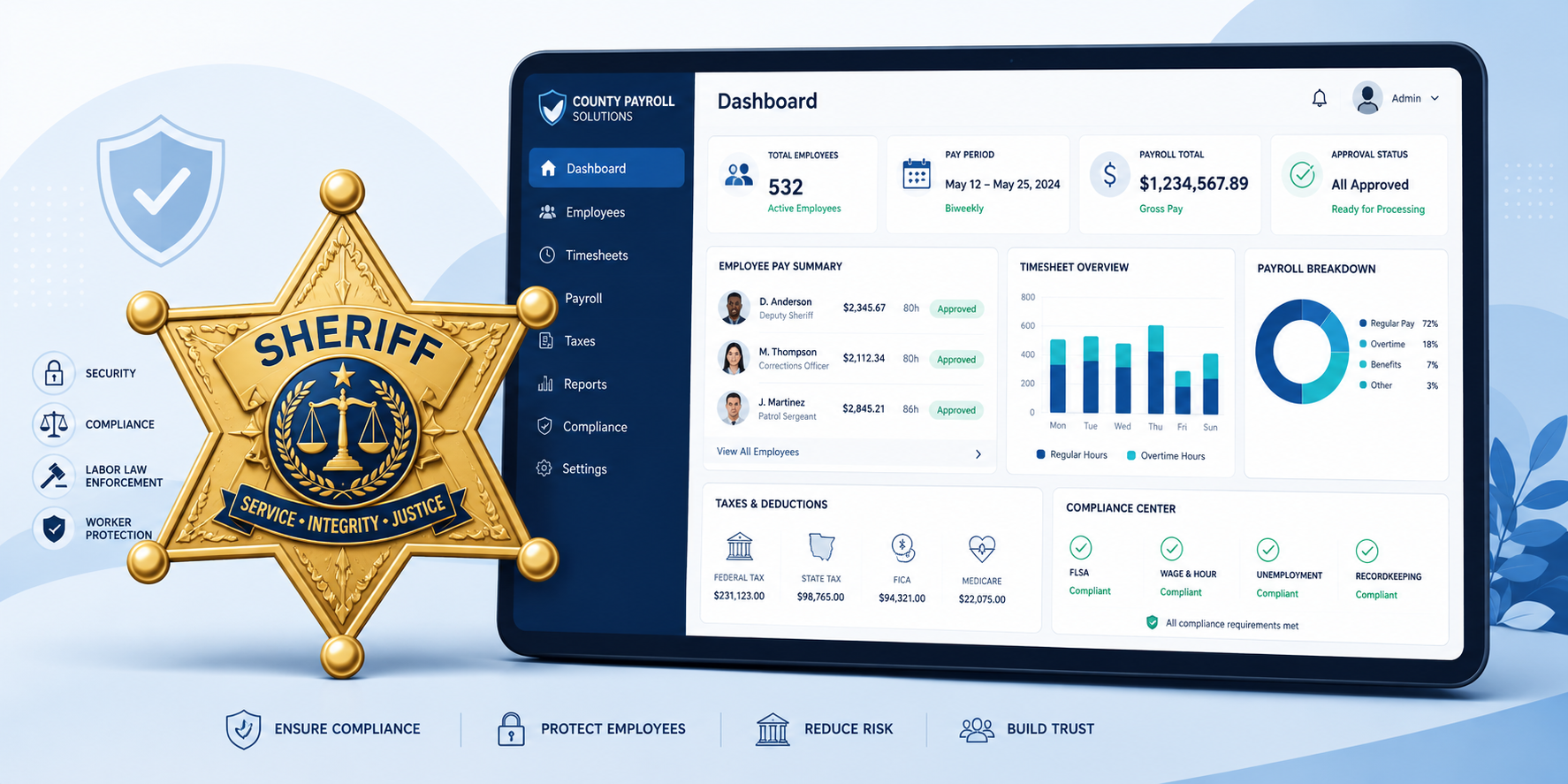

Law enforcement agencies are running short-staffed and over budget. Over 70% of agencies say recruiting new officers is more difficult now than it was five years ago, and the average department is operating at just 91% of authorized staffing levels. The people who are still on the job are working harder, logging more overtime, and depending on accurate paychecks to make it worth it. When payroll gets it wrong, it doesn't just create a compliance problem. It breaks trust with the people carrying the badge.
The problem is that most payroll software was not built for how law enforcement pay actually works.
Why Payroll for Law Enforcement Is Different
Most commercial payroll platforms are built for the standard 40-hour workweek. Law enforcement does not work that way.
Under FLSA Section 7(k), law enforcement employees have an overtime threshold of 43 hours for a 7-day pay period, 86 hours for a 14-day period, and 171 hours for a 28-day period (Source). A deputy working four 10-hour shifts per week looks like they've triggered overtime under a standard 40-hour calculation. Under 7(k), they have not. Get that wrong across 100 sworn officers and you've got real DOL exposure, union grievances, and back-wage liability.
Then add comp time. Law enforcement officers can accrue up to 480 hours of compensatory time at 1.5x for every overtime hour worked, and they must be permitted to use it unless doing so would unduly disrupt agency operations (Source). That accrual has to be tracked precisely, because it's a real liability on the county's books. And starting in 2026, municipalities must separately report FLSA-qualified overtime on Form W-2 using new IRS codes, as the grace period for noncompliance has ended.
On top of that: shift differentials, specialty assignment pay (K-9, SWAT, SRO), off-duty detail hours, POST certification tracking, and pay structures that run differently for sworn personnel versus civilian staff, sometimes in the same pay period.
Most general-purpose payroll tools can't handle any of that out of the box. Here are five that are worth an honest look.
The 5 Best Payroll Software Platforms for Sheriff's Offices and Law Enforcement
1. Netchex: Best Overall for Law Enforcement Payroll
If there is one platform on this list that was built to handle the specific compliance demands of law enforcement payroll, it's Netchex.
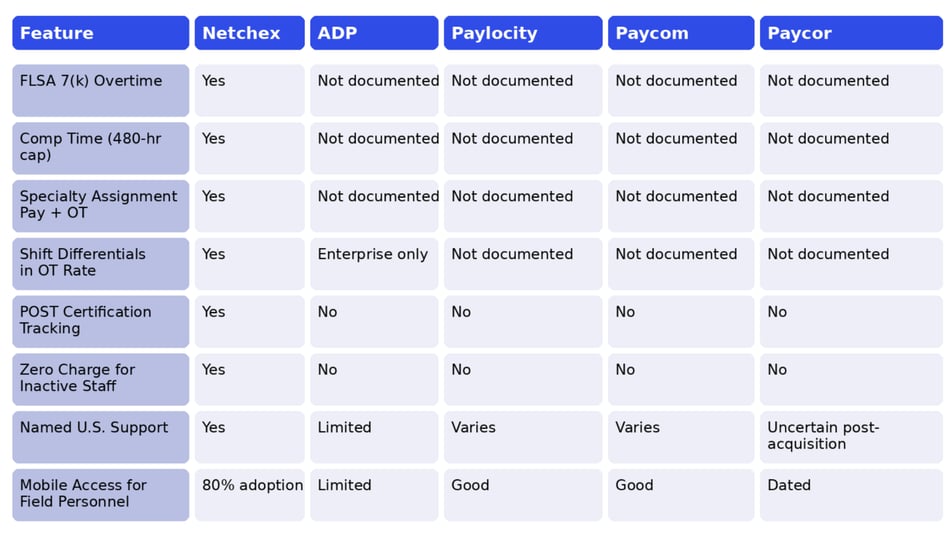
Netchex supports FLSA Section 7(k) overtime on both 7-day and 14-day work periods. It can run sworn and non-sworn staff on different overtime calculations in the same payroll run. Comp time accrues at 1.5x with the 480-hour cap enforced, tracks liability for county finance, and calculates payouts at the deputy's current rate upon separation. Specialty assignment pay, shift differentials, and off-duty detail hours all integrate directly into the overtime regular rate, the way FLSA requires.
POST certifications and continuing education credits are tracked with automated expiration reminders. For reserves and part-time deputies not on active payroll, Netchex charges nothing. The mobile app has 80% adoption, meaning your deputies can check comp time balances and pay stubs from a patrol car at 2am without calling HR.
Support is named, U.S.-based, and consistently rated 97-98% for customer satisfaction.
The 28-day work period configuration is in development. Union CBA rules like seniority-based overtime distribution and callback minimums require custom setup. Those are worth confirming before you sign.
Best for: Sheriff's offices and law enforcement agencies of any size that need full 7(k) compliance, comp time tracking, and specialty pay handled natively.
2. ADP Workforce Now: Enterprise-Scale Infrastructure
ADP has genuine scale. Its multi-state tax filing is strong, its marketplace connects to hundreds of third-party tools, and for a very large county department with dedicated HRIS staff and a substantial implementation budget, ADP can be configured for complex payroll.
The limitation is what's in the documentation. ADP publishes FLSA compliance content, but that content covers the standard 40-hour threshold only. There is no mention of Section 7(k), extended work periods, or law enforcement-specific overtime thresholds anywhere in their public-facing materials. That does not mean the capability doesn't exist at enterprise tiers, but it does mean you will need to verify it explicitly in a demo, not assume it.
User reviews also flag a steep setup curve. G2 reviewers describe implementation as genuinely complicated for teams without dedicated HR infrastructure. For a county finance team with two payroll administrators managing 150 deputies, that friction is worth factoring in.
Good for: Large county departments with dedicated HRIS staff, complex integrations, and budget for a full enterprise implementation.
3. Paylocity: Good Mid-Market With Real Compliance Gaps
Paylocity is a clean mid-market HCM platform. The compliance dashboard is useful, Workforce Index analytics give solid operational visibility, and with several integrations, connecting scheduling tools is realistic. For a standard employer, it works well.
For law enforcement, the problem is documentation. A search of Paylocity's entire public-facing product materials turns up no mention of Section 7(k), law enforcement overtime thresholds, comp time with 480-hour caps, or specialty assignment pay integration. These are not edge cases. They are the foundation of payroll for every sworn employee every pay period.
There are also documented support concerns relevant to law enforcement contexts. BBB complaints reference Paylocity's team struggling with union-related payroll changes, which created errors during exactly the situations where accuracy matters most. For a sheriff's office running CBA-governed overtime distribution and shift bids every cycle, that is a real risk.
Good for: Non-sworn civilian staff payroll at a government agency, if a separate platform is handling sworn officer compliance.

4. Paycom: Strong Engineering, Narrow Law Enforcement Fit
Paycom's single-database architecture is genuinely good. No reconciliation between modules. Beti lets employees verify their own pay before a run is submitted. The Government and Compliance module generates FLSA earnings reports, EEO-1 documentation, and OSHA filings.
The distinction worth understanding here is that a FLSA earnings report is a reporting output. It is not a payroll engine that computes overtime on an extended work period. Paycom's overtime documentation references the standard 40-hour threshold. Section 7(k) is not mentioned. That matters because if the engine is calculating overtime incorrectly, the report is reflecting incorrect figures.
Paycom also has just two verified G2 integrations, which means law enforcement scheduling platforms like InTime, TeleStaff, and ATLAS are unlikely to connect. For agencies where scheduling and payroll need to talk to each other, that's a real constraint.
Good for: Civilian and administrative staff payroll at government agencies where standard 40-hour overtime rules apply.
5. Paycor (Now Owned by Paychex): Proceed With Caution
Paycor has OnDemand Pay, which is a genuine retention tool for deputies who rely on overtime. The platform handles payroll, HR, time, and benefits in one system.
Two things are worth knowing before you commit. First, Paycor was acquired by Paychex in April 2025 for $4.1 billion. Paychex announced $90 million in cost synergies for fiscal 2026. The support model, feature roadmap, and pricing visible today may look different 12 months from now. Second, Capterra reviewers documented the GL upload process as so unreliable they abandoned it entirely and went back to manual entry. For a county government where payroll must flow into Tyler MUNIS or a state financial system, that is not a minor inconvenience.
Like the others, Paycor's public documentation does not address Section 7(k) overtime, comp time accrual, or specialty assignment pay.
Good for: Smaller civilian government departments with straightforward pay structures and a tolerance for platform transition risk.
Platform Comparison at a Glance
The Bottom Line
Most payroll vendors sell compliance. Few can document it for law enforcement specifically. The difference between a platform that handles 7(k) overtime natively and one that generates a FLSA report is the difference between getting overtime right and building a liability you won't find until an audit or a union grievance.
If you are evaluating platforms for a sheriff's office, start with the compliance documentation. Ask every vendor to show you, in writing, how they handle Section 7(k) overtime on a 14-day work period. Ask how comp time accrual is tracked and capped. Ask what happens to that liability when a deputy separates.
The answers will narrow the list quickly.
Want more hiring and payroll tips? Visit higherme.com.
Frequently Asked Questions
1. What is the best payroll software for sheriff's offices?
Netchex is the strongest option for most sheriff's offices and law enforcement agencies. It is the only mid-market platform with documented support for FLSA Section 7(k) overtime on 7-day and 14-day work periods, comp time accrual at 1.5x with a 480-hour cap, specialty assignment pay integrated into overtime calculations, and zero charge for reserve deputies not on active payroll.
2. What is FLSA Section 7(k) and why does it matter for law enforcement payroll?
Section 7(k) allows public agencies to calculate overtime for law enforcement on extended work periods rather than the standard 40-hour weekly threshold. For a 14-day period, overtime only kicks in after 86 hours. A deputy working 84 hours across two weeks owes zero overtime under 7(k), even though a standard weekly calculation would generate several hours of overtime pay. If your payroll system doesn't calculate 7(k) correctly, it is computing overtime wrong for every sworn employee every pay period (Source).
3. Can law enforcement agencies pay comp time instead of overtime cash?
Yes. Under the FLSA, law enforcement officers can accrue up to 480 hours of compensatory time at 1.5x in lieu of cash overtime. That accrual represents real financial liability on the agency's books and must be paid out at the employee's current rate upon separation. A payroll system that doesn't track it precisely is understating the county's obligations.
4. Do I need to report FLSA overtime separately on W-2s for law enforcement in 2026?
Yes. Starting in 2026, municipalities are required to separately report FLSA-qualified overtime on Form W-2 using specific IRS codes. The penalty relief period that applied to the 2025 tax year has ended. Agencies that have not configured their payroll systems to distinguish FLSA overtime from contract-based overtime need to do so now.
5. What should I ask a payroll vendor before signing a contract for a sheriff's office?
Ask them to show you, in writing, how the system handles FLSA Section 7(k) overtime on a 14-day work period. Ask how comp time accrual is tracked, how the 480-hour cap is enforced, and how separation payouts are calculated. Ask whether specialty assignment pay and shift differentials feed into the overtime regular rate. If they cannot answer these in the demo, the platform was not built for law enforcement payroll.
Book a Demo
We'll contact you as soon as possible to better understand how we can help you!