



Let's be honest about something the industry doesn't say out loud enough: most restaurants don't have a hiring problem. They have a hiring strategy problem. There's a difference. And closing that gap, between reactive scrambling and deliberate, repeatable process, is one of the highest-leverage moves an operator can make.
The data is worth sitting with before we go any further.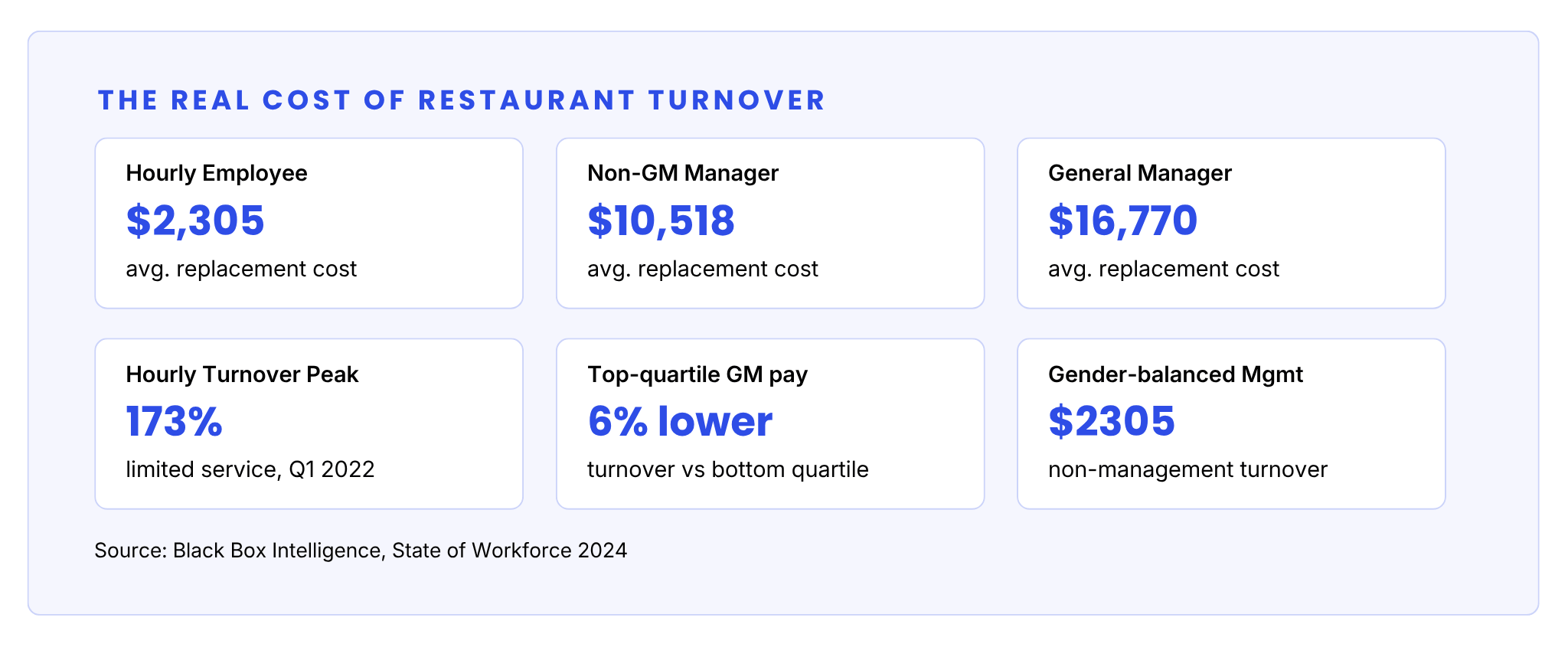 But there's a genuinely encouraging flip side to that data. Restaurants in the top quartile for GM compensation see 6% lower turnover than those in the bottom quartile. Brands with gender-balanced management teams report 23% lower non-management turnover. And restaurants with lower overall turnover levels consistently outperform on same-store traffic and sales growth.
In other words, who you hire and how you hire them is not a soft, people-feelings issue. It's a revenue and margin issue dressed in aprons.
This guide is built for operators who want to stop treating hiring as a reactive scramble and start treating it as a competitive advantage. Let’s dive in.
Phase 1: Before You Post Anything, Know What You're Actually Hiring For
The most general mistake in restaurant hiring happens before a single word of a job post is written. Operators pull up last year's description, post it to the same three platforms, and wonder why they keep getting the same mediocre results.
Start upstream. Before you define the role, define the problem the role needs to solve. Are you losing servers because you're understaffed on Friday nights? Are BOH inconsistencies tied to experience gaps, or are they actually a communication and onboarding failure? The answers change who you should hire and what you should be looking for.
Then map the role with real precision. A prep cook and a line cook are not interchangeable. A host at a casual neighborhood spot and a host at a fine dining establishment require fundamentally different temperaments, and the job description should reflect that. With the post-pandemic blurring of traditional FOH/BOH lines, including more cross-training, delivery operations, and digital ordering systems, the reality of most restaurant roles has genuinely evolved. Write for the job you have in 2026, not the one you had in 2019.
Getting role clarity right before you post is exactly the problem HigherMe's platform is built to solve. Most operators are writing job posts from scratch every time, which means they're also making the same structural mistakes every time. HigherMe's hiring guidebook points out that the best-performing posts answer five candidate questions immediately: what is the role, what does a normal day look like, what's required, what do I get in return, and why should I trust this company. Read more here!
Phase 2: Write a Job Post That Works Like Marketing
Here's a reframe that changes everything: a job posting is not a legal document. It's a marketing copy for the most important customer you have, which is a prospective employee.
-1.png?width=420&height=357&name=Blog%20Banners%20(3)-1.png) The restaurant industry is notorious for job posts that read like walls of requirements. "Must have 2+ years of experience. Must be available nights and weekends. Must be a team player." None of it is wrong, but none of it is compelling either. A high-performing job post in 2026 does five things well: it leads with your restaurant's identity before it lists requirements; it tells candidates what's in it for them before telling them what's expected; it shows compensation clearly; it communicates culture in specific and concrete language rather than buzzwords; and it makes applying as frictionless as humanly possible.
The restaurant industry is notorious for job posts that read like walls of requirements. "Must have 2+ years of experience. Must be available nights and weekends. Must be a team player." None of it is wrong, but none of it is compelling either. A high-performing job post in 2026 does five things well: it leads with your restaurant's identity before it lists requirements; it tells candidates what's in it for them before telling them what's expected; it shows compensation clearly; it communicates culture in specific and concrete language rather than buzzwords; and it makes applying as frictionless as humanly possible.
On compensation, this is no longer optional and the data is unambiguous. According to research, 82% of U.S. workers are more likely to consider applying to a job if the pay range is listed in the posting, and 74% say they're less interested in applying when that information is absent. Transparency early doesn't just attract more applicants. It attracts the right ones and filters out mismatches before they waste anyone's time.
On culture: "fast-paced environment" and "team player" are meaningless to any serious candidate. Tell a story instead. "We do family meals together before every dinner service" or "our GM has been with us for six years and started as a line cook" communicates something real. Culture-signaling in job postings helps candidates self-select in or out before the first interview, which is exactly what you want.
One more thing: keep the application friction low. A post that requires a candidate to create an account, answer five essay questions, and upload three documents will lose strong candidates who have other options. In this labor market, most of them do.
HigherMe's job post guidebook makes a sharp observation that's easy to overlook: your employer brand doesn't live in a culture paragraph that says "we're like family." It lives in tone. Does the language sound human? Inclusive? Direct? The guidebook recommends writing job titles at 35 characters or fewer, keeping them free of symbols and inside jargon, and structuring the body into five clear sections: a short intro, a day-in-the-life snapshot, a brief team description, requirements, and an invitation to apply. Predictable structure, as they put it, is not boring. It is respectful of a candidate's time. That's the mindset shift that separates posts that fill roles from posts that just sit there. Read more here!
Phase 3: Source Candidates Beyond the Obvious
Most restaurants post on Indeed and ZipRecruiter and call it a sourcing strategy. That's table stakes, not strategy. Industry-specific platforms like Poached, HotSchedules' talent marketplace, culinary-focused LinkedIn communities, reach candidates who are actively thinking about restaurant careers rather than passively browsing general job boards.
But the highest-quality sourcing channel is one most operators underutilize: employee referrals. Referrals work for two interconnected reasons. First, your existing staff already understands the culture and pace of your operation, they won't recommend someone they think will struggle or create friction. Second, referred hires onboard faster and stay longer because they already have a social anchor in the team before day one.
Build a formal referral program. It doesn't need to be elaborate. A $150–$200 bonus paid after a referred hire completes 90 days is enough of an incentive to make referrals top of mind. Announce it at pre-shift, put it in your team communication channel, and make the process of submitting a referral dead simple..png?width=2048&height=845&name=Blog%20Banners%20(4).png) This is where HigherMe's sourcing tools can change the equation meaningfully. The Text to Apply feature lets candidates apply instantly from a simple text, meeting hourly workers exactly where they are rather than routing them through a multi-step desktop application flow. Their branded careers page is built to show only open, location-specific roles and delivers an 88% application completion rate, which is a meaningful jump over the industry average. And because HigherMe integrates directly with major job boards, postings go live across multiple platforms from a single dashboard. Less admin, more reach, better-quality applicants at the top of the funnel.
This is where HigherMe's sourcing tools can change the equation meaningfully. The Text to Apply feature lets candidates apply instantly from a simple text, meeting hourly workers exactly where they are rather than routing them through a multi-step desktop application flow. Their branded careers page is built to show only open, location-specific roles and delivers an 88% application completion rate, which is a meaningful jump over the industry average. And because HigherMe integrates directly with major job boards, postings go live across multiple platforms from a single dashboard. Less admin, more reach, better-quality applicants at the top of the funnel.
Phase 4: Run a Structured Interview Process
The single biggest upgrade most restaurants can make to their interview process costs nothing. Make it structured.
As per research, structured interviews showed a validity coefficient of 0.42 for predicting job performance, significantly more predictive than resumes, unstructured interviews, or years of experience.
For a restaurant context, structured means every candidate for a given role gets asked the same core questions, in roughly the same order, and is evaluated against the same criteria. This doesn't make the interview robotic. It makes it fair and consistent, generating comparable data across candidates rather than gut impressions shaped by rapport and first-impression bias.
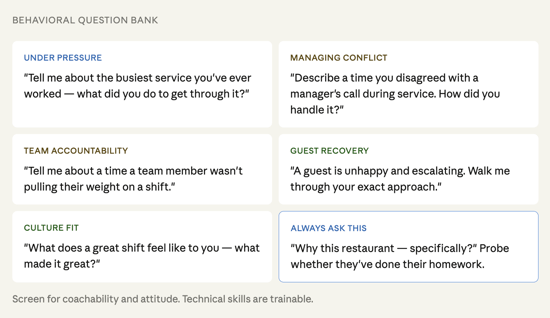
That last question matters more than most operators think. Research shows that employees who feel their organizations recognize their talents and promote skill development are 47% less likely to seek new job opportunities. The interview is your first opportunity to gauge genuine alignment, and a candidate who can answer "why us?" with specificity and conviction is already signaling something meaningful about how they'll show up once hired.
One important calibration: experience and most technical skills are trainable. Attitude is not. Screen for coachability, genuine curiosity, and hospitality instinct. And be honest about what the job is actually like. Operators who oversell and underdeliver create the exact churn they're trying to prevent. Candidates who know exactly what they're walking into and choose it anyway are the ones who last.
Running a structured interview process is only as effective as the logistics behind it. Missed interviews and scheduling chaos quietly kill great hiring pipelines. HigherMe's interview management tools let operators handle everything from one dashboard, with round limits, calendar sync, and direct messaging built in. Candidates get a mobile-friendly self-scheduling link, automated reminders, and the ability to reschedule via text using available time slots. The result: a 67% reduction in no-shows. For multi-location operators managing dozens of open roles simultaneously, this kind of automation isn't a luxury. It's the difference between a hiring process that moves and one that stalls. Read more here!
Phase 5: Don't Lose Them Before Day One
According to SHRM, up to 20% of employee turnover occurs during the first 45 days of work. That means the retention battle starts before orientation, before the apron is even issued.
Once you've made the hiring decision, move fast. A same-day verbal offer followed by written confirmation within 24 hours is the standard to hold yourself to. In a market where candidates are weighing multiple offers simultaneously, delays communicate disorganization.
Pre-boarding, the period between offer acceptance and day one, is an underinvested retention window that most operators completely ignore. At minimum, send a welcome message that confirms their schedule, tells them what to wear, and gives them a single point of contact for questions. Ideally, also share your employee handbook and a brief introduction to the team. The goal is simple: make them feel like they made the right decision before they've served a single table.
HigherMe's paperless onboarding removes the single most avoidable first-day failure: the stack of forms on a folding table. New hires can complete their entire onboarding flow digitally before day one. For an industry where 20% of turnover happens in the first 45 days, eliminating that friction isn't just about efficiency. It's about signaling to a new hire, before they've worked a single shift, that this operation has its act together and values their time. Read more here!
.png?width=2048&height=445&name=Blog%20Banners%20(5).png)
Phase 6: Onboarding Is Where Retention Gets Won or Lost
The research here should be on every operator's wall. A study by the Brandon Hall Group found that a strong onboarding process improved new hire retention by 82% and improved new hire productivity by over 70%. That's not a marginal gain. Yet the average restaurant onboarding experience is some version of: "Here's your apron, shadow Maria for a few shifts, you'll figure it out." Only 12% of employees report that their organization's onboarding process is excellent, and a negative onboarding experience makes employees twice as likely to seek a new job soon after starting.
HigherMe automates the entire onboarding task list so nothing falls through the cracks in a busy operation. Employment verification, document signing, and tax form collection all happen inside one connected flow, without chasing paperwork across departments or relying on a manager to remember what's been completed. For restaurant groups managing multiple locations and high-volume hiring, that kind of systematic consistency is what separates onboarding that actually sticks from onboarding that just technically happened. Read more here!
Phase 7: Retention Starts at the Job Post
The framing of hiring and retention as sequential problems is subtly wrong. They're the same problem viewed from different ends of the timeline.
Hire for longevity, not just vacancy fill. Ask candidates explicitly where they want to be in two years. Build internal career pathways and make them visible during the hiring process. A clear path from line cook to sous chef, or from server to floor manager, converts a transactional job into a genuine career opportunity, and the candidates who respond to that framing are almost always the ones you most want to keep.
Competitive compensation is non-negotiable but insufficient alone. The operators who build genuinely differentiated total reward packages, including scheduling flexibility, staff meals, benefits, and real development opportunities, consistently outperform on retention even in markets where they can't win on hourly rate alone.
And fix management before it becomes a turnover driver. A survey by Hays found that 47% of active job seekers want to leave their jobs specifically because of bad company culture. No onboarding program in the world overcomes a toxic shift culture. The hiring process needs to screen for management quality as rigorously as it screens for technical skills.
The Bottom Line
The restaurant industry has a reputation for treating its people as interchangeable. The data makes clear this is both ethically wrong and operationally expensive. The operators who hire thoughtfully, onboard genuinely, and invest in the development of their people are building something that compounds over time. They're building teams. And teams, not recipes, not concepts, not Instagram followings, are what separate the restaurants guests return to from the ones they forget.
For more hiring tips and tricks, visit higherme.com.
Book a Demo
We'll contact you as soon as possible to better understand how we can help you!