

.png)

You posted the job. Applications came in. And then silence. Candidates stopped responding. Interviews got ghosted. Offers went cold.
If you're hiring hourly workers for hotels, resorts, or any hospitality operation, you already know this feeling. The hourly hiring market moves fast. Candidates apply to five jobs at once and take the first one that responds. If your process has even one unnecessary delay or confusing step, you lose them. Here are
7 Reasons Why
it happens and what to do about it.
1. Your Hiring Process Is Too Long and Too Complicated
This is the number one reason. Hourly candidates are not looking for a career portal with eight steps, a cover letter upload, and a captcha. They're looking for a job, often urgently. If your application takes more than five minutes on a phone, a large chunk of people won't finish it.
The fix is simple: cut it down. Ask only what you need upfront. You don't need a resume to hire a front desk associate or housekeeping staff. Name, availability, and a couple of basic questions are enough to start.
2. You're Too Slow to Follow Up
In hourly hiring for hotels and hospitality, speed is everything. A candidate who applies on Monday and hears nothing by Wednesday has already accepted something else. Studies consistently show that the average hourly worker expects to hear back within 24 hours.
Automated responses aren't impersonal. They're respectful. Sending an immediate confirmation and a next step keeps candidates engaged before they move on.
3. Competing Offers Get There First
The hourly job market is competitive. Your best applicants aren't just applying to you. They're applying to three places at once and taking the first offer that feels solid. If your process takes a week and your competitor takes two days, you'll lose almost every time.
The only answer here is urgency. Prioritize fast screening, fast decisions, and fast offers for candidates you want.
4. Candidates Don't Know What Happens Next
After applying, most candidates are left wondering: did anyone see this? Am I being considered? When will I hear back?
That uncertainty kills momentum. When people don't know what to expect, they assume nothing is happening and they move on. A simple status update at each stage ("Your application is under review," "We'd like to schedule an interview") goes a long way. It costs almost nothing and significantly reduces ghosting.
5. Scheduling Becomes a Bottleneck
Back-and-forth scheduling is one of the most underrated drop-off points. A recruiter sends a few available slots. The candidate doesn't match any of them. Someone has to follow up. By the time a time is confirmed, it's been four days.
Self-scheduling tools solve this completely. Let candidates pick a time from your calendar directly. It's faster for everyone and removes a common exit point from your funnel.
6. Expectations Didn't Match Reality
A candidate applies thinking the role is mornings, close to home, at a certain pay rate. They get to the interview and find out it's evenings, a longer commute, and lower pay than expected. That's an immediate drop.
This isn't always avoidable, but a lot of it is. Detailed, honest job descriptions with pay range, hours, and location upfront filter out poor-fit candidates early and keep good-fit candidates interested all the way through.
7. Your Recruiters Are Juggling Too Many Tools
When your team is managing applications in one tool, messages in another, interviews in a third, and onboarding paperwork in a fourth, things fall through the cracks. Follow-ups get missed. Candidates wait longer than they should.
Fragmented tools create fragmented experiences. Candidates feel it, even when they can't name it.
-1.png?width=1200&height=613&name=Blog%20Banners%20(6)-1.png)
What This Actually Costs Your Business
A candidate dropping off isn't just an inconvenience. In high-volume hospitality hiring, it has real downstream effects.
Shifts go unstaffed. When you can't hire fast enough, open roles translate directly to operational gaps. That means existing staff covering more hours, guest experience taking a hit, and manager time going to floor coverage instead of recruitment.
Your cost per hire goes up. Every dropped candidate means re-posting, re-screening, and restarting the process. For hospitality operators hiring at volume, this adds up quickly.
Your employer brand takes a hit. Candidates talk. A confusing or slow application process leads to negative reviews on Glassdoor or Indeed, which affects future applicants. In a tight labor market, your reputation as an employer matters more than most businesses realize.
Your team burns out. Recruiters spending hours chasing candidates, re-sending messages, and coordinating across tools have less bandwidth for the parts of hiring that actually require human judgment.
The compounding effect is the real problem. One dropped candidate is a small loss. Thirty dropped candidates per month, consistently, is a broken process..png?width=1500&height=257&name=Blog%20Banners%20(10).png) How to Actually Reduce Drop-Offs
How to Actually Reduce Drop-Offs
There's no single fix. But there are clear patterns that work for hourly hiring in hotels, resorts, and hospitality operations.
-
Make applying take under 3 minutes. Mobile-first, short, and direct. No resume required for entry-level roles.
-
Automate your communication. Set up triggered messages at each stage. Confirmation when they apply. Update when they're shortlisted. Reminder before the interview. These don't need to be personal. They just need to exist.
-
Use pre-screening questions smartly. Ask the two or three things that actually matter for the role upfront. This speeds up screening on your end and signals to candidates that you're organized.
-
Let candidates self-schedule. Remove the back-and-forth. A shared calendar link at the right moment keeps momentum going.
-
Write honest job descriptions. Be specific about pay, hours, location, and what the job actually involves. This reduces mismatched applicants and increases offer acceptance.
-
Consolidate your tools. The fewer places your hiring process lives, the fewer opportunities for delays and missed follow-ups.
-
Move fast when you find someone good. Same-day or next-day decisions on strong candidates. In hourly hiring, speed is your competitive advantage.
-
Track where people are dropping. You can't fix what you don't measure. Know your application completion rate, your interview show-up rate, and your offer acceptance rate, and look for where the biggest gaps are.
-1.png?width=750&height=427&name=Blog%20Banners%20(8)-1.png) How HigherMe Helps
How HigherMe Helps
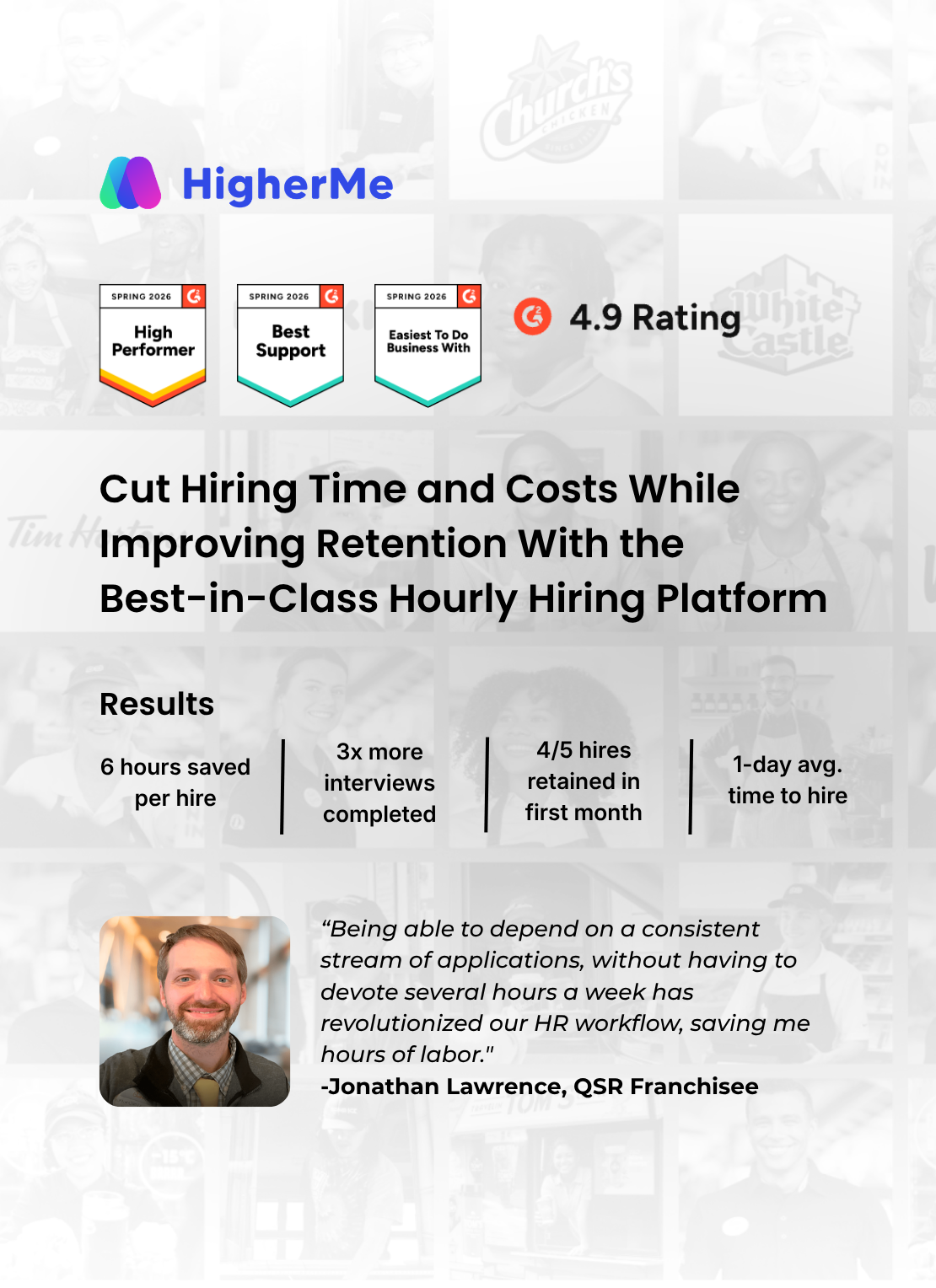
HigherMe is built specifically for high-volume hourly hiring. It's an end-to-end platform that handles the entire process, from application to onboarding, in one place.
Here's what that looks like in practice.
Candidates apply through a mobile-first, quick-apply flow designed for hourly roles. Pre-screening questions are built in, so your team is only reviewing candidates who already meet your basic criteria. No sifting through unqualified applications.
Communication is automated. Candidates get updates at each stage without your team having to manually follow up. Interview scheduling is self-serve, so no back-and-forth.
HigherMe also brings AI-powered tools and job posting best practices into the workflow, helping you write better job descriptions, flag high-potential candidates faster, and reduce the manual work that slows most hiring teams down.
Once someone is hired, onboarding starts immediately within the same platform. New hires complete paperwork and get set up before their first day, which means they show up ready to work instead of spending their first shift filling out forms.
For hotel groups and hospitality operators hiring at scale, this is the difference between a process that leaks candidates at every step and one that converts them consistently.
Want to see how it works? Visit higherme.com to book a demo.
Book a Demo
We'll contact you as soon as possible to better understand how we can help you!