

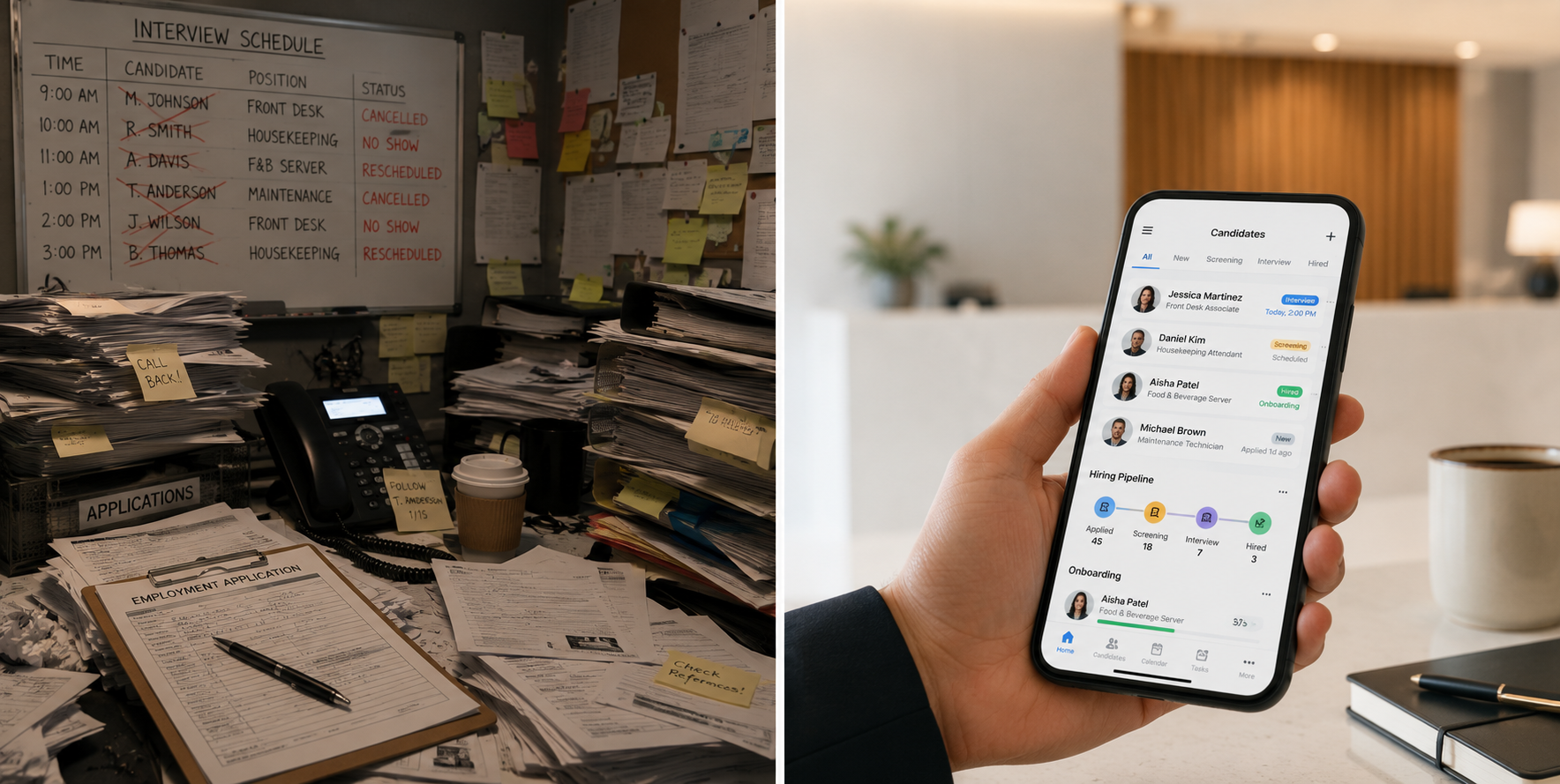

Picking the wrong hiring platform does not just slow down recruiting. It costs you candidates who drop off mid-application, new hires who show up to a paperwork disaster on day one, and managers who spend more time fighting software than filling shifts. According to a 2024 analysis of BLS data by HR Dive, nearly 3 million people left their roles in leisure and hospitality in just the first four months of 2024, a quit rate 204% above the national average. In an industry moving that fast, a clunky hiring process is not a minor inconvenience. It is a competitive disadvantage.
Most GMs evaluate hiring platforms on price and feature lists. The ones who end up with the right tool ask better questions than that.
Here are seven of them.
1. How fast can a candidate actually apply?
This is the question most platform demos skip entirely. You will see dashboards, reporting screens, and integrations. What you rarely see is what the application experience looks like on a candidate's phone at 9pm after a shift somewhere else.
Hourly hospitality candidates are not sitting at a desktop with a resume formatted and ready. They are applying from their phones, between shifts, with limited patience for multi-step processes. Every additional screen in the application flow costs you completed applications. The platforms that understand this have built for mobile-first, low-friction entry. The ones that have not will show you a mobile-responsive version of a desktop form and call it the same thing.
Ask to see the candidate-facing application on a phone before you sign anything.
HigherMe's Text-to-Apply lets candidates start an application by texting a number or scanning a QR code, completing the whole thing in under a minute from their phone. For a hotel posting roles across multiple locations, that friction reduction translates directly into more completed applications and a larger pool to hire from.
2. Does it understand multi-location hiring?
A hiring platform built for a single-location business will create more work for a GM overseeing multiple properties. You need to be able to post roles across locations, manage applicants by property, and give location-level managers visibility into their own pipeline without giving them access to everything else.
Ask specifically: can individual location managers see and action their own applicants without needing admin access to the whole account? If the answer involves a workaround, that workaround will become someone's full-time problem.
3. How does it handle onboarding, not just hiring?
A lot of platforms stop at the offer letter. That is fine if you have a separate onboarding system that actually works. Most hotels do not. They have a folder of PDFs, a stack of forms, and a manager who prints everything out the morning someone starts.
The question to ask is whether the platform can carry the new hire from application through to their first completed shift without the process falling apart in the middle. That means digital offer letters, tax forms, compliance documents, and any property-specific paperwork, all completable from a phone before day one.
HigherMe's paperless onboarding covers the full pre-employment documentation flow digitally. New hires complete everything before they walk in. Managers do not chase paperwork. Day one starts with the job.
4. What does the candidate ranking actually do?
Most platforms have some version of candidate ranking or scoring. What varies enormously is what that ranking is based on and who controls it.
There is a meaningful difference between a platform that automatically filters candidates based on algorithmic pass/fail decisions and one that surfaces the strongest applicants for a hiring manager to review. The first removes human judgment from the process entirely. The second makes human judgment faster and better informed.
For hotel hiring, where culture fit and reliability often matter as much as experience, you want a hiring manager in the decision, not just an algorithm. Ask exactly how the ranking works, what signals it uses, and whether a hiring manager can override or adjust it.
5. How does it connect to your payroll system?
This question gets asked less often than it should, and it causes problems every time. A hiring platform that does not talk to your payroll system means someone is manually re-entering new hire data somewhere downstream. That is an error waiting to happen and administrative time nobody has budgeted for.
Ask whether the platform has a native integration with your payroll provider, what data passes between the two systems, and whether that integration is two-way. A one-way push is better than nothing. A two-way sync is the only version that actually removes work from your team.
6. Is it built for the way hourly candidates actually look for work?
This is a broader version of the application friction question and it matters for sourcing, not just conversion. The best hiring platforms for hospitality have direct integrations with the job boards hourly workers actually use: Indeed, Snagajob, and similar. Posting to those boards from within the platform, and pulling applicants back in automatically, is table stakes.
What separates the better platforms is depth of those integrations. Ask whether the platform has any kind of preferred or certified partnership status with major job boards, because that affects how prominently your roles are surfaced to candidates and how smoothly applicant data flows back into your pipeline.
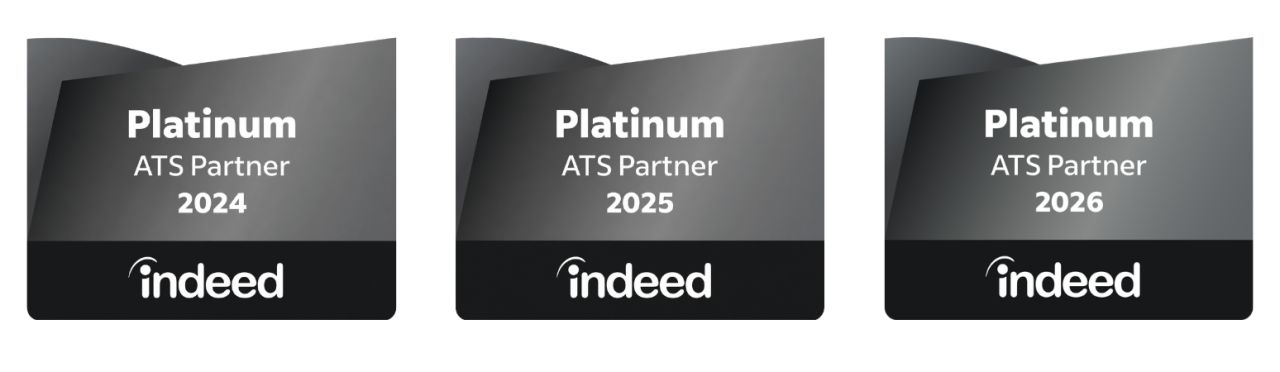
HigherMe holds Indeed Platinum ATS Partner status, three consecutive years running through 2026. That is the highest tier Indeed awards, and it directly affects how HigherMe-powered job postings perform on the platform.
 7. What does implementation and support actually look like?
Every platform sells you on the product. Fewer are honest about what happens in the first 90 days after you sign. Implementation timelines, training for location managers, and what support looks like when something breaks on a Saturday before a busy weekend are questions worth asking before you commit.
Ask for specifics: how long does onboarding take, who owns the implementation on their side, and what is the support channel when you have a problem. "Email us and we'll get back to you" is a different answer than a dedicated contact who knows your account.
The right platform is not the one with the longest feature list
It is the one built for the way your operation actually works. Multi-location, high-volume, mobile-first, and connected to the systems you already use. A platform that checks those boxes does not just make hiring easier. It changes the quality of the people you hire and the experience they have from the moment they apply.
If you want to see how HigherMe was built specifically for multi-location hotel and hospitality operators, take a look at what we do higherme.com.
Frequently Asked Questions
1. What should a hotel GM prioritize when evaluating a hiring platform?
Start with the candidate experience, not the admin dashboard. The best platform is the one that makes it easiest for the right candidates to apply and get hired quickly. From there, evaluate whether it handles onboarding as well as hiring, whether it works across multiple locations cleanly, and whether it connects to your payroll system without manual re-entry in between.
2. How important is mobile optimization for hotel hiring platforms?
It is not optional. The overwhelming majority of hourly hospitality candidates apply from their phones. A platform that was built for desktop and adapted for mobile is a different product from one built mobile-first. Ask to see the candidate-facing application on an actual phone during any demo. That single screen will tell you more than an hour of dashboard walkthrough.
3. What is the difference between candidate ranking and automated filtering?
Candidate ranking surfaces the strongest applicants for a hiring manager to review. Automated filtering removes candidates from consideration based on algorithmic criteria before a human ever sees them. For hotel hiring, where reliability, attitude, and fit often matter as much as experience, you want a hiring manager involved in the decision. Ranking supports that. Automated filtering replaces it.
4. Does payroll integration really matter for a hiring platform?
More than most GMs realize until they are dealing with the alternative. Without integration, new hire data gets manually re-entered into a separate payroll system, which takes time and introduces errors. A two-way integration between your hiring platform and payroll system means data flows automatically, onboarding is cleaner, and your team does not spend the first week of every new hire's employment doing data entry.
5. What is Indeed Platinum ATS Partner status and why does it matter?
It is the highest certification tier Indeed awards to applicant tracking systems. Platforms that hold it have met Indeed's strictest standards for integration quality, which affects how job postings perform on the platform and how cleanly applicant data flows between the two systems. For hotels that rely on Indeed as a primary sourcing channel, the ATS partnership tier of your hiring platform directly affects your candidate volume.
6. How long should it take to implement a new hiring platform?
It varies by platform and by the complexity of your operation, but for a multi-location hotel group, a reasonable expectation is two to four weeks for full implementation including location setup, manager training, and job board integrations. Be cautious of platforms that promise same-day setup for complex accounts, and equally cautious of ones that cannot give you a clear timeline at all. Ask who owns the implementation on their side and what the escalation path is if something goes wrong.
Book a Demo
We'll contact you as soon as possible to better understand how we can help you!