



Here's the thing about Workstream: it solves a real problem. The founders came from the restaurant and hourly hiring space. They knew the pain. Slow hiring processes. Candidates ghosting. Manual screening eating up manager time. Workstream fixed that for QSR chains and large hospitality brands. Burger King, Jimmy John's, Chick-fil-A. The platform delivers a unified hiring, onboarding, scheduling, and payroll experience that keeps data from duplicating across systems. That's genuinely valuable. But valuable for one buyer doesn't mean optimal for all buyers. Hotel operators - especially independent properties and smaller multi-unit groups, often find themselves paying for capabilities they don't use while missing features built specifically for hotel hiring. Hotel and catering roles average about 27 days to fill. The platform that moves fastest on this metric isn't always the most feature-complete. Sometimes it's the one built for your exact situation.
What Workstream Does Well
(And When It Might Be Overkill)
Workstream's pitch is straightforward: unified hiring, onboarding, scheduling, and full-service payroll in one system. No data re-entry between systems. No reconciliation headaches. A flat fee per headcount means predictable costs whether you're running payroll weekly or bi-weekly.
The platform has genuine strengths. VoiceAI handles automated phone screening 24/7. Mobile-first design means candidates apply and communicate on their phones. Multi-location visibility lets you manage hiring across properties from one dashboard. And the customer list proves it works at scale.
Here's where the fit gets tight for some hotels. Workstream is built around QSR and large hospitality workflows. The onboarding is solid but not hotel-specific. The scheduling integration works but requires coordination with separate scheduling systems. And the unified payroll, while a strength for large multi-location operators, can be overkill for independent hotels or smaller groups that already have payroll vendors they trust. Setup requires coordination across hiring, scheduling, and payroll. That's not a huge lift for a large chain. For a property manager running a single location or a small group, it's friction you may not need.
The integration ecosystem is narrower than some platforms. If your hotel uses unusual vendors or has custom integrations, you may find limitations.
The 7 Best Workstream Alternatives for Hotel Hiring
1. HigherMe: Built for Hotel Hiring, Not QSR Retrofitted
HigherMe's advantage over Workstream isn't breadth. It's precision. The platform was built by people who ran hotel properties and knew exactly where hiring breaks down.
A candidate applies via Text-to-Apply or a branded careers page. The application loads fast. Zero loading delays. NextMatch AI pre-screens and ranks candidates. Managers get a shortlist instead of hundreds of unfiltered applications. Onboarding sits in the same system. No portal login. No separate process. W-4, direct deposit, I-9, E-Verify, handbook, all done before day one.
HigherMe serves 40-plus hotel properties. Days Inn, Holiday Inn, LaQuinta, SpringHill Suites, Motel 6, PRG Hospitality. These are real operations running hiring at volume.
Platform coverage:
- Text-to-Apply and branded careers pages. 88% application completion rate.
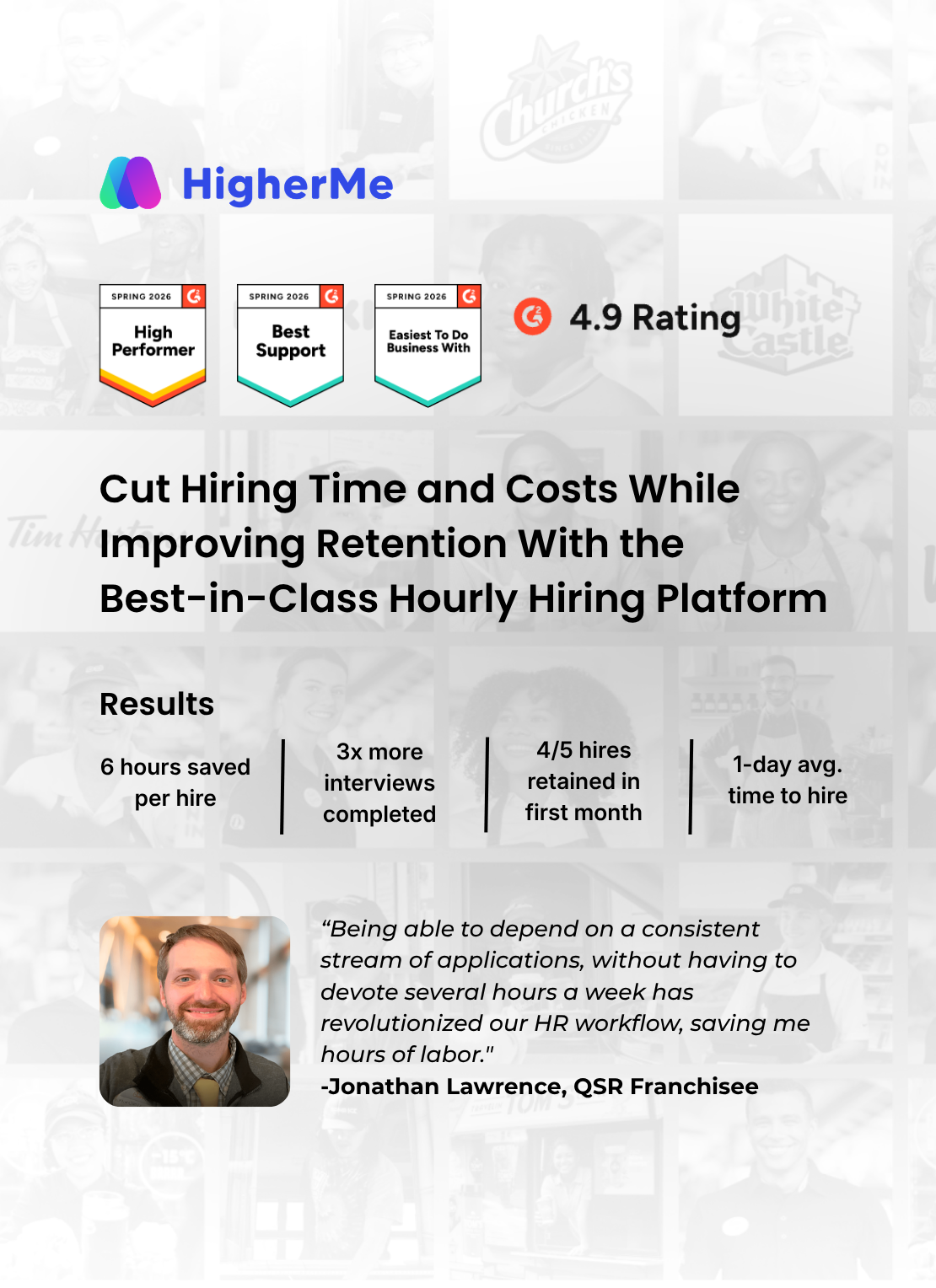
- NextMatch AI pre-screening. Saves about 30 minutes per candidate. 3x more completed interviews versus manual job board management.
- Automated interview scheduling with text-based rescheduling for no-shows.
- Paperless onboarding inside the same platform.
- Hiring Hub for multi-property management. Each property can hire independently.
- Integrations with ADP, Paychex, Checkr.
- Optional payroll.
Average time-to-hire is two days. Setup is under 24 hours. No IT involvement.
For hotels where hiring speed and onboarding efficiency are the bottleneck (which is most hotels) HigherMe is purpose-built for that exact problem.
Best for: Multi-property hotels, independent operators managing multiple locations, anyone prioritizing hiring speed and seamless onboarding.
2. Paradox: Conversational AI at Enterprise Scale
Paradox powers McDonald's global hiring. The Olivia chatbot screens candidates 24/7 in 100+ languages. It integrates into large HRIS ecosystems. For hotel groups running thousands of hires annually with dedicated implementation budgets, it's proven.
Implementation takes months. Paradox is a screening and engagement layer, not a complete hiring and onboarding system. You're bolting it onto existing infrastructure. For a hotel operator trying to move faster this quarter without a six-month project, it's not the answer.
Good for: Large enterprise hotel chains with significant implementation resources and global hiring scale.
3. Fountain: High-Volume Funnel Management
Fountain excels at one thing: moving thousands of applications through a hiring pipeline. Stage-based workflows, SMS communication, funnel analytics. UPS, Amazon DSP, Sweetgreen use it for high-volume frontline hiring.
For hotels, the configuration overhead and setup timeline are the constraint. Onboarding is limited. You need separate tools for post-hire. And the enterprise focus means smaller operators often feel like they're paying for complexity they don't use.
Good for: Large hotel groups or management companies with 500+ annual hires and dedicated HR resources.
4. Harri: Hospitality HCM with Full Workforce Management
Harri combines hiring, scheduling, labor optimization, and compliance in one hospitality-focused platform. If scheduling and labor cost management are as critical as hiring for your operation, the integration is valuable.
The trade-off: broader scope means less specialization in hiring speed. The mobile app has had reliability issues. Setup takes weeks.
Good for: Full-service hotel groups or management companies where hiring, scheduling, labor, and compliance are equally important daily problems.
5. Hireology: Multi-Location Hotels, AHLA Partner
Hireology ranks as the top ATS for hotels on Hotel Tech Report and partners with AHLA. It provides hiring, onboarding, skills tests, and strong scheduling/payroll integrations built for multi-location hotels.
The guardrails that make it valuable for consistency can slow down hiring. Some operators report thin applicant flow and inconsistent implementation support.
Good for: Multi-property hotel groups where hiring consistency and compliance are the priority.
6. Fourth / PeopleMatter: HCM Suite for Existing Customers
PeopleMatter (owned by Fourth) offers hiring, mobile onboarding, E-Verify, and scheduling. Solid if you're already in the Fourth ecosystem.
For fresh evaluation, the consensus is clear: the feature gap versus newer platforms is noticeable. Mobile experience lags. AI screening isn't native.
Good for: Existing Fourth HCM customers only.
7. Homebase: SMB Scheduling with Hiring Basics
Homebase is scheduling-first. Hiring is included but basic. Free tier covers scheduling and time tracking. Paid tiers add Indeed and ZipRecruiter job posting, basic ATS, onboarding, and payroll.
For a single independent hotel with occasional hiring needs, the free tier is worth trying. The ceiling appears fast. Per-location pricing means multi-property groups pay a lot. No AI screening. Support is inconsistent.
Good for: Single independent properties with tight budgets and low hiring volume.
Quick Comparison
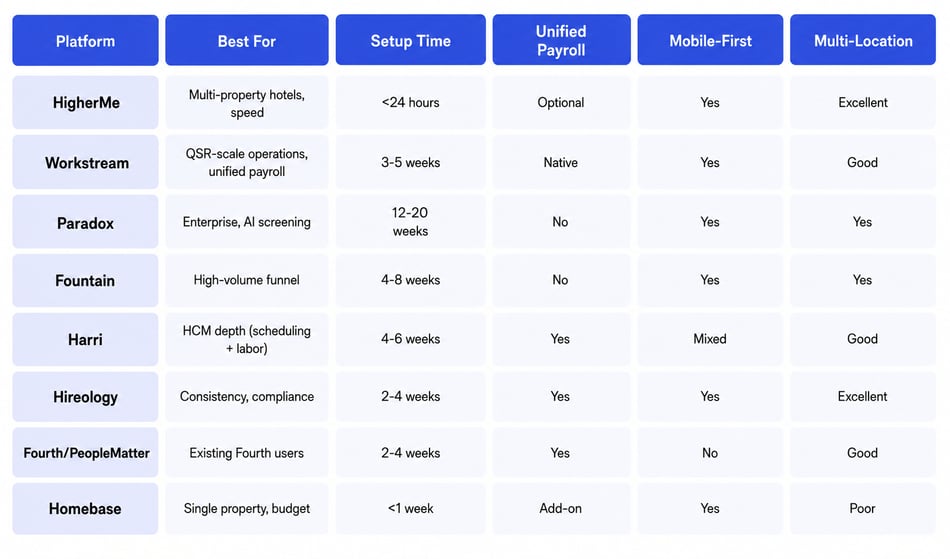
Conclusion
Workstream works for what it was built for: high-volume, multi-location restaurant and hospitality brands that want one vendor for hiring, onboarding, scheduling, and payroll. If that describes your operation, it's solid.
But hotel hiring has different constraints than QSR hiring. Volume is constant but often lower. The roles are different (housekeeping, front desk, maintenance). The hiring challenges are different (seasonal surges, high turnover in specific roles). Workstream's QSR foundation is a strength if you're Chick-fil-A. It's a limitation if you're running a boutique hotel group or independent properties.
HigherMe was built for hotel hiring first. The difference shows up in the details: how fast applications load, how candidates are scored, how onboarding actually connects to hiring instead of living in a separate system.
Visit higherme.com to know more.
Frequently Asked Questions
1. Is Workstream worth it for small or independent hotel operators?
If you're a single property hiring occasionally, no. Workstream's strength is managing multiple properties at high volume. Below that threshold, you're paying for unified payroll and scheduling integration you may not use. An ATS focused solely on hiring speed would serve you better.
2. How does HigherMe's onboarding compare to Workstream's?
HigherMe's onboarding lives inside the same hiring system. No separate portal. No login issues. No candidates losing access to onboarding links. Workstream's onboarding is robust but requires handoff from hiring. Different philosophies. HigherMe optimizes for fewer handoffs. Workstream optimizes for deeper post-hire functionality.
3. Do I need native payroll bundled with hiring?
Depends. If payroll is a pain point and you want one vendor, bundled payroll saves time and integration headaches. If your payroll provider is solid and you trust them, paying extra for unified payroll you don't need is inefficient. Be honest about where your real friction is.
4. Can I use Workstream if I only need hiring and onboarding, not scheduling or payroll?
Yes, but you're paying for features you won't use. Workstream's pricing is based on headcount and selected modules. If you're only using hiring and onboarding, a platform focused on those two things would be more cost-efficient.
5. How fast can HigherMe actually get me a candidate to interview?
Average time-to-hire across the platform is two days. Some properties see candidates moving through screening and into interviews within hours. A lot depends on your volume and how quickly your managers respond to the shortlist. But the platform doesn't add friction. That's the difference.
Book a Demo
We'll contact you as soon as possible to better understand how we can help you!