

-Jun-02-2026-12-17-05-1461-PM.png)

QSR turnover still clears 130% annually for most operators. Replacing a single hourly employee costs between $2,000 and $5,000 once you account for recruiting time, manager hours, and training. (Paytronix, December 2025) Workstream has become a well-known name in this space, especially among larger franchise groups. But a recognizable brand does not automatically mean the right fit for your operation. If you are running five locations or fifty, the platform you pick needs to match how your hiring actually works day to day, not just check boxes on a feature list.
Here are seven alternatives worth a serious look in 2026.
Why Franchise Restaurant Hiring Needs Its Own Category of Software
Most HR platforms were not designed with a QSR operator in mind. They were built for office hiring, then adapted. And that gap shows up everywhere, from application flows that assume candidates are on a desktop, to onboarding tools that require IT setup, to reporting dashboards that make sense for a single headquarters but break down across thirty locations.
Franchise restaurant hiring has a specific rhythm. Volume is constant. Candidates move fast or they disappear. Managers are on the floor, not at a desk. And the cost of an unfilled shift is immediate and visible. You need software that was designed for that reality, not software that sort of works if you configure it correctly.
A few things that genuinely matter when you are evaluating tools for this context:
-
Response speed to candidates. Hourly job seekers apply to multiple places at once. The operator who follows up within the hour wins. Platforms that rely on manual outreach or daily email digests do not cut it.
-
Mobile-first, not mobile-compatible. There is a real difference between a platform that was built for mobile and one that has a mobile version. Application completion rates reflect that difference.
-
Onboarding in the same system. Hiring someone is one thing. Getting their paperwork done before their first shift so they actually show up ready to work is another. If onboarding lives in a different tool, that handoff is where candidates fall through.
-
Multi-location visibility without multi-location headaches. Franchise operators need to see what is happening across locations without managing five separate logins or building manual reports.
The 7 Best Workstream Alternatives
1. HigherMe: Built for Franchise Restaurants, Not Adapted for Them
There is a version of this list where we bury the lede. We are not doing that. HigherMe is the strongest option for franchise restaurant operators, and the reason comes down to where the platform started: it was built by former franchise owners, for franchise operators.
That is not a marketing line. It shows up in the product. The application flow is designed around how hourly candidates actually behave. The Candidate Score ranks applicants by proximity to the store, availability match, and relevant experience, so managers are not wading through unqualified applications to find someone who lives forty minutes away and can only work Sundays. Text-to-Apply works off QR codes placed directly in your restaurant. A candidate sees the poster, texts a number, and is in your pipeline before they finish their coffee. The whole thing takes under a minute.
HigherMe serves 20,000+ franchise locations. You will recognize the customer list: Domino's, Dunkin', Tim Hortons, Chick-fil-A, Wendy's. These are not pilots or one-off enterprise deals. These are franchise operators who staff at volume, every week, and need a system that keeps up.
What the platform covers:
- Text-to-Apply and QR sourcing with Indeed Platinum Partnership, giving your listings 98% visibility on the platform
- NextMatch AI pre-screening that interviews candidates automatically, scores them, and hands your managers a shortlist rather than a pile of resumes. Operators report saving around 30 minutes per candidate on screening time.
- Automated scheduling with text-based rescheduling that cuts down on no-shows
- Branded careers pages built for each location, with an 88% application completion rate
- Paperless onboarding covering W-4s, direct deposit, I-9/E-Verify, and employee handbooks, all completed before the new hire's first day
- Hiring Hub for centralized oversight across every location, with location-level controls for managers
- Payroll integration with ADP and Paychex, plus HigherMe's 2-way payroll option - Netchex, for operators who want to consolidate
The results from actual operators are specific. A Tim Hortons franchisee went from struggling to fill positions to receiving 25x more applicants per week after switching to HigherMe. A Domino's franchise group running 36 locations got driver hiring down to a 72-hour turnaround.
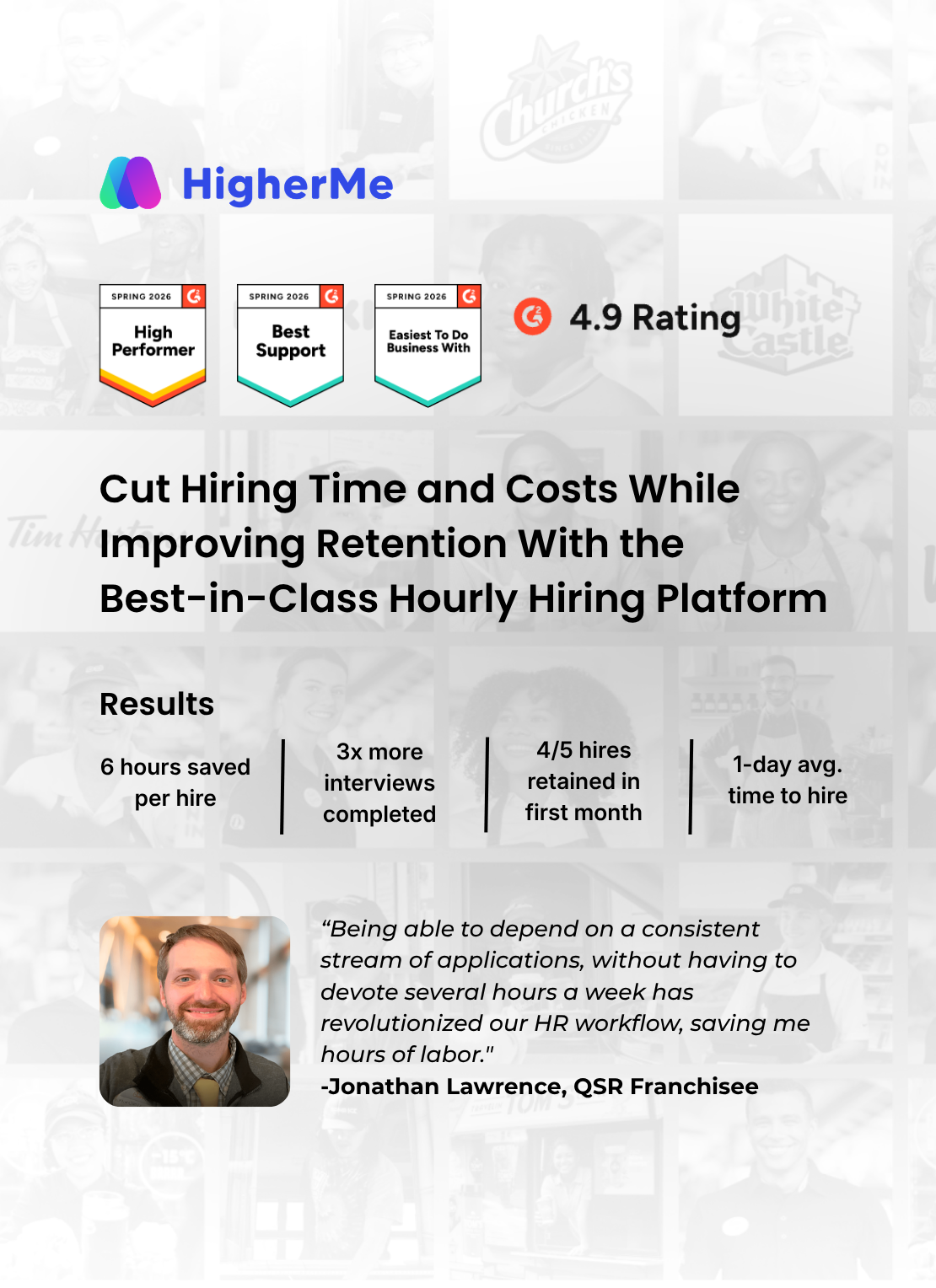
Across their customer base, HigherMe reports an average time-to-hire of one day and 3x more completed interviews versus managing job boards manually.
Setup is under 24 hours. No IT involvement, no lengthy implementation. For anyone who has sat through a six-week enterprise onboarding, that matters.
The honest tradeoff: if you are a single-location independent restaurant with two or three hires a year, HigherMe has more platform than you need. But for any multi-unit franchise operator dealing with constant hiring volume, it is purpose-built for your situation.
Best for: Multi-unit QSR franchise groups, operators standardizing hiring across locations, anyone who needs fast onboarding without technical overhead.
2. Fountain: When Volume Is the Whole Problem
Fountain is designed around one specific use case: processing a very large number of applications quickly. If you are running a massive frontline operation and your primary challenge is funnel management at scale, it handles that well. UPS, Sweetgreen, and similar high-throughput employers use it for a reason.
The platform's stage-based workflow automation is genuinely flexible. You can build multi-step screening sequences, automate candidate progression, and track drop-off at every stage. SMS communication keeps candidates moving through the funnel without requiring manager involvement at each step.
Where it falls short for most franchise restaurant operators is scope and fit. Fountain is not franchise-specific. It was not built for QSR workflows, and the configuration required to make it work for your operation adds meaningful setup time. Onboarding and post-hire HR functionality is thin. You will likely need additional tools alongside it, which brings its own integration headaches.
Good for: Large-scale frontline operations with dedicated HR teams and continuous, high-volume hiring. Less suited for mid-size franchise groups without implementation resources.
3. Harri: Better Fit for Full-Service and Hospitality
Harri is more of an HCM platform than a pure hiring tool. It’s about recruiting, scheduling, labor optimization and employee engagement all through the lens of hospitality. Its customers are mainly full-service restaurants, hotel groups and resorts. They have over 600 clients and serve more than 5 million employees.
For QSR operators, Harri is more platform than necessary in some areas and less optimized in others. The scheduling and labor tools are genuinely built for hospitality, which is useful for full-service environments with complex shift structures and tip management. But the hiring flow is not as fast or mobile-native as what QSR operators need when they are filling ten crew positions across three locations this week.
Good for: Full-service restaurants, hotel groups, and hospitality operators who need workforce management alongside hiring. Not the strongest fit for pure-play QSR franchise groups.
4. Hireology: For Franchise Systems That Prioritize Process Consistency
Hireology's value proposition is structured and consistent hiring across locations. It creates approval workflows, standardizes application stages and gives franchisor-level visibility into what’s happening at each unit. That structure is good for franchise systems that have a heavy compliance burden.
The platform also serves industries outside restaurants, including automotive and healthcare, which means it is not deeply specialized for QSR. The structured, process-driven approach that works well for compliance can slow things down in frontline hiring environments where speed is the constraint, not process.
If your franchise system has a strong HR function and your biggest concern is hiring consistency and compliance documentation across a large network, Hireology is worth evaluating. If you need to fill a line cook position by Thursday, the workflow overhead will frustrate you.
Good for: Franchise systems with dedicated HR oversight where consistency and compliance documentation matter more than speed.
5. Paradox: Enterprise AI, Enterprise Requirements
Paradox is probably the most widely recognized AI hiring tool in QSR because it powers McDonald's global hiring through McHire. The Olivia chatbot handles conversational screening at scale, supports over 100 languages, and integrates into large HRIS ecosystems. For enterprise brands running millions of candidate interactions annually, it is a proven tool.
For the average franchise operator, the realistic barrier is implementation. Paradox is an enterprise product in terms of cost, setup timeline, and IT requirements. It is primarily a screening and engagement layer, not a full hiring and onboarding system, which means you are still stitching together other tools for the rest of the process.
If you are a large enterprise brand with a dedicated implementation budget and IT resources, the AI capability is genuine. If you are a franchise group with fifteen locations trying to move faster on hiring, Paradox is probably not the right entry point.
Good for: Large enterprise restaurant brands with significant annual hire volumes and the resources to support a proper implementation.
6. Homebase: Scheduling First, Hiring Second
Homebase is a scheduling tool that added a hiring module. For a single-location independent restaurant, the free tier makes it accessible and the ease of use is real. A lot of small operators use it precisely because it does not require much setup or training.
The limitation is just as real: when hiring is not the core product, the hiring features reflect that. There is no meaningful AI screening, Text-to-Apply is not a native feature, and the onboarding functionality is basic. For a franchise operator who needs a consistent hiring pipeline across multiple locations, Homebase hits its ceiling quickly.
It is a reasonable choice for a small independent restaurant with occasional hiring needs. For franchise operators dealing with constant turnover and multi-location complexity, it is not built for the job.
Good for: Single-location independent restaurants with limited hiring volume and tight budgets.
7. JazzHR: Solid ATS, Wrong Context
JazzHR is a mid-market ATS with good pipeline management, collaborative hiring tools, and decent job board distribution. It works well for SMBs with a small HR team running structured recruiting for professional roles.
The problem for franchise restaurant operators is that it was never designed for hourly hiring. The application flow assumes a more traditional candidate journey. Text-to-Apply, AI pre-screening, and mobile-first candidate experience are not core to the product. For a QSR operator trying to hire faster, JazzHR adds process without solving the actual problem.
Good for: SMBs running structured, lower-volume recruiting. Not suited for high-volume hourly franchise operations.
Quick Comparison
-Jun-02-2026-12-14-57-5202-PM.png?width=950&height=441&name=Blog%20Banners%20(2)-Jun-02-2026-12-14-57-5202-PM.png) Conclusion
Conclusion
Workstream is a real platform with a real customer base, and for operators who want hiring, payroll, and scheduling under one roof with enterprise support, it does the job. But it is not the only option and, depending on your actual hiring challenges, it may not be the most efficient one for you.
If you are running a franchise restaurant operation and your core problem is hiring volume, speed, and onboarding consistency across locations, the rest of this list exists. And HigherMe sits at the top of it because it is the one platform here that was built from the ground up for exactly that problem.
Start there. Visit higherme.com to know more.
Frequently Asked Questions
1. What should I actually be looking for in a Workstream alternative?
Think about what is breaking in your current process first. Is it application volume? Candidate drop-off? Onboarding delays? No-shows? Different platforms solve different problems. For franchise restaurant operators, the highest-leverage features are typically Text-to-Apply, AI pre-screening, automated scheduling, and paperless onboarding in a single platform.
2. Is HigherMe built for multi-location franchise operators specifically?
Yes. It serves 20,000+ franchise locations and was built by people who ran franchise restaurants. The multi-location Hiring Hub, location-specific Text-to-Apply, and Candidate Scoring are all designed with franchise operations in mind, not retrofitted from a corporate hiring tool.
3. How is HigherMe's AI screening different from what Paradox offers?
NextMatch AI is designed for hourly and franchise hiring. It ranks candidates by proximity to the store, schedule availability and relevant experience, saving about 30 minutes per candidate on screening. Paradox’s Olivia is more conversational and works at enterprise scale with multilingual support, but it also requires a large investment to implement. They are solving similar problems for very different buyer profiles.
4. Can HigherMe connect to my existing payroll system?
Yes. HigherMe has integrations with ADP and Paychex, but has its own payroll module that operators can use to consolidate. It also integrates with scheduling platforms like 7Shifts and background check services like Checkr.
5. How fast can I actually get HigherMe running?
Under 24 hours. The platform is set up to be configured by operators without IT support. Branded careers pages, Text-to-Apply posters, and job board connections are all handled through the platform itself.
Book a Demo
We'll contact you as soon as possible to better understand how we can help you!