

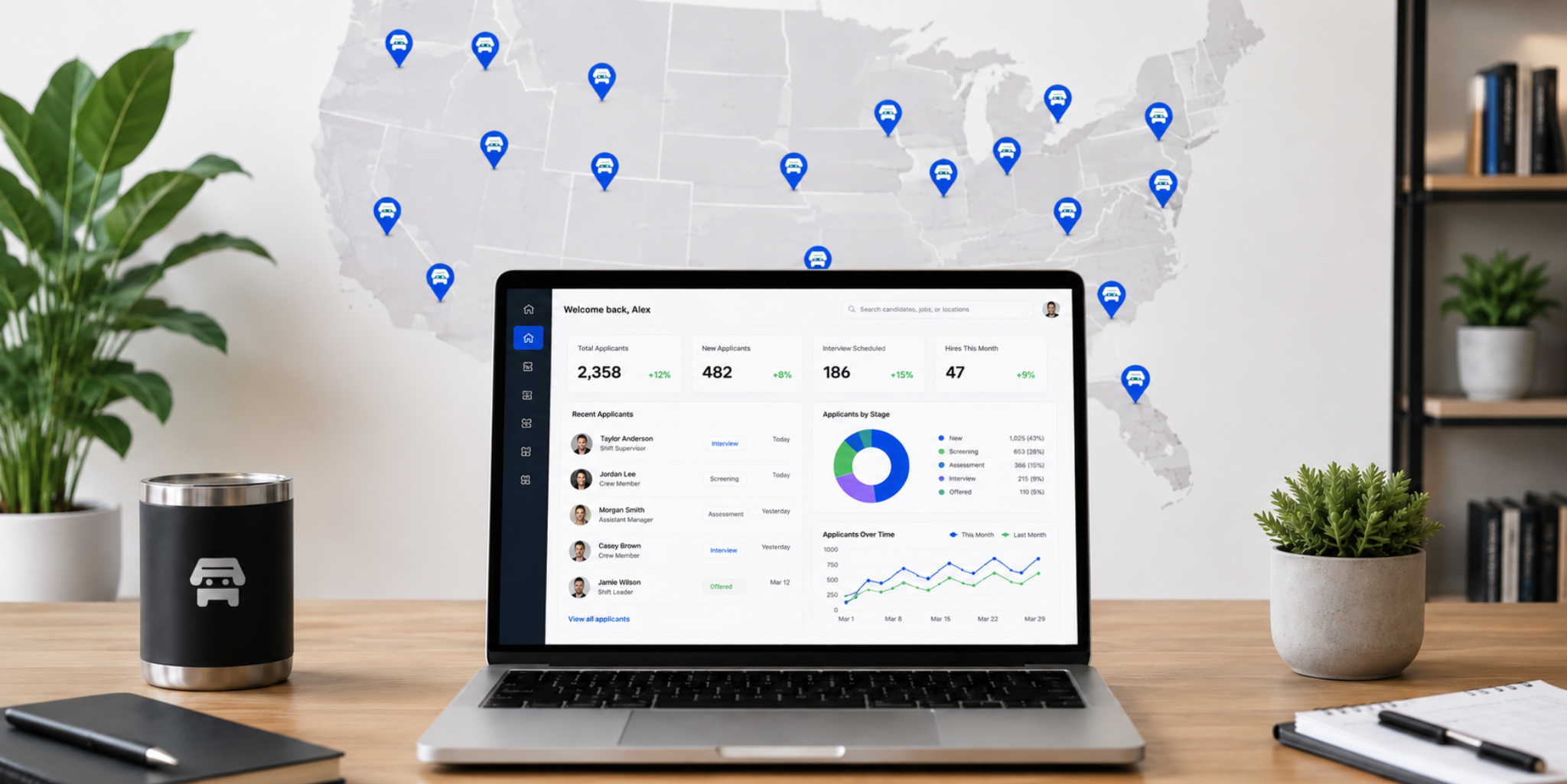

Running one location is hard. Running ten is a different problem entirely. The hiring process that works when a single manager can eyeball every applicant starts breaking down the moment you add a second location, a third, a fifth. Suddenly you are dealing with inconsistent screening, no visibility into what is happening at each site, and location managers all doing things their own way. Turnover in franchise QSR already exceeds 130% annually. Every day a role sits open at any one of your locations costs you money and puts pressure on the crew that stayed.
The right hiring software does not just solve one location's problem. It solves the problem at scale, without turning your managers into administrators.
The Real Hiring Challenge Across Multiple Franchise Locations
Single-location operators have it relatively simple. One applicant pipeline. One manager making calls. One set of interview slots to manage. Franchise operators at scale are dealing with something structurally different.
Visibility is the first issue. If you have locations across three cities and each one is using a different process or no process at all, you have no reliable picture of where your hiring actually stands. You find out a location is understaffed when a manager texts you on a Saturday, not from a dashboard.
Consistency is the second. Without a standardized hiring process, you get wildly different candidate experiences depending on which location someone applies to. That inconsistency affects your brand and your hiring outcomes.
Speed is the third. Franchise hourly candidates are not waiting around. They are applying to several places at once. The operator who responds first usually wins. Approval chains and multi-step workflows that made sense in a corporate environment actively hurt you here.
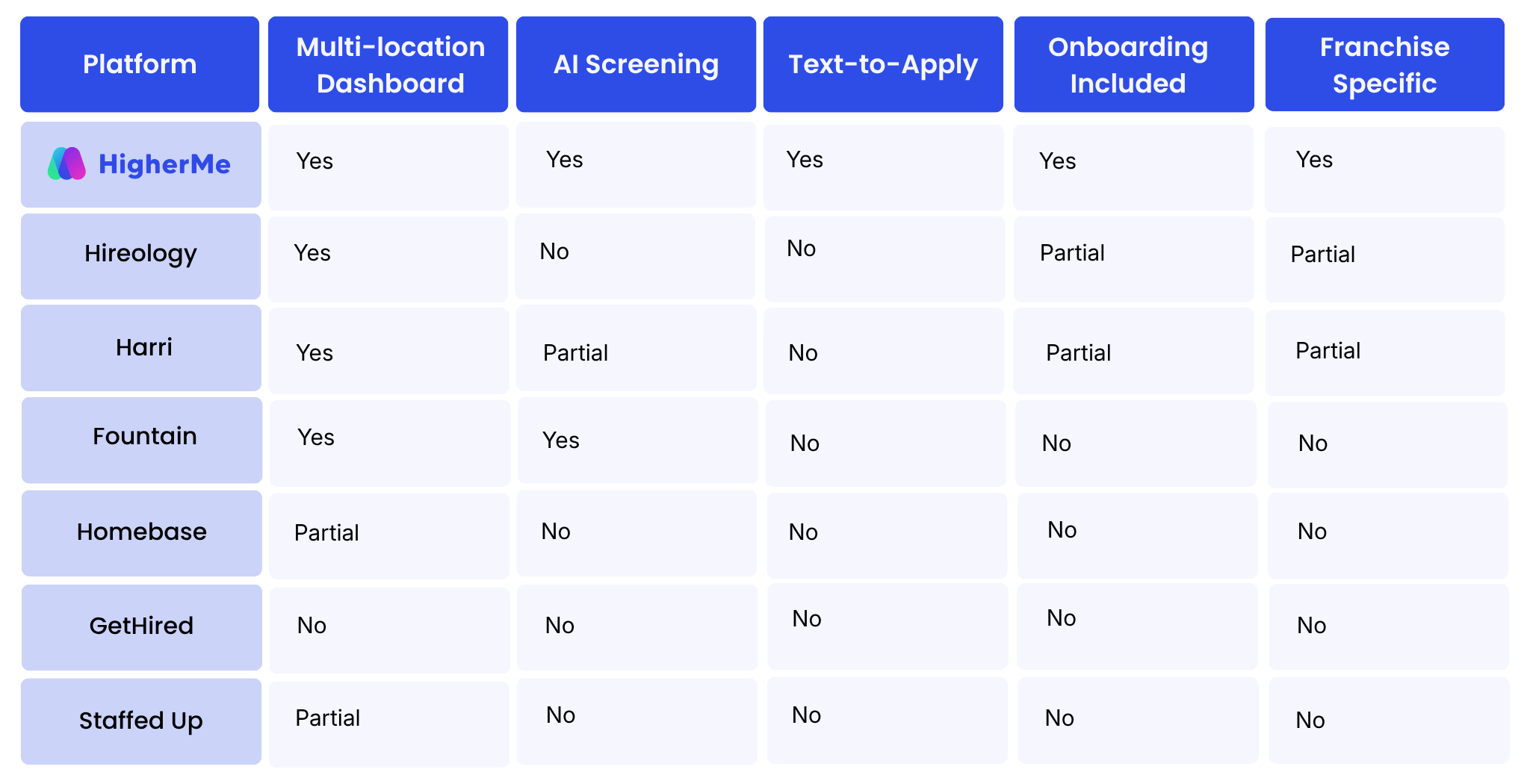
The platforms below handle these three challenges in different ways. Here is how they stack up.
The 7 Best Hiring Software Platforms for Multi-Location Franchise Operations
1. HigherMe: Built for Franchise Hiring at Any Scale
Most hiring tools work fine for one location and get messier as you add more. HigherMe is the exception. It was designed from the start around the franchise model, specifically for operators running multiple hourly-hiring locations who need both central control and local speed.
It supports 20,000+ franchise locations. Brands like Domino's, Dunkin', Tim Hortons, Chick-fil-A, and Wendy's run their hiring on it. A Tim Hortons franchisee reported reaching 25x more applicants per week after switching. A 36-location Domino's group brought time-to-hire down to a 72-hour window. Average time-to-hire across the platform sits at one day.
-
Hiring Hub is where multi-location operators spend most of their time. One dashboard. Every location. Every candidate. Every stage. You can see where each pipeline stands, move candidates, send bulk invites, and kick off onboarding across all your locations without logging in and out of separate accounts.
-
Text-to-Apply captures candidates right at the point of highest intent, standing in front of your location. They text a keyword, complete an application in under four minutes on their phone, and they are in your pipeline. No job board required.
-
NextMatch AI (Amelia) runs pre-screening conversations with every applicant automatically. By the time a manager looks at a candidate profile, that person has already been screened for availability, location fit, and relevant experience. Your managers are not the bottleneck anymore.
-
Candidate Score ranks applicants across all your locations by proximity, shift availability, and prior experience. You are not comparing 40 unranked applications. You are looking at a prioritized list.
-
Paperless Onboarding means when you hire someone across any location, they complete tax paperwork, direct deposit, and employee handbooks before day one, all inside the same platform. No separate portals. No printed forms chased down at the start of a shift.
Why HigherMe Works at Franchise Scale
The architecture matters here. HigherMe gives central visibility to whoever needs it - a franchise owner overseeing multiple units, a regional manager, a franchisor, while still letting individual location managers run their own pipelines at the speed they need. That combination of centralized oversight and local autonomy is exactly what franchise hiring requires, and it is harder to find than you would think.
Setup takes under 24 hours. No IT project. No dedicated implementation team.
2. Hireology: Strong on Compliance, Slower on Speed
Hireology was built around structured, compliant hiring across multi-location franchise systems. Standardized application stages, approval chains, franchisor-level reporting, and compliance documentation give central HR teams real visibility across their network. For franchise systems with a dedicated HR function where brand compliance and consistency are the top priorities, the structure has genuine value.
The tradeoff is pace. Those structured workflows that protect compliance add steps to a process that hourly hiring cannot always afford. Candidates applying for a crew position are not waiting two days for an approval chain to complete. If speed is the primary pressure on your operation, Hireology's design will create friction. Best for franchise systems with centralized HR teams where compliance uniformity matters more than time-to-hire.
3. Harri: Best for Full-Service Multi-Location Hospitality
Harri is a hospitality-focused workforce management platform that combines recruiting with scheduling, labor optimization, and employee engagement. For full-service restaurant groups and hotel operators managing complex multi-location workforces, the depth across all those functions is genuinely useful. For QSR franchise operators, the scope of the platform tends to exceed daily needs. The hiring flow is not optimized for the fast, mobile-first pace that QSR candidates expect, and the broader platform adds complexity that most franchise location managers do not need. Best for full-service restaurant groups and hospitality operators who need workforce management alongside recruiting.
4. Fountain: Handles Volume, Requires Resources to Set Up
Fountain is built to move large numbers of candidates through a hiring funnel quickly. For enterprise franchise brands processing thousands of applications monthly across many locations simultaneously, the stage-based automation holds up. What operators consistently run into is the setup requirement. Getting Fountain configured for franchise-specific workflows is a meaningful project, not a quick launch. Post-hire onboarding is also thin, so you will need additional tools once an offer is accepted. Best for large enterprise franchise groups with dedicated HR teams and ongoing high-volume hiring.
5. Homebase: Good Starting Point, Limited Franchise Depth
Homebase is primarily a scheduling platform that added a hiring module. For a single-location independent operator, the free tier makes it very accessible, and the ease of use is real. A lot of small operators land here first precisely because it does not require much to get started.
The ceiling shows up quickly for franchise operators. Hiring is not the core product, and that shows in the feature depth. No meaningful AI screening. Text-to-Apply is not native. Onboarding is basic. Multi-location management requires workarounds. For a franchise group dealing with constant turnover across several units, Homebase hits its limits fast. Best for single-location independent operators with limited hiring volume.
6. GetHired: Simple Tool, Limited at Scale
GetHired focuses on job posting and basic applicant tracking. It is straightforward and affordable for operators with modest hiring volume. At the multi-location franchise level, the gaps become real: no multi-location architecture, no AI screening, limited automation. It handles the basics for simple use cases, but it was not built to scale with a growing franchise group.
7. JazzHR: Structured Workflow Tool With a Corporate Orientation
JazzHR is an ATS built for small to mid-size businesses that want structured, organized hiring workflows. Resume parsing, collaborative hiring tools, customizable pipelines. For a franchise operator whose challenge is primarily corporate-style role management, it works reasonably well.
Where it falls short for most franchise operators is the hourly hiring fit. There is no native text-based candidate communication. The application flow is not built for mobile-first hourly applicants. And the platform assumes a hiring process that moves at a corporate pace, not a QSR one. Best for small to mid-size businesses hiring across mixed corporate and hourly roles.
Quick Comparison Table
One Thing to Keep in Mind
Franchise hiring is not just a volume problem. It is a coordination problem. The operators who solve it are the ones who stop treating each location like a separate hiring silo and start running the whole operation from one connected system.
A tool that was designed for corporate hiring will slow you down. A scheduling tool that added a hiring tab will hit its limits. What multi-location franchise operators need is a platform built for exactly this operating model.
Visit higherme.com and see what franchise-first hiring looks like in practice.
Frequently Asked Questions
Q1: What is the best hiring software for multi-location franchise operations in 2026?
HigherMe is the strongest purpose-built option for franchise operators. It was designed specifically for multi-unit hourly hiring, with a centralized dashboard, AI pre-screening, Text-to-Apply, and built-in onboarding. For franchise groups with a large compliance-focused HR function, Hireology is also worth evaluating, though the structured workflow approach trades speed for consistency.
Q2: How should hiring software handle multiple franchise locations differently from a single location?
The core difference is visibility and coordination. A single-location operator just needs a pipeline. A multi-location operator needs to see every pipeline at once, run consistent processes across all of them, and still let each location manager move fast independently. Not every platform is built for that dual requirement. Look for true multi-location dashboards, not just the ability to create separate accounts.
Q3: How do franchise operators maintain hiring consistency without slowing down individual locations?
Standardize the process at the platform level- application questions, screening criteria, interview stages, and then let the automation handle execution locally. When your AI pre-screens every applicant the same way across every location, and your interview scheduling runs automatically, consistency does not depend on individual managers following a manual. It is built into the workflow.
Q4: Is it worth switching from a scheduling tool like Homebase to a dedicated hiring platform?
For single-location operators with low hiring volume, probably not. For franchise operators managing constant turnover across multiple locations, almost always. Scheduling tools that added hiring features are not built for the depth of pipeline management, AI screening, and onboarding that a franchise operation running 50-plus hires per month actually needs.
Q5: What integration should franchise hiring software have?
At minimum: payroll, background checks, and scheduling. For franchise operators, the key is that employee data flows from the hiring platform into your HR and payroll system without manual re-entry. HigherMe integrates with Netchex, ADP, Paychex, Checkr, 7Shifts, and others. That kind of connected stack is what removes the admin burden from location managers.
Book a Demo
We'll contact you as soon as possible to better understand how we can help you!