Nearly half of branded hotels worldwide are run by third-party management companies, according to JLL research reported by Hotel Dive. In practice, one hiring team might be filling housekeeping and front desk roles for a Hilton, a Marriott and an IHG property in the same week. More than half of U.S. hotels are also still understaffed, per AHLA's March 2026 survey. Most hiring software for hotel management companies was built with one brand in mind. Below are six tools worth evaluating, and where each one fits best.
Why Multi-Brand Hiring Is Harder Than It Looks
-
Every brand has its own standards. Job titles, uniform policies, training requirements and even interview questions differ by flag. Your hiring system has to support those differences without turning into five separate systems.
-
GMs recruit on top of running the building. Most properties don't have a dedicated recruiter. Screening and scheduling land on the GM, so they happen when the GM has a spare minute, and good applicants don't wait that long.
-
Your portfolio keeps changing. Management contracts come and go, and new properties open. When you take over a hotel, it needs to be hiring within days. A system that takes months to set up per property can't keep up.
What to Look for in Hiring Software for Hotel Management Companies
Before you look at specific vendors, decide what you're evaluating them on. For multi-brand operators, these criteria matter most:
- One system, flexible by property: shared screening standards and reporting, with job posts and onboarding paperwork that can vary by brand, role and state.
- Mobile-first applications: hourly candidates apply from their phones, and many won't finish anything that feels like a desktop form.
- Automated screening and scheduling: this takes the most hours off your GMs.
- Onboarding and payroll connections: data entered once and passed along, with state-specific forms handled for you.
- Portfolio reporting: time to hire, interview show rates and source cost, compared across properties.
- Fast setup per property: new contracts shouldn't wait on implementation.
The 6 Best Tools for Multi-Brand Hotel Hiring
1. HigherMe
HigherMe is an hourly hiring platform used across 20,000+ locations in hospitality, QSR, retail, healthcare and service. It was designed for operators who hire for many locations from one central team, which makes it a natural fit for hotel management companies.
-
Candidates can apply by text, scanning a QR code or using a short mobile application that HigherMe says takes as little as four minutes. HigherMe reports that Text-to-Apply candidates are 8x more likely to be hired than applicants from other channels.
-
From there, NextMatch AI asks every candidate the same structured interview questions, so your managers review summaries instead of making screening calls. Qualified candidates book interviews into slots your GMs have set and get automatic reminders.
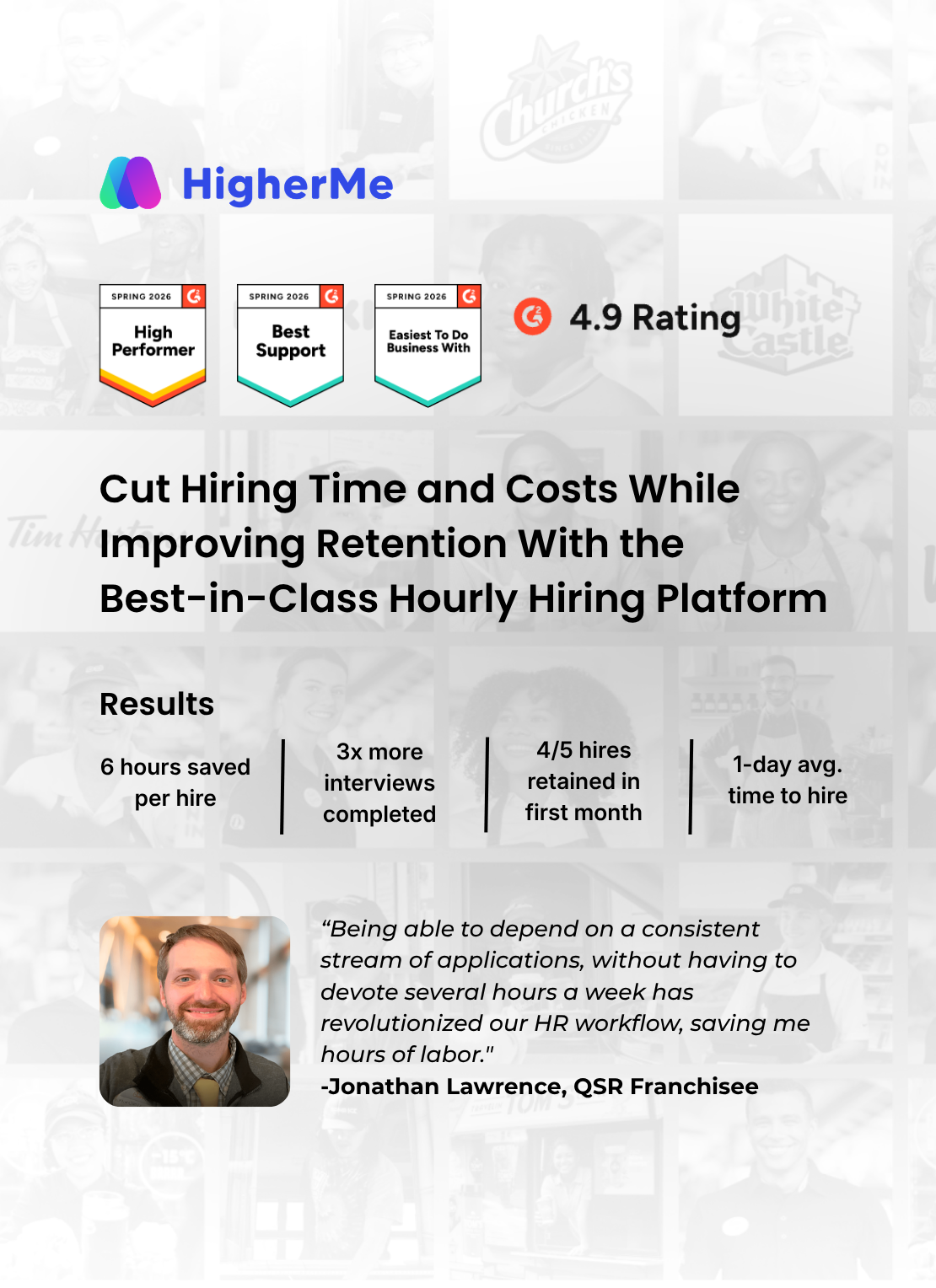
HigherMe reports 6 hours saved per hire and 67% fewer interview no-shows.
-
After the offer, paperless onboarding sends each new hire the right documents for their role and location. That covers tax forms, I-9 with E-Verify, and direct deposit, and gets new hires ready for payroll in under 30 minutes. One dashboard shows hiring and onboarding progress across every property. Payroll is available as an optional add-on, and HigherMe also integrates with ADP, Paychex and Checkr.
Best for: Management companies that want one hourly hiring system across every property and brand, without an enterprise-length implementation.
2. Workday Paradox
Paradox uses a conversational AI assistant to screen candidates and schedule interviews by chat and text. Workday acquired Paradox in October 2025, so it now sits alongside Workday's recruiting and HCM products.
Trade-off: It's built for enterprise buyers. You get the most from it if you already use Workday, and smaller management companies may find the cost and implementation heavier than they need.
Good for: Large operators already running Workday.
3. Fountain
Fountain automates high-volume hourly hiring across industries. It offers mobile applications, configurable hiring workflows and automated interview scheduling.
Trade-off: Fountain isn't specific to hospitality, so hotel workflows and brand differences need to be set up during configuration. Pricing is custom.
Good for: Operators with big seasonal hiring surges who have the internal capacity to configure their own workflows.
4. Hireology
Hireology serves multi-location businesses, including hotel management companies. It brings job postings, applicant review and hiring approvals into one system, so corporate HR can see hiring activity across each property and keep the process the same from one location to the next. .
Trade-off: Hireology covers hiring. Scheduling and HR typically stay in other systems.
Good for: Mid-size management companies that want consistent hiring practices and visibility across properties.
5. Harri
Harri is a hospitality workforce suite. It combines hiring, scheduling, time and attendance, and a chat-to-apply assistant, and it integrates with payroll providers such as ADP and Paychex.
Trade-off: A broad suite means a heavier rollout and custom pricing. Its native payroll module is UK-only, so U.S. operators rely on integrations [VERIFY].
Good for: Hotel groups that want hiring and scheduling from a single vendor.
6. UKG
UKG is an enterprise HCM platform covering HR, payroll, workforce management and recruiting. Large hospitality operators use it to run scheduling, time tracking and payroll for thousands of hourly workers across many properties from one system.
Trade-off: UKG's biggest strength is HR and workforce management rather than high-volume hourly recruiting. Many operators pair it with a dedicated hiring tool. Implementation is long.
Good for: Large management companies standardizing HR and payroll across their whole portfolio.
Quick Comparison
|
Tool
|
Core strength
|
Payroll
|
Best fit
|
|
HigherMe
|
Hourly hiring + onboarding
|
Optional native
|
Multi-property, multi-brand operators
|
|
Workday Paradox
|
Conversational AI screening
|
Via Workday
|
Enterprise Workday users
|
|
Fountain
|
Configurable high-volume workflows
|
Integrations
|
Seasonal surge hiring
|
|
Hireology
|
Multi-location hiring visibility
|
Integrations
|
Mid-size management companies
|
|
Harri
|
Hiring + scheduling suite
|
Integrations (U.S.)
|
Single-vendor workforce suite
|
|
UKG
|
Enterprise HCM
|
Native
|
Portfolio-wide HR standardization
|
Picking the Right Fit
No single tool wins on every criterion. The right choice depends on your portfolio size, your existing HR systems and how much setup work your team can take on. Our view: the best hiring software is the one every GM in your portfolio will actually use, not the one with the longest feature list. To see how HigherMe handles hiring across multiple properties, visit HigherMe.
Frequently Asked Questions
1. What is the best hiring software for hotel management companies?
The best hiring software for hotel management companies supports hourly, high-volume hiring across many properties. That means mobile apply, automated screening and scheduling, connected onboarding, and reporting across the whole portfolio. HigherMe was built for exactly this kind of multi-location hourly hiring, with Text-to-Apply, AI screening and paperless onboarding in one platform.
2. How do hotel management companies manage hiring across multiple properties?
Most set screening standards, job templates and reporting centrally, and let property GMs run interviews and make the final hiring call. That only works when every property uses the same system. HigherMe gives corporate HR one dashboard across all locations while GMs handle their own interviews.
3. What is the difference between an ATS and HCM software for hotels?
An ATS manages hiring, from job posting through the offer. HCM software manages the employee after they're hired: HR records, payroll and scheduling. Large operators often run both, with an hourly-focused ATS feeding the HCM system. HigherMe integrates with payroll providers like ADP and Paychex, and also offers its own optional payroll.
4. How much does hotel hiring software cost?
Most vendors in this category quote custom pricing based on the number of locations and modules. The real cost to compare is your cost per hire and the GM hours spent on hiring. HigherMe reports saving 6 hours per hire, which adds up quickly across a large portfolio.
5. Why are hotels still short-staffed even after raising wages?
Pay is only part of it. Slow responses and long applications cost hotels candidates too. AHLA's March 2026 survey found that more than half of hotels are still understaffed, even though 70% offer higher wages. Faster mobile applications and automated scheduling, like HigherMe's Text-to-Apply and AI screening, help hotels hire the candidates they're already attracting.


-2.png)