

-Aug-11-2026-05-22-14-2958-PM.png)

You own hotels. That's not the same as operating them, and that distinction matters when you're evaluating hiring platforms. Your job isn't to manage day-to-day staffing. Your job is to understand whether your managers (whether franchisees, third-party operators, or your own team) are hiring right, controlling labor costs, and maintaining brand standards.
You care about four things: ROI, standardization, operator accountability, and data. Are labor costs running where you budgeted them? Is turnover eating into your margins? Are franchisees hiring for brand consistency or just filling positions? When you acquire a new property, can you integrate it into your hiring and onboarding systems without expensive customization?
Hospitality turnover averages 70% annually, and at replacement costs of $1,500-$2,500 per person, that's serious money. Across a portfolio of 10-20 properties, you're looking at $200,000-$500,000 in annual turnover costs. Most ownership groups accept that as inevitable. Better hiring systems can cut that number significantly. The question is: which platform actually helps you manage it?
We evaluated six platforms against what ownership groups actually need: visibility, scalability, cost control, and the ability to mandate standards across operators while staying out of daily operations.
The Real Problem: You Can't Manage What You Can't See
Here's the ownership group dilemma. You own properties. You may franchise them, third-party manage them, or operate them directly. But you don't necessarily have visibility into hiring practices at each location. One property manager is great - attracts strong candidates, trains people well, maintains low turnover. Another is a mess, constantly understaffed, weak hiring process, high turnover. You find out when turnover numbers hit your P&L, not when the problem starts.
Your current situation: each operator uses whatever hiring system they prefer. Or more likely, spreadsheets and email. You can't compare hiring performance across your portfolio. You can't see which properties attract candidates easily and which struggle. You can't measure franchisees or operators against hiring KPIs because you don't have consistent data to measure against.
The franchise agreement or management contract says they'll maintain brand standards and control costs. But without visibility into their hiring process, how do you enforce that? You're paying franchise fees or management fees based on assumptions about how they'll operate. You're not validating those assumptions with data.
Labor cost control compounds this. When a property reports 80% turnover, you want to know why. Is it low wages? Poor hiring? Bad training? Toxic management? You can't diagnose problems you can't see.
Integration is another pain point. When you acquire a new property with its own hiring system, integrating it into your portfolio takes time and money. You need systems that scale without expensive customization.
The 6 Best ATS Platforms for Hotel Ownership Groups
1. HigherMe - Built for Portfolio Oversight and Accountability
HigherMe was designed for ownership groups that need visibility across multiple properties and operators while letting each location maintain some autonomy. It's the only platform in this category that prioritizes the owner's perspective, not just the property manager's.
Text-to-Apply works across all your properties consistently. You set screening questions that align with your brand standards. Whether a property is franchised, third-party managed, or self-operated, candidates apply the same way. This consistency matters for standardization. You're not relying on each operator to implement their own application process. It's built in.
Portfolio dashboard is where ownership groups actually get value. You see hiring performance across all your properties at once. Which locations are attracting candidates easily? Which are perpetually understaffed? Which ones are training people well and keeping them? Which ones are burning through staff? You see turnover costs by property. You see hiring cycles by location. You see patterns that inform decisions.
NextMatch AI screens using consistent criteria. This is critical for ownership groups because it removes the question of whether one property manager is hiring better than another, or whether they're just hiring differently. AI video interviews ensure every candidate across your portfolio is assessed the same way. You get comparable data. You can actually compare operator performance.
Multi-property support means one system handles five properties, fifteen properties, or fifty properties without breaking. Integration is clean. You're not managing fragmented tools across locations. You're managing one system that scales.
Reporting ties hiring performance to business metrics. You see turnover costs. You see hiring speed. You see training consistency. You can tie that data to occupancy rates, guest satisfaction scores, and revenue per available room. You're not just reporting on hiring. You're reporting on the relationship between hiring quality and business outcomes.
G2 rated HigherMe 4.9/5. Best Support, Easiest to Do Business With, High Performer Spring 2026. For ownership groups, responsive support matters. When a critical property hits a hiring problem, you need help that understands your portfolio complexity.
Best for: Ownership groups operating one or more properties across multiple operators seeking visibility, accountability, and standardization without micromanaging daily operations.
2. TalentReef - Legacy System for Legacy Problems
TalentReef is an older ATS designed when hospitality meant pushing more volume through faster. Basic job posting, screening, and mobile applications.
For ownership groups, the problems are significant. Support is slow and doesn't staff weekends. Thirty-minute phone holds. Support tickets taking days. Customization requires support intervention and waiting. When you're managing multiple properties, slow support becomes a portfolio-level problem. Each location's hiring hiccup ripples across your operations.
The system also feels outdated. For sophisticated ownership groups evaluating platform stability and long-term viability, that's a red flag. You don't want to build your portfolio's hiring infrastructure on aging software.
G2: 3.8/5 from 41 reviews. Complaints are consistent: slow support, outdated interface, poor customization.
Good for: Single properties or very basic operations. Not for multi-property portfolios.
3. HotSchedules - Scheduling Tool With Hiring Delusions
HotSchedules is solid at shift scheduling, labor forecasting, and time tracking. It manages the staff you already have effectively.
But it's not an ATS. You implement HotSchedules, you still need a separate system to recruit, screen, and interview. That's two platforms for one problem. For ownership groups trying to standardize across properties, that fragmentation defeats the purpose. You're not simplifying your operators' lives. You're adding complexity. Plus, you're not getting the visibility you actually need into hiring performance.
Good for: Scheduling optimization only. Not a hiring solution.
4. Toast - Restaurant Software Pretending to Be Hotel Software
Toast is restaurant point-of-sale software with bolted-on labor management. For restaurants, the integration makes sense. For hotel ownership groups? It's completely misaligned.
Toast's hiring module feels grafted on. Basic job posting and candidate collection with no real ATS features. No Text-to-Apply, no AI screening, no portfolio visibility. You're buying restaurant software and accepting weak hiring capabilities as the cost. Hotel ownership groups need ATS-first platforms.
Good for: Restaurants. Not hotels. Definitely not ownership groups managing multiple properties.
5. Tapcheck - Wage Access Benefit, Not Hiring Infrastructure
Tapcheck gives workers access to earned wages before payday. It's a retention benefit. Workers appreciate flexibility. Retention can improve.
But it's not an ATS. It's not a hiring platform. It's a supplemental benefit. For ownership groups consolidating hiring infrastructure across properties, Tapcheck is not a core solution. It's nice-to-have at best.
Good for: Wage access benefit layered on top of a real ATS. Not a hiring solution.
6. Wonolo - Gig Labor Platform Without Permanence Strategy
Wonolo is a shift-claiming marketplace where workers get paid quickly for on-demand labor. Workers like flexibility. In theory, it fills staffing gaps.
For ownership groups managing permanent staffing across a portfolio, this is backwards. You're hiring transient workers without commitment to your brand, properties, or service standards. For ownership groups trying to maintain brand consistency across properties, gig labor undermines that positioning. Plus, you're paying per-shift commissions. The math doesn't work for core operations.
G2: 3.8/5 from 20 reviews.
Good for: Emergency coverage. Not permanent staffing or portfolio strategy.
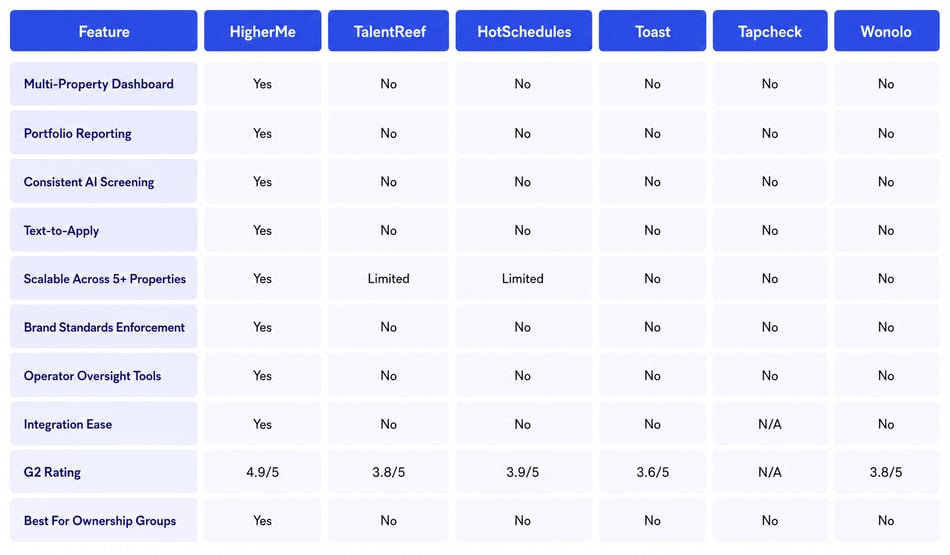
Quick Comparison: Platform Features
Why HigherMe Actually Solves the Ownership Group Problem
The other platforms serve other purposes, but none of them solve what ownership groups actually need. TalentReef is outdated. HotSchedules is scheduling software. Toast is a restaurant tool. Tapcheck is a benefit. Wonolo is gig labor. None of them give you portfolio visibility or accountability tools.
HigherMe was built for ownership groups managing multiple properties and operators. You get visibility into hiring across your portfolio. You can compare operator performance against consistent metrics. You can enforce brand standards without micromanaging day-to-day operations. You can tie hiring performance to business outcomes. You can scale without expensive customization.
Most importantly, you can actually manage what you own. You're not flying blind on labor costs and hiring quality.
The Bottom Line
Hotel ownership is about ROI, standardization, and control. When you can see hiring performance across all your properties, when operators are working from consistent playbooks, when you understand the relationship between hiring quality and occupancy rates, you make better decisions. HigherMe enables that by giving ownership groups the visibility they need to manage hiring at portfolio scale.
FAQs for Hotel Ownership Groups
1. How much visibility do you actually need into operator hiring practices?
Enough to know whether they're controlling costs and maintaining standards. You don't need to approve every hire. You need to see turnover rates, hiring cycles, and training consistency by property. You need to understand whether a property's high turnover is a market problem, an operator problem, or a hiring process problem. Without that visibility, you're making capital decisions with incomplete information.
2. Can you really standardize hiring across franchisees and managed properties without micromanaging?
Yes, with the right platform. You set brand standards, screening criteria, and onboarding requirements. Each property/operator executes within that framework. You monitor performance against metrics. You don't manage hiring. You manage outcomes. There's a big difference.
3. What's the real cost of not being able to compare operator performance on hiring?
Significant. You don't know which operators are hiring well and which are burning through staff. You can't identify best practices to share across your portfolio. You're essentially paying franchise fees or management fees based on assumptions you're not validating with data. When one property underperforms on occupancy, you don't know if it's because of hiring quality or something else.
4. How does integration actually work when you acquire a new property with its own system?
With HigherMe, the new property comes online in days, not weeks. You don't need expensive customization. The property manager starts using the same system as every other location. You get immediate visibility into their hiring performance. You can start standardizing processes immediately. That matters when you're acquiring multiple properties and need to integrate quickly.
5. How much can better hiring actually improve your portfolio's financial performance?
Directly. Turnover costs run $1,500-$2,500 per person. Across a 15-property portfolio with 25-30 staff per property and 70% turnover, you're looking at $400,000-$800,000 in annual replacement costs. Better hiring upfront reduces turnover. For your portfolio, that's tens of thousands in annual savings. Plus, trained, stable staff improve occupancy and guest satisfaction, which drive revenue.
Sources
- Hospitality Turnover in 2026: Industry Benchmarks and What They Mean for Your Labor Budget
- Employee Turnover Cost Statistics 2026: Replacement Costs, Retention Data & Industry Benchmarks
- The Real Cost of Hotel Employee Turnover in 2026 (And How to Reduce It)
- HigherMe Reviews 2026 on G2
- US Hospitality Industry: Key Trends and Statistics for 2026
Book a Demo
We'll contact you as soon as possible to better understand how we can help you!