

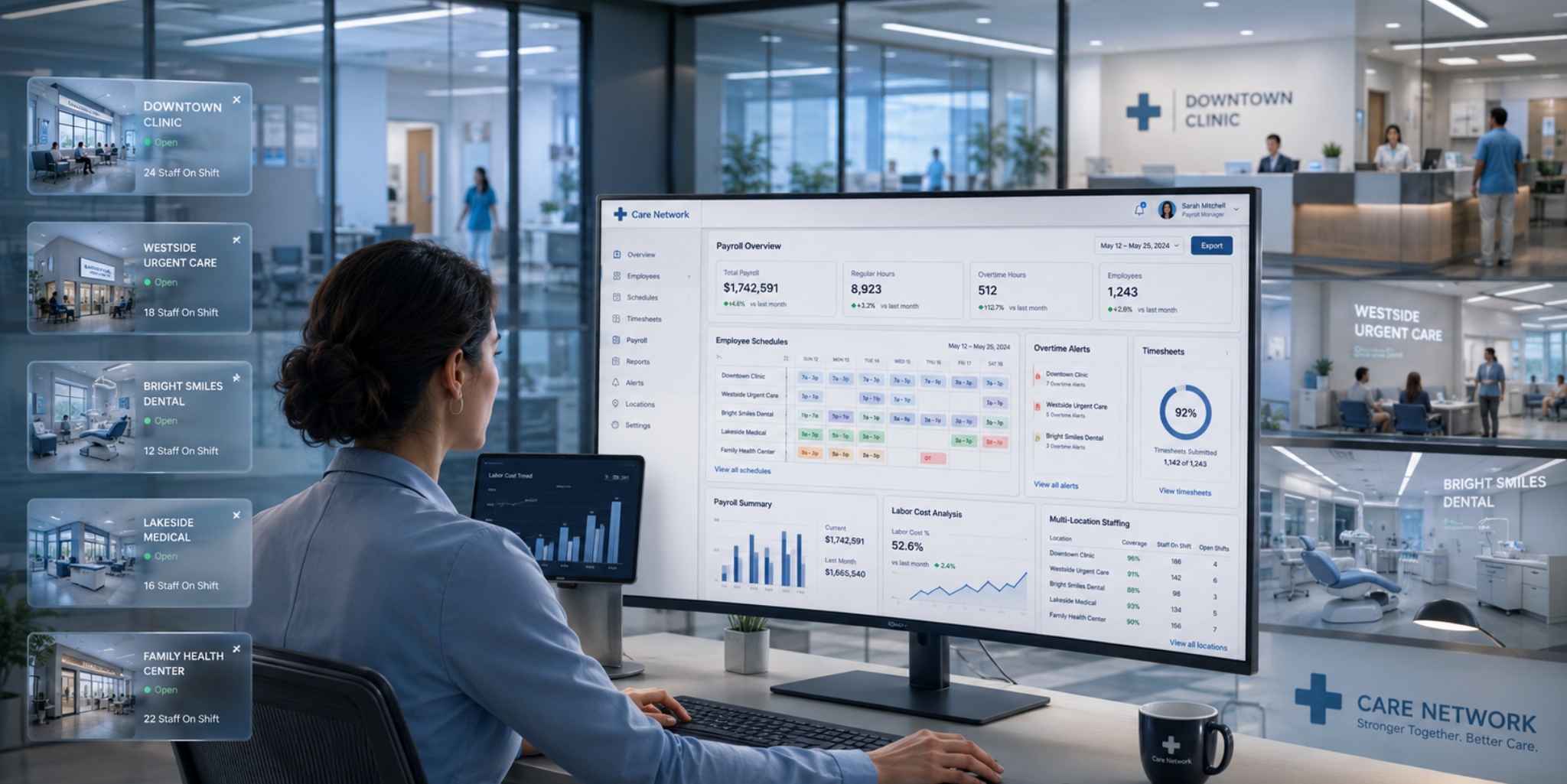

Healthcare payroll isn't like everyone else's.
The IRS charges $1,100 per employee, per incident for incorrect payroll tax filings. That's before your state comes knocking. And that's just fine. The real cost is the hours your team spends fixing it, explaining it, and making sure it doesn't happen again.
Here's the thing: most payroll errors in healthcare aren't careless mistakes. They're what happens when you run a genuinely complicated workforce through software that wasn't built for it. You've got nurses working nights, CNAs on rotating shifts, part-time front desk staff, and occasionally a travel worker at a different rate. Sometimes at multiple locations.
This is a breakdown of five payroll platforms that healthcare organizations actually use, what each one is good at, and where each one will let you down.
Why Most Payroll Software Struggles in Healthcare

General-purpose payroll software was built for a simpler workforce. A salary, a pay period, a direct deposit. Done.
Healthcare doesn't work like that. You have staff holding multiple roles at different pay rates. Shift differentials that kick in after 8pm or on weekends. On-call premiums that only apply when someone actually gets called in. Certification requirements that affect whether someone should be working, and getting paid, at all.
When your software can't handle those things natively, your payroll team handles them manually. Spreadsheets, workarounds, someone's tribal knowledge about how the system was configured three years ago. It works until someone leaves or something breaks.
There's also the turnover problem. Hospital staff turned over at 18.3% in 2024. In home care, that number was 79.2%. That's a constant stream of new hires entering your payroll system and departing staff needing to exit cleanly. If your platform wasn't built for that volume, you feel it every single pay period.
The 5 Best Payroll Platforms for Healthcare
1. Netchex: Best Overall for Healthcare Organizations
Netchex is a full HCM platform with payroll, HR, benefits, time tracking, scheduling, compliance, all in one system. It's not a payroll tool that added HR features later. The whole thing was designed to work together, which matters when you're trying to get an employee from offer letter to first paycheck without re-entering their information four times.
For healthcare specifically, the shift differential handling is native. Nights, weekends, holidays, on-call activation, those pay rules live in the system and apply automatically when the hours qualify. Scheduling feeds directly into payroll, so the math happens without someone manually reconciling two separate platforms the day before payday.
Multi-location payroll is where Netchex gets useful for franchise healthcare operators. You can centralize payroll across all your sites while keeping location-level configuration for state wage differences and labor rules. If you're running urgent care clinics in Texas and Florida, they're not on the same labor law, and Netchex handles that without requiring a separate workflow for each state.
There's also an Earned Wage Access feature, which lets employees pull their earned pay before the scheduled payday. That sounds like a small thing until you look at the retention math. Replacing a single RN costs around $61,000. (Source: https://www.aag.health/post/hr-in-healthcare-statistics-trends) Anything that reduces financial stress for frontline staff and gives them a reason to stay is worth paying attention to.
Netchex is ranked #1 for customer service on G2, based on 100+ verified reviews.
Good fit for multi-location healthcare groups, urgent care franchises, home health agencies, and anyone running a mixed hourly/salaried workforce across more than one site.
One honest tradeoff: Netchex is a bigger platform than some organizations need. A solo practice with eight employees probably doesn't need everything it offers.
2. Paycom: Good for organizations that want employees managing their own data
Paycom's standout feature is something they call Beti which is essentially the idea that employees review and approve their own pay before payroll runs, not after. Errors get caught at the source instead of becoming corrections on the next cycle. For a healthcare org with high headcount and a lot of moving pieces, that's a real operational benefit.
The platform handles multi-location payroll within a single database, which simplifies reporting for HR managers overseeing more than one facility. Compliance reporting is solid. Document management is secure and accessible, which counts for something in healthcare where paper records across five locations is a genuine risk.
Works well for mid-to-large healthcare organizations that want employee self-service to do more of the heavy lifting.
Worth knowing: Paycom is on the pricier end, especially for smaller operations. The interface has a learning curve, staff usually need real training before they're comfortable in it. And third-party integrations, particularly with clinical scheduling tools, can hit walls depending on your existing tech stack.
3. Paychex Flex: Better if you'd rather outsource the whole thing
If your preference is to hand payroll off entirely rather than run it in-house, Paychex is worth considering. Their PEO option is one of the more mature offerings in the market; you get actual administrative support alongside the software, not just a help center and a ticketing system.
For smaller healthcare practices or single-location clinics where the HR team is one person wearing several hats, having a managed service behind you can genuinely reduce the burden. Multi-state payroll is covered, tax filing is handled, and the standard payroll operations work.
The honest limitations: the interface is dated. Clinical credential tracking is basically not there. If you're running a shift-heavy workforce, you'll probably run into scenarios where Paychex can't do what you need without a workaround. And support quality is inconsistent, it really depends on what tier you're on.
4. Rippling: Interesting if IT and HR need to work together
Rippling connects HR, payroll, and IT in the same platform, so onboarding a new employee can simultaneously set up their payroll, provision their laptop, and give them access to the tools they need. For organizations where those functions are tightly connected, that's genuinely useful.
The multi-state payroll engine is strong. Onboarding automation is fast, which matters when you're replacing staff as often as most healthcare organizations are. Workflow automation is flexible enough that some healthcare orgs use it for credential verification steps that connect back to payroll access.
Best for healthcare organizations that have a real IT function and want a unified system, or tech-forward groups building out their infrastructure.
The gap: Rippling wasn't built around clinical operations. Shift differential handling is not where it needs to be for a complex healthcare workforce. Healthcare-specific compliance features lag behind Netchex and Paycom. Modules add up in cost fast, and implementation is not simple.
5. Gusto: Fine for a small, simple operation
Gusto is clean, easy to use, and affordable. For a small independent clinic with a handful of salaried staff and no location complexity, it does the job and doesn't require much setup.
That's where the praise ends for healthcare use cases. There's no shift differential engine. No credential tracking. Time tracking is an add-on. Multi-location support is minimal. The moment your staff composition gets complicated - per-diem workers, rotating shifts, multiple pay rates, Gusto requires manual work that grows with your headcount.
If you're early stage and small, it's fine. If you're running anything at scale, you'll outgrow it and migration is annoying.
So which one is it?
Depends on your situation, but the differences between these platforms are real.
Gusto works for small and simple. Paychex makes sense if you want managed services over self-serve software. Rippling is worth a look if IT and workforce management need to live together. Paycom is strong if you want employees more involved in their own payroll data.
Netchex is the only platform on this list where healthcare payroll complexity is a core use case, not an added configuration. Shift differentials, multi-location management, earned wage access, compliance reporting - those aren't features someone requested and got bolted on. They're built in.
For an HR or payroll manager dealing with this stuff every day, that distinction is the difference between a system that runs and a system that runs and creates problems.
Bottom line
Healthcare payroll is hard because healthcare workforces are genuinely complicated. The fix isn't trying harder with the wrong tool, it's using a platform that was actually designed for what you're dealing with.
If you're running more than one location, managing shift-based staff, or operating in a state with tight wage and hour laws, pick a platform built for that reality.
For more hiring and payroll info, visit higherme.com.
Frequently Asked Questions
1. What payroll software works best for multi-location healthcare organizations?
Netchex is the strongest option here. You can run centralized payroll across all your locations while keeping site-level configuration for different state laws and labor rules. Paycom can do it too, though it's a bigger investment.
2. Does healthcare payroll software handle shift differentials automatically?
The good ones do. Netchex calculates night differentials, weekend premiums, holiday rates, and on-call pay natively, no manual adjustments. Platforms like Gusto and Paychex Flex don't have that built in, which means someone on your team is doing that math by hand.
3. What compliance features should I be looking for in healthcare payroll software?
Start with automated tax filing across states, ACA reporting, and wage and hour compliance. If you're in a clinical setting, add credential tracking connected to payroll status and audit-ready reporting to that list.
4. Is healthcare payroll genuinely that different from regular payroll?
Yes. The workforce mix alone - salaried, hourly, per-diem, contract, travel staff - is more complicated than most industries. Layer in shift differentials, credentialing requirements, and turnover volumes that keep your active roster constantly changing, and general-purpose payroll software starts showing real gaps.
5. How does high turnover actually affect the payroll team?
Hospital turnover at 18.3% and home care turnover close to 80% means your payroll roster is always changing. New hires need to get set up correctly and fast. Departing employees need to exit cleanly. If your payroll system doesn't connect to hiring and onboarding, your team is manually bridging that gap on every single transition.
Book a Demo
We'll contact you as soon as possible to better understand how we can help you!