



Operating a portfolio of distinct hotel brands is fundamentally different from managing franchised properties or running a single brand. You're not executing one standard across locations. You're managing five different brands with five different market positions, five different service philosophies, and five different competitive landscapes simultaneously. Your luxury boutique brand hires differently than your value brand. Your extended-stay properties need different staff profiles than your convention hotels. Yet they're all under one portfolio that needs unified labor cost management and efficiency.
The hospitality industry averages 70% annual turnover, but turnover costs vary dramatically across your brands. Losing a luxury front desk associate costs more than replacing a budget property housekeeper. Your hiring system needs to handle that complexity—managing distinct brands with brand-specific standards while optimizing labor economics across the entire portfolio. We evaluated five platforms against what multi-brand hotel operators actually need.
The Challenge: Brand Differentiation Without Fragmentation
Multi-brand hotel operators face a paradox. Each brand has distinct positioning and service standards. You can't use one hiring and training approach for a luxury brand and a value brand. They attract different candidates, pay different wages, and require different service training. Yet you need unified hiring infrastructure that consolidates costs, improves efficiency, and gives you portfolio-wide visibility.
Your typical problem: each brand is managed separately. One uses Indeed, another uses Facebook, another relies on word-of-mouth. Brand A's hiring manager is excellent and attracts strong candidates. Brand B's process is so slow that candidates move to competitors. You're not comparing performance across brands. You're not optimizing what works. You're running five separate hiring operations that happen to report to the same company.
The hidden cost is missed economies of scale. You could consolidate recruiting costs, standardize onboarding training, and create portfolio-wide hiring efficiency. Instead, you're duplicating effort across brands because your tools don't let you do both—maintain brand differentiation and achieve operational efficiency.
Training consistency is another pain point. Each brand has service standards you want upheld, but without centralized onboarding, every property interprets them differently. Some properties deliver brand-consistent training. Others skip steps because they're understaffed. Your brand experience becomes inconsistent, which shows up immediately in guest satisfaction and online reviews.
The 5 Best Hiring Platforms for Multi-Brand Hotel Operators
1. HigherMe - Built for Multi-Brand Portfolio Operations
HigherMe was designed for operators managing multiple distinct hotel brands. It consolidates recruiting, screening, interviews, and onboarding while letting each brand maintain its own standards and service philosophy.
Text-to-Apply is your efficiency tool across brands. Each brand can customize screening questions to match its positioning, but the application experience stays consistent, candidates text a keyword and complete screening in under 4 minutes. Text-to-Apply candidates are 8x more likely to convert to hires compared to traditional job boards. Across five brands, that efficiency multiplies.
NextMatch AI screens candidates using brand-specific criteria. A luxury brand asks different questions than a value brand, but AI ensures consistent evaluation within each brand. You get ranked candidates with transcripts. Your brands make data-driven hiring decisions instead of relying on manager intuition.
Portfolio dashboard shows you hiring performance across all brands at once. You see which brands are attracting candidates, which are struggling, where training is lagging, what your turnover costs are running by brand. You identify patterns, maybe your luxury brand has lower turnover but slower hiring. Your value brand fills positions faster but loses people within 90 days. That visibility lets you optimize.
Paperless onboarding trains new hires on brand-specific standards before day one. Luxury brand staff arrive understanding premium service. Value brand staff arrive understanding efficiency. Budget-conscious. The training is aligned to brand positioning, not generic.
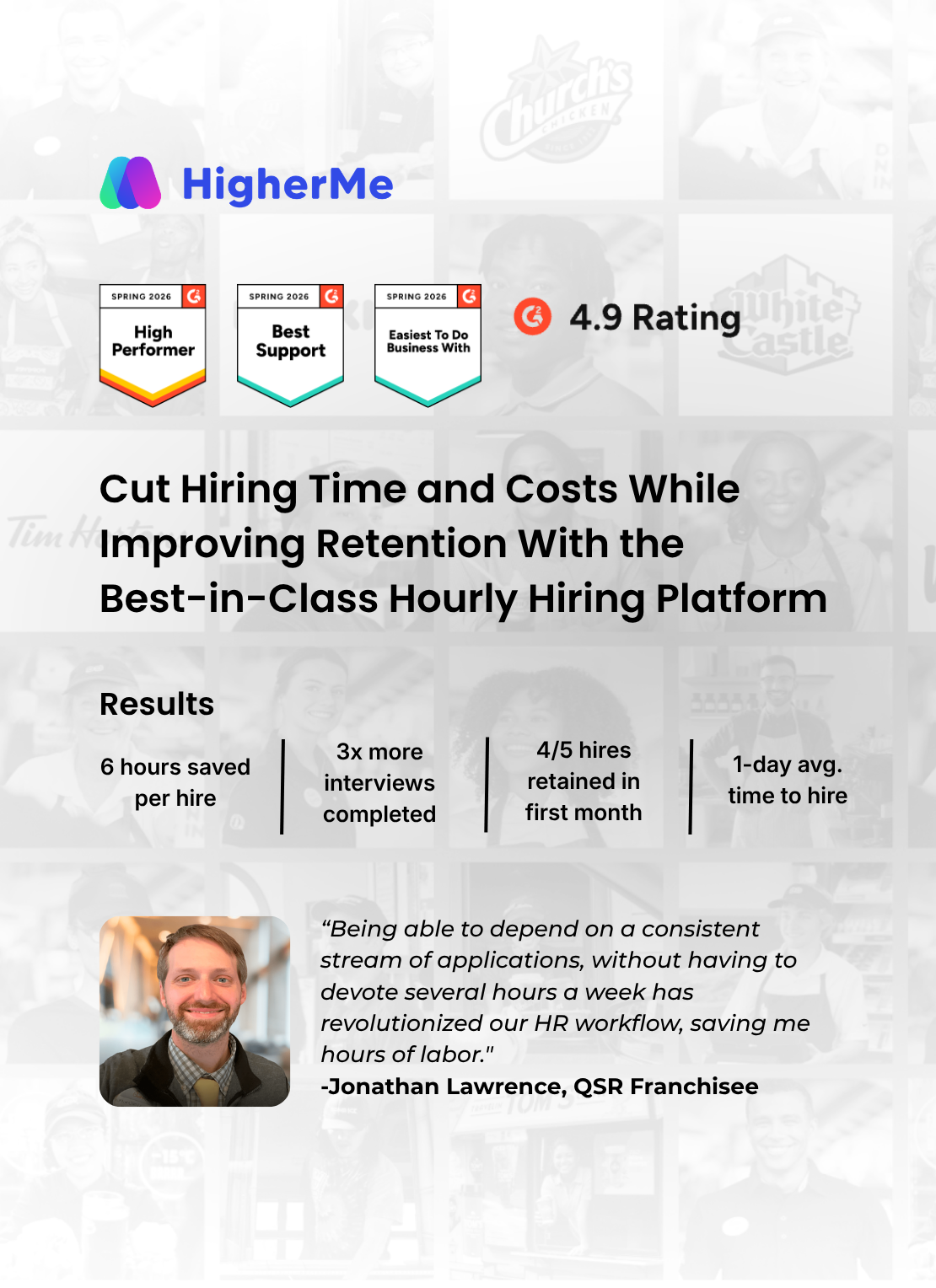
G2 customers rated HigherMe 4.9/5, and the platform won Best Support, Easiest to Do Business With, and High Performer Spring 2026. For multi-brand operations, responsive support matters. When a critical hiring problem hits one brand, you need help fast.
Best for: Multi-brand hotel operators running one or more distinct brands seeking unified hiring infrastructure with brand-specific execution.
2. Harri - Basic Aggregation Without Brand Focus
Harri pulls postings from Indeed, Craigslist, and Facebook into one dashboard, handling basic candidate scoring and interview scheduling. It's functional for single brands or simple operations.
For multi-brand operators, the limitations appear quickly. No Text-to-Apply means you're stuck with standard job board conversion rates. No AI screening for brand-specific evaluation. No brand-differentiated onboarding. You're still manually evaluating hundreds of applications across brands. For operators trying to maintain brand differentiation while improving efficiency, Harri doesn't solve either problem.
G2: 4.3/5 from 139 reviews.
Good for: Single-brand operations only.
3. HotSchedules - Scheduling Tool Masquerading as a Platform
HotSchedules excels at shift scheduling, labor forecasting, and time tracking. It's solid for managing the staff you already have.
It doesn't help you get staff. If you implement HotSchedules, you still need a completely separate system to recruit, screen, and interview candidates. That's two platforms managing one problem. For multi-brand operators trying to consolidate infrastructure, this fragmentation is a headache. You're not simplifying. You're adding complexity.
Good for: Scheduling optimization only. Requires a separate ATS.
4. Instawork - Gig Platform for Emergency Coverage
Instawork is a gig marketplace where workers claim available shifts. When someone calls out unexpectedly, you fill the gap within hours.
For permanent hiring across brands, it's ineffective. You're cycling through transient workers with zero commitment to your brands, service standards, or training philosophy. For multi-brand operators where brand consistency matters, gig labor undermines your positioning. You can't build brand-aligned teams on shift workers.
G2: 4.2/5 from 5 reviews.
Good for: Emergency same-day coverage only.
5. Tapcheck - Wage Access Benefit, Not Hiring Tool
Tapcheck is a wage access platform giving workers access to earned wages before payday. Workers appreciate the flexibility. Retention can improve when people have financial options.
But it's not a hiring tool. It doesn't recruit, screen, or interview anyone. It's a supplemental benefit layered on top of a real hiring system, not a hiring system itself. For multi-brand operators consolidating tools, it's nice-to-have at best, not core infrastructure.
Good for: Wage access benefit only. Requires a separate ATS.
Quick Comparison: Platform Features
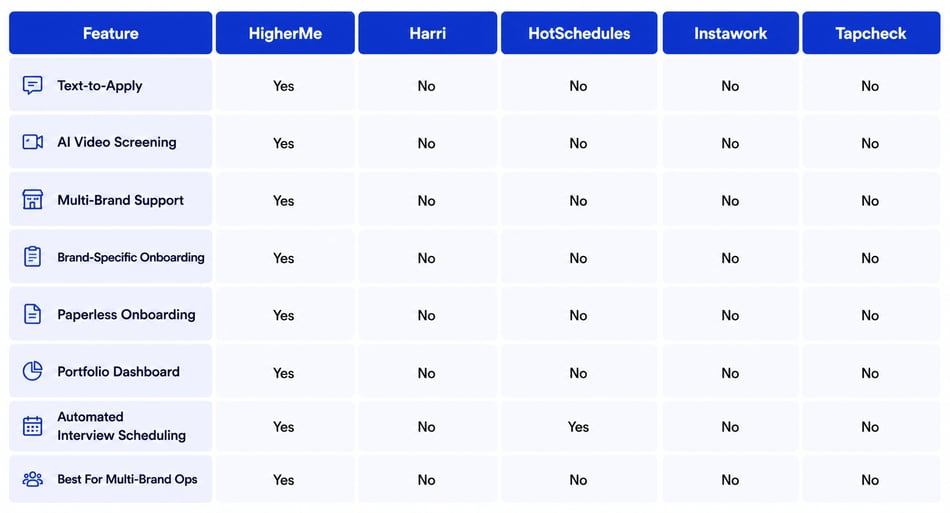
Why HigherMe Wins for Multi-Brand Operations
The others serve limited purposes. Harri is basic without brand focus. HotSchedules is scheduling software. Instawork is a gig platform for emergencies. Tapcheck is a benefit, not a hiring tool. None of them solve multi-brand hiring.
HigherMe was built for your reality. Text-to-Apply works across brands with customizable screening. AI screening evaluates candidates using brand-specific criteria. Portfolio dashboard gives you visibility into what's working across your brands. Paperless onboarding ensures brand-specific training at every property. You're not managing five separate hiring operations. You're managing one system that scales across brands while protecting brand differentiation.
The Bottom Line
Multi-brand success depends on unified hiring infrastructure that respects brand differentiation. When you can see hiring performance across all brands, when training aligns to brand positioning, when labor costs are optimized across the portfolio, you deliver operational excellence. HigherMe enables that by giving you the efficiency of centralized hiring with the sophistication of brand-specific execution. Check out HigherMe and speak with someone who understands multi-brand hotel operations at scale.
FAQs for Multi-Brand Hotel Operators
1. How much does brand-specific hiring consistency impact guest experience?
Significantly. Guests experience your brands through your staff. Staff trained in brand-specific service standards deliver consistent brand experience. Replacement costs run $1,500-$2,500 per person, and losing trained staff who understand brand positioning is more expensive than replacing generic hospitality workers. When staff are aligned to brand standards, guest satisfaction improves, repeat bookings increase, and online reviews reflect brand positioning rather than inconsistent service.
2. Can you really manage five distinct brands in one hiring system?
Yes, if the system lets each brand customize screening and training while consolidating visibility and efficiency. HigherMe's approach is centralized infrastructure with brand-specific execution. Each brand maintains its standards. Your portfolio gets unified reporting, shared recruiting efficiency, and data-driven insights across all brands at once.
3. What's the real value of portfolio-wide hiring visibility?
You immediately see which brands are attracting candidates easily and which are struggling. You can identify process gaps that are specific to certain brands. Maybe your luxury brand is losing candidates to slow responses. Maybe your value brand is filling positions but losing people within 90 days. That visibility lets you optimize each brand while improving portfolio economics.
4. How does brand-specific onboarding impact retention?
Significantly. New hires trained in brand-specific standards arrive confident and aligned to their property's positioning. They understand why their brand exists and what service excellence means in that context. HigherMe customers report 15-20% improvement in new-hire retention in the first 90 days. For multi-brand operators, that improvement compounds across five brands.
5. Can better hiring actually reduce portfolio turnover costs?
Yes. Better hiring upfront (pre-screening for brand fit), faster onboarding (getting people productive immediately and aligned to brand standards), and systematic processes (consistency across locations and brands) all improve retention. The math is significant: at 70% turnover across a five-brand portfolio with 100+ total staff, you're looking at $200,000-$400,000 in annual replacement costs. Better hiring systems reduce all of it.
Sources
- Hospitality Turnover in 2026: Industry Benchmarks and What They Mean for Your Labor Budget
- Employee Turnover Cost Statistics 2026: Replacement Costs, Retention Data & Industry Benchmarks
- The Real Cost of Hotel Employee Turnover in 2026 (And How to Reduce It)
- HigherMe Reviews 2026 on G2
- US Hospitality Industry: Key Trends and Statistics for 2026
Book a Demo
We'll contact you as soon as possible to better understand how we can help you!