



Multi-property hotel operators face hiring complexity that single-property owners never encounter. Whether you're a regional chain, a franchise operator, or an independent owner managing three properties across different markets, operators managing 3-25 properties report that standardization and coordination across locations is their primary hiring challenge, accounting for 45% of hiring time wasted on duplicative processes.
Your challenge is elegant in theory, messy in practice. Same standards across properties. Local flexibility where markets demand it. Compliance consistency. Payroll integration across properties. Staff transfers between properties. Retention tracking that shows you where your best people work. All simultaneously.
Your hiring software can't treat each property independently. It can't be totally centralized either. You need smart control where standardization matters and autonomy where markets require it.
The Problem: Standardization Across Locations Without Crushing Local Flexibility
Multi-property operators live in the tension between standardization and localization. You want every guest to have the same experience at Property A as Property B. That means consistent hiring standards. Consistent training. Consistent quality. But markets vary. Denver's labor market is different from Miami's. What works in one location doesn't work everywhere.
Your hiring can't be centrally controlled to the point that GMs can't adapt to their market. But it can't be so decentralized that every property operates like an independent business. You need a middle ground.
Volume compounds the problem. You're hiring 50-100 people annually across properties. Managing 50 individual hiring processes is chaos. Managing them all centrally removes local control. Your software needs to find the middle.
Compliance is another layer. You're managing across states. Wage and hour laws vary. Background check requirements vary. Your system needs to enforce state-specific compliance at the property level without crushing corporate efficiency.
Staff transfers between properties is opportunity and complexity. Your best front desk manager at Property A gets promoted to GM at Property B. Your top housekeeper wants to transfer for a raise. Your company grows because good people move up. But your software needs to track transfers, pay changes, history.
Retention matters because good staff are expensive to replace. If your best people concentrate at one property, you have a vulnerability. If you lose a key person, that property suffers. Your hiring system needs to track where your best people work. Help you retain them. Support career development.
Payroll integration is simpler in theory than practice. You might have different payroll systems at different properties. Or same system but complicated payroll structures. Your hiring software needs to coordinate across all of it.
The 5 Best ATS Platforms for Multi-Property Hotel Operators
1. HigherMe: Multi-Property Built for Hospitality
HigherMe handles multi-property operations because it was built for hospitality at scale with local flexibility built in.
-
Multi-property dashboard gives you visibility without crushing local control. Corporate sees all hiring across properties. GMs see their property. Customizable permissions ensure appropriate access at every level. You're not choosing between central control or local autonomy. You get both.
-
Standardized job templates with local customization enforce standards while respecting markets. Create "Front Desk Agent" once. Every property uses that template. Every property can add location-specific questions or requirements. Consistency with flexibility.
-
Staff transfer tracking shows career paths. Someone moves from Property A to Property B. Their history follows them. You can quickly identify who's moved where. Succession planning becomes possible.
-
Retention analytics show you where your best people work. You see turnover by property. You see which properties retain people longer. That data helps you identify what's working and what isn't. Best practices get replicated.
-
Interview scheduling and reminders reduce no-shows 67%. No-show reduction scales across properties. Faster hiring at every location. Automation does the work.
-
Paperless onboarding syncs with your payroll system. People hired Monday are payroll-ready Tuesday. Whether they're at Property A or Property B. Tax forms digital. I-9 done. Payroll integration means data flows automatically.
-
Integration with ADP, Paycheck, Netchex works for multi-location operations. Payroll sync across properties. No manual reconciliation.
Best for: Multi-property hotel operators managing 3-25 properties across markets.
Why this works: HigherMe won Best Support on G2. When you're managing hiring across multiple properties and something breaks, having support that understands hospitality matters.
2. Fountain: Analytics and Workflow Visibility
Fountain emphasizes automation and analytics. Multi-property operators appreciate visibility into hiring patterns.
High-volume handling across properties. Workflows customizable by property. Analytics show hiring metrics by location. Mobile solid. Video interviews. But exports limited. No real-time collaboration. UI clunky. Pricing opaque. For operators tracking hiring across properties, analytics help.
Good for: Multi-property operators wanting analytics and workflow visibility across locations.
3. Harri: Hospitality Operations at Scale
Harri bundles recruiting, scheduling, onboarding, compliance. Built for hospitality specifically.
Clean interface. Scheduling integrates well. Support usually responsive. Handles hospitality operations. But inconsistent support quality. Integration problems linger. Reporting clunky. For hospitality-focused operators, Harri helps.
Good for: Multi-property operators wanting hospitality-specific hiring platform.
4. TalentReef: Volume Speed Across Locations
TalentReef moves hospitality volume fast. Multi-property operators appreciating speed like this.
Mobile-first application. Automated screening. Compliance checks. Interface works. But looks dated. Resume parsing breaks. Reporting basic. Multilingual weak. For pure volume without sophistication, it works.
Good for: Multi-property operators focused on speed in hiring across locations.
5. Hireology: SMB Operators Managing Few Properties
Hireology centralizes recruitment for small multi-location operators. Good if you're managing 2-3 properties.
One place from posting to onboarding. Interview scheduling self-serve. Multi-location management. Small team friendly. But interface dated. Learning curve steep. Users report bugs. Reporting doesn't customize. For operators managing few properties, simplicity appeals.
Good for: Small multi-property operators managing 2-3 locations.
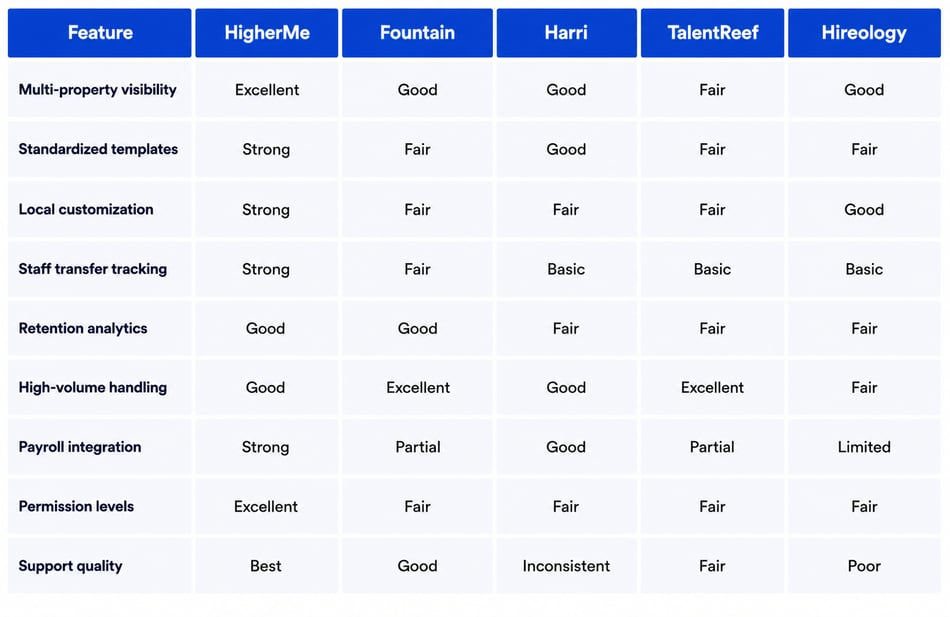
Quick Comparison: Feature Showdown
Conclusion
Multi-property operators need hiring software that doesn't force you to choose between standardization and flexibility. You need central oversight without crushing local control. You need standardized hiring standards with local adaptation. You need visibility into what's working and why.
HigherMe wins because it was built for exactly this scenario. Multi-property dashboards. Standardized templates with local customization. Staff transfer tracking. Retention analytics. Payroll integration. Everything built around "how do we standardize hiring across properties while respecting local markets?"
Ready to standardize hiring across your properties? HigherMe helps multi-property hotel operators manage hiring consistently while supporting local flexibility.
FAQs
1. How do we standardize hiring across properties without crushing local control?
Hybrid approach works. Standardized job templates for consistency. Local customization allowed within templates. Corporate approval for final hire if needed. Permission levels let corporate see all hiring while GMs control their property. HigherMe supports this structure well.
2. Can we track our best staff across properties?
Yes. Your ATS should track employee history across properties. You see who's best. Where they work. Retention rates per location. That data helps you identify high-performing properties. Learning from their practices. Identifying promotion candidates.
3. What happens when we want to transfer someone between properties?
System should track the transfer. History follows them. Training requirements might vary. Payroll changes if it's a raise. Your ATS should facilitate this smoothly. HigherMe supports transfers and tracks compensation changes.
4. How do we handle different payroll needs at different properties?
Most platforms integrate with multiple payroll processors. Some properties might be on ADP. Others on Paycheck. Your ATS should feed both. Or you might have same payroll processor but different pay scales by location. System should handle both scenarios.
5. Should we hire the same way at every property?
Mostly yes. Core hiring process is standardized. But local questions addressing market-specific needs are fine. One property in a college town might hire student staff. Another nearby might not. Framework same. Questions customized.
Book a Demo
We'll contact you as soon as possible to better understand how we can help you!