


Hotel hiring has a speed problem that most operators are still solving with slow tools.
The front desk agent you interviewed Monday has three other offers by Wednesday. The housekeeping role you posted last week is bleeding drop-offs because your application takes 15 minutes to fill out on a phone. By the time your GM calls back that promising candidate, they've already started somewhere else.
Hotel turnover for hourly employees runs above 70% annually. That means you're not just hiring to grow, you're hiring constantly just to stay even. And if your process isn't built for speed, you're losing candidates to competitors who are before you even realize they were interested.
Here's what actually moves the needle.
1. Switch to text-first candidate communication
Text message response rates are more than four times higher than email. For hourly hotel candidates who are checking their phones constantly and not refreshing an inbox, this gap is even more pronounced. Stop treating email as your default outreach channel. Text for interview confirmations, status updates, and initial screening. Save email for offer letters and compliance paperwork.
The practical shift here isn't just cultural, it's structural. If your ATS only surfaces candidates through an email dashboard, your GM isn't going to catch the 10pm application from someone who can start Monday. You need two-way communication baked into your hiring workflow.
HigherMe includes built-in two-way text messaging so hiring managers can communicate with candidates directly from the platform, no personal cell phones, no dropped threads.
2. Make your application completable in under three minutes on a phone
Up to 73% of candidates abandon applications that are too long or complex, especially on mobile devices. If your application has more than five fields and requires a resume upload, you're losing people before they ever hit submit. The resume requirement especially is a relic: most hourly hotel candidates don't have an updated resume sitting on their phone. Asking for one is a silent rejection.
Trim your application to name, contact info, availability, and one qualifying question. That's enough to start a conversation and enough to filter out the obvious mismatches.
3. Use Text-to-Apply at every physical touchpoint
Your property already has candidates walking through it every day: guests who might be job-hunting, delivery drivers, contract staff, people applying at a neighboring business. A Text-to-Apply code on a break room flyer, a lobby poster, or a staff entrance door converts casual interest into an actual application without requiring anyone to open a browser.
This is especially powerful for multi-property hotel operators. Instead of managing separate postings across locations, a single shortcode can route candidates to the right opening based on what they text in, or surface all available roles at once.
HigherMe's Text-to-Apply feature lets candidates apply directly from a text, with no app download and no login required. Candidates text a shortcode and they're in your pipeline immediately. Read More!
4. Respond within 24 hours, every time
Speed signals seriousness. 88% of candidates want an interview scheduled within a week of applying, and top operators treat response time as a KPI, not a nice-to-have. For hourly hotel roles where candidates are often applying to five or six jobs at once, being the first to respond meaningfully increases your odds of landing the hire.
What most properties get wrong is that they wait until a manager has bandwidth to review before sending any acknowledgment. The candidate hears nothing for two days and assumes the posting was stale. Automate your first-touch text so that every applicant gets a response within minutes, even if it's just "We got your application. We'll be in touch by [day]."
5. Screen via text, not phone tag
A five-question text screening sequence can replace a 20-minute phone screen and surface the same information in a fraction of the time. Ask about availability, preferred start date, whether they have prior hotel or hospitality experience, and any role-specific requirements. You get answers asynchronously, which means your hiring manager can review them between shifts instead of blocking off calendar time.
The added benefit: candidates who ghost a phone screen will often respond to a text screen. Lower friction at this stage keeps more qualified people in the funnel.
6. Send automated interview reminders
Candidate ghosting is a hotel hiring epidemic. Someone confirms a Tuesday morning interview and doesn't show. No call, no text, nothing. An automated reminder the evening before, including the location, who to ask for, and a simple "Reply YES to confirm," reduces no-shows substantially without requiring any manual effort from your team.
The reminder also gives candidates an easy, low-stakes way to reschedule rather than just disappearing. That's more useful than it sounds: a candidate who reschedules is still a viable hire. A ghost is just a wasted slot on your calendar.
HigherMe sends automated interview reminders so candidates stay engaged and your no-show rate drops without your managers chasing anyone down.
7. Build a mobile-optimized careers page for your property
Generic job board postings are fine for top-of-funnel volume, but if a candidate Googles your hotel name plus "jobs" and lands on a non-mobile-friendly page with a broken form, they're gone. Your careers page should load fast on a phone, show open roles clearly by location, and let someone apply in two taps.
This is table stakes for branded hotel operators managing multiple properties. Candidates should be able to see all openings in one place, filtered by property or role type, without having to navigate a corporate careers portal that wasn't built for hourly applicants.
8. Let candidates self-schedule interviews
Sending a scheduling link via text removes an entire back-and-forth round from your hiring process. Instead of three messages to find a mutual time, the candidate picks from your available slots and it lands on your calendar automatically. For GMs juggling front desk coverage and housekeeping schedules, this alone can cut time-to-interview by two or three days.
The secondary benefit is that self-scheduling filters for candidates who are actually interested. Someone who takes 30 seconds to book a slot is more likely to show up than someone who said "sure, whenever works for you."
9. Complete onboarding before day one
The offer-to-start gap is where you quietly lose people. A candidate accepts verbally on Friday, then arrives Monday to a stack of paperwork and spends their first hour filling out forms at the front desk. That friction compounds: they're already late to training, already annoyed, and already wondering if the job is organized enough to be worth their time.
Sending digital onboarding documents via mobile link before the first day means new hires arrive ready to work. Tax forms, direct deposit setup, handbook acknowledgment, scheduling preferences: all of it can be completed from their phone in the days before they start. It also signals that your property runs a professional operation, which matters more than most managers realize for early retention.
HigherMe's paperless onboarding lets new hires complete all pre-start documents on mobile, and it integrates with payroll so nothing has to be re-entered manually. Read More!
10. Track application-to-hire speed by source
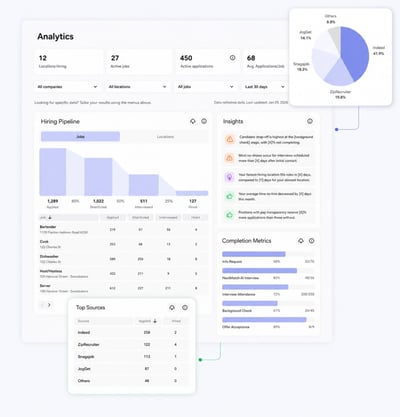 If you don't know which channel is producing candidates who show up, stay past 90 days, and perform, you're optimizing on gut feel. Mobile-first hiring platforms give you this data by source, by role, and by location. You might find that your Text-to-Apply flyers have a lower application volume than Indeed but twice the conversion rate. That's a budget and effort reallocation decision hiding in your analytics.
Time-to-hire by source also surfaces bottlenecks. If candidates from one channel take six days longer to move from application to offer, there's likely a process gap at a specific stage, and you can fix it.
HigherMe's advanced analytics dashboard tracks your full hiring funnel, from application source through to hire, so your team can see exactly where candidates are dropping off and where your fastest hires are coming from.
The bottom line
Hourly hotel hiring is a volume game with a speed constraint. Candidates aren't waiting around. The properties that hire fastest are the ones with frictionless mobile applications, same-day text follow-up, and automated processes that keep candidates moving through the funnel without requiring a manager to be hands-on at every step.
If your current process was designed for a desktop world, it's costing you candidates you never knew you lost. The shift to text and mobile-first hiring isn't a future investment. It's already the baseline for the operators winning the talent competition right now. Visit higherme.com for more info.
Frequently Asked Questions
1. We post jobs but barely get applicants. What are we doing wrong?
Most hotel operators are posting on job boards and waiting. The problem isn't visibility, it's friction. If your application takes more than three minutes on a phone, you're losing candidates before they finish. HigherMe fixes this with mobile-optimized applications, Text-to-Apply, and direct integrations with Indeed, so your jobs get seen and actually get completed.
2. We get applicants but they ghost us before the interview. How do we stop that?
Ghosting almost always happens in the silence between application and interview. Candidates apply to multiple jobs at once, and whoever follows up first wins. HigherMe sends automated text follow-ups immediately after someone applies and automated reminders before the interview, so candidates stay warm and your no-show rate drops without your managers chasing anyone.
3. Our GMs are too busy to manage hiring on top of everything else. Is there a way to make this less manual?
This is the core problem HigherMe was built for. Screening questions go out automatically, interview reminders send themselves, and onboarding documents are completed by the new hire on their phone before day one. Your GM makes the final call. Everything leading up to it runs without them.
4. We're hiring across multiple hotel properties and it's hard to keep track of who's applied where. Can one tool manage all of it?
Yes. HigherMe gives you a single dashboard across all your locations. Each property manages its own pipeline, but you get full visibility at the operator level: where you're getting applicants, where roles are stalling, and which locations have open positions that need attention.
5. How fast can we realistically get someone from application to first shift?
HigherMe customers average a 2-day time to hire. Between instant application acknowledgment, same-day text screening, self-scheduled interviews, and mobile onboarding completed before day one, the bottlenecks that typically stretch hiring to two weeks get cut down significantly.
6. We've tried hiring software before and it created more work than it saved. Why would this be different?
Most hiring tools were built for corporate HR teams, not hotel managers running a shift. HigherMe is designed for operators: setup is fast, the interface works on a phone, and the automations are pre-built for hourly hiring workflows. You're not configuring a system. You're turning on a process that already works.
Book a Demo
We'll contact you as soon as possible to better understand how we can help you!