



Hospitality hiring is a particular kind of chaos. You need warm bodies fast, but you also need the right ones. Turnover in this industry averages 75% annually, and that's on a good year. Quick-service environments can hit 130%. The platforms below were evaluated specifically for how well they serve hotel and hourly hospitality hiring, not just general recruiting. Spoiler: the tools built for corporate tech hiring often don't.
How we ranked these: Each platform was evaluated on:
-
features that matter for hospitality and hourly hiring,
-
verified user reviews from G2, Capterra, Google, and other sources, and
-
pros and cons.
Let’s dive in!
#1 HigherMe
.png?width=120&height=120&name=Best%20ats%20blog%20logo%20(1).png)
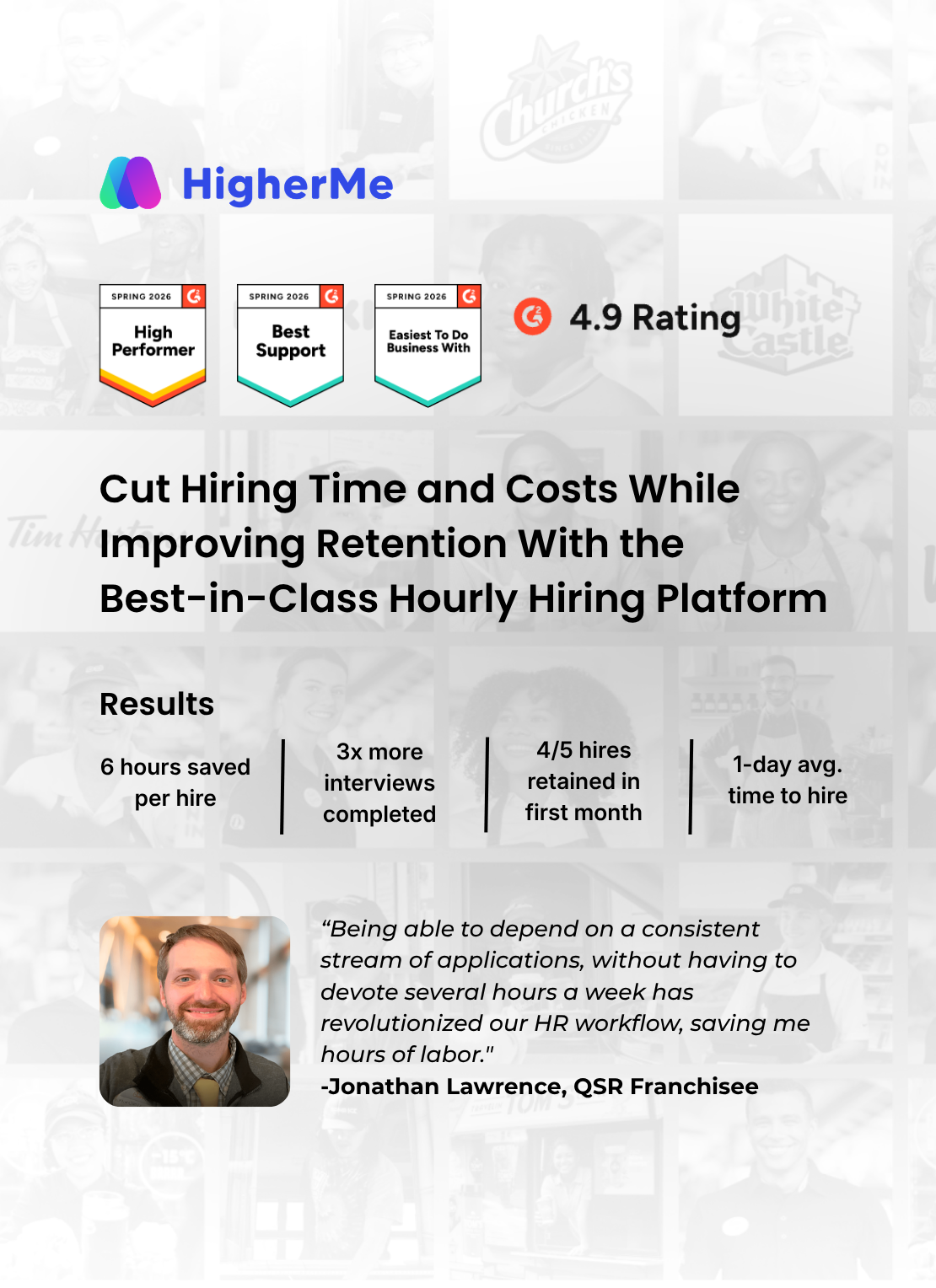
HigherMe was built for exactly the type of hiring that breaks most general ATS tools: high-volume, hourly, multi-location, with a workforce that applies from their phones and ghosts you if the process takes more than five minutes. It’s not just an ATS but a full talent acquisition partner. It's purpose-built for hotels, retail, hospitality and QSR businesses that need to move fast without sacrificing candidate quality. The platform covers job posting, applicant tracking, automated screening, interview scheduling and onboarding in one place, designed for operators, not HR consultants.
The impeccable customer list consisting of Hyatt, Hampton Inn, Palihouse and more, tells the story. For hotel F&B, QSR-adjacent hospitality, and franchise operators, that's meaningful proof of scale. Reviewers consistently flag how much time it saves managers compared to juggling email inboxes and spreadsheets for hourly applicants.
|
Pros
|
Cons
|
What Users Say
Hiring managers say the platform cuts the back-and-forth out of scheduling and screening, particularly for multi-location teams. A recurring theme across reviews is how quickly new managers get up to speed, with most reporting they were running live job posts within the same day. The most common ask: more granular reporting at the location level without having to upgrade tiers. Read more here!
Best for: Hotel F&B teams, QSR brands, franchise hospitality operators, and any multi-location business that needs to hire hourly workers fast, at scale, without a dedicated recruiting team to manage the process.
2. Harri
.png?width=120&height=120&name=Best%20ats%20blog%20logo%20(2).png) Harri is built specifically for the service industry, with hotels and restaurants making up most of their customer base. Their talent pool is hospitality-focused, and the platform covers hiring, onboarding, scheduling, and workforce management in one place.
Harri is built specifically for the service industry, with hotels and restaurants making up most of their customer base. Their talent pool is hospitality-focused, and the platform covers hiring, onboarding, scheduling, and workforce management in one place.|
Pros
|
Cons
|
What Users Say
The most-cited praise across G2 and Capterra: having everything in one place makes a real operational difference, especially for GMs managing large teams. Users who came from multi-system setups consistently say Harri reduced admin load noticeably. The friction point almost everyone mentions is the mobile experience: the manager and employee apps have persistent bug reports, including login loops and missed notifications, which is a problem for a frontline workforce that lives on their phones.
Best for: Enterprise hotel groups and multi-unit restaurant brands with ongoing, high-volume hiring and a need for workforce management in the same system.
3. Workable
.png?width=120&height=120&name=Best%20ats%20blog%20logo%20(3).png) Workable is one of the most genuinely user-friendly ATS platforms out there. It posts to 200+ job boards in one click, has solid AI-assisted screening, and its interview scheduling is consistently praised for eliminating calendar back-and-forth.
Workable is one of the most genuinely user-friendly ATS platforms out there. It posts to 200+ job boards in one click, has solid AI-assisted screening, and its interview scheduling is consistently praised for eliminating calendar back-and-forth.
It's not hospitality-native, but it's flexible enough to work well for hotel operators who need a clean, fast recruiting engine without the complexity of an enterprise HCM.
|
Pros
|
Cons
|
What Users Say
Reviewers across Capterra and G2 consistently call Workable the easiest ATS they've onboarded a team onto. The phrase "up and running same day" appears across multiple reviews. Where sentiment dips is post-sale: several users note that account manager quality drops sharply after the contract is signed, and the AI candidate scoring draws criticism for being imprecise. Satisfaction is decent for the price point, but mostly for teams under 200 employees.
Best for: Mid-size hotel groups and independent properties that want a reliable, easy-to-manage ATS without paying for hospitality-specific modules they won't use.
4. Greenhouse
.png?width=120&height=120&name=Best%20ats%20blog%20logo%20(4).png) Greenhouse is a well-built platform, consistently rated among the top enterprise ATS tools. For hospitality, it fits corporate hotel chains better than operations-level hiring. One verified hospitality reviewer on Capterra described it as a tool that "helps streamline the entire hiring process from posting jobs and tracking applicants to scheduling interviews and managing feedback." The analytics, customizable workflows, and DEI reporting are genuinely strong.
Greenhouse is a well-built platform, consistently rated among the top enterprise ATS tools. For hospitality, it fits corporate hotel chains better than operations-level hiring. One verified hospitality reviewer on Capterra described it as a tool that "helps streamline the entire hiring process from posting jobs and tracking applicants to scheduling interviews and managing feedback." The analytics, customizable workflows, and DEI reporting are genuinely strong.
The problem is speed. For high-volume hourly roles, Greenhouse's structure can slow things down rather than accelerate them. Some users report candidate profile loading times of 10+ minutes, which is a real problem when you're trying to fill 50 housekeeping roles before peak season.
|
Pros
|
Cons
|
What Users Say
Users in corporate and enterprise settings describe Greenhouse as one of the better designed platforms they've worked with, specifically praising the structured interview kits and scorecard system for reducing interviewer bias. In hospitality contexts though, the feedback is more divided: teams that hire for management roles love it, while those trying to use it for high-volume frontline hiring find the workflow too rigid and slow. A common frustration is slow page loads on large candidate lists and the need to click through too many screens for routine actions.
Best for: Corporate hotel chains with a dedicated TA team that values structured, data-informed hiring and has the headcount to justify the complexity.
5. Hcareers
.png?width=120&height=120&name=Best%20ats%20blog%20logo%20(5).png) Hcareers has been around for over 25 years, and for hotel hiring in the US, it's still one of the most targeted places to post. The candidate pool is made up of people specifically looking for hospitality work, which means less noise from people who applied to 200 jobs and don't actually want yours. It provides employer branding tools, resume database access, and AI-driven candidate matching on top of standard job listings. It's not a full ATS, so you'll need something else for pipeline management, but as a sourcing tool it punches above its weight for hotel and resort roles.
Hcareers has been around for over 25 years, and for hotel hiring in the US, it's still one of the most targeted places to post. The candidate pool is made up of people specifically looking for hospitality work, which means less noise from people who applied to 200 jobs and don't actually want yours. It provides employer branding tools, resume database access, and AI-driven candidate matching on top of standard job listings. It's not a full ATS, so you'll need something else for pipeline management, but as a sourcing tool it punches above its weight for hotel and resort roles.
|
Pros
|
Cons
|
What Users Say
Employers on Hotel Tech Report highlight that Hcareers delivers a noticeably higher candidate quality-to-noise ratio compared to generalist boards, particularly for experienced hotel roles. The trade-off is reach: for entry-level or hard-to-fill hourly positions, the volume of applicants is smaller than on Indeed or ZipRecruiter. The per-post pricing also comes up frequently as a barrier for smaller independent properties that can't justify $249+ for a role they need filled once a year.
Best for: Hotels and resorts in the US looking for a targeted sourcing channel with an industry-committed candidate base. Works best as one part of a multi-channel strategy.
6. Hosco
.png?width=120&height=120&name=Best%20ats%20blog%20logo%20(7).png) Hosco is the closest thing to LinkedIn, but for hospitality. It has several hospitality-specific profiles and partnerships with many hotel schools globally, making it a strong pipeline for early-career talent and international hires. Luxury hotel groups with properties across multiple countries will find it particularly useful because of its multilingual support and global reach.
Hosco is the closest thing to LinkedIn, but for hospitality. It has several hospitality-specific profiles and partnerships with many hotel schools globally, making it a strong pipeline for early-career talent and international hires. Luxury hotel groups with properties across multiple countries will find it particularly useful because of its multilingual support and global reach.
Unlike Hcareers, Hosco also offers a free employer profile and basic job posting, making it accessible for smaller properties too. It's primarily a sourcing and employer branding platform, not a full ATS.
|
Pros
|
Cons
|
What Users Say
Employers who use Hosco for graduate and early-career recruitment rate it highly for the quality of candidates coming out of hospitality school pipelines. The employer branding tools get specific praise: hotel groups say the company profile pages do real work in attracting candidates who actually understand the industry. The gap users flag is depth of reach for operational, hourly roles, where Hosco's community skews toward career-builders rather than shift-takers.
Best for: International hotel brands and luxury properties that want to attract career-focused hospitality talent, including early-career candidates from top hotel schools.
7. Wonolo
.png?width=120&height=120&name=Best%20ats%20blog%20logo%20(8).png) Wonolo is not exactly an ATS. It's a same-day staffing marketplace that connects businesses with pre-vetted workers for immediate needs. For hotels dealing with a sudden call-out on a busy weekend, or event staffing for a banquet, it fills a gap that traditional hiring tools simply can't. Workers are rated and reviewed, so you can build a bench of people you trust over time. The platform has filled over 3 million jobs and operates across 100+ US cities.
Wonolo is not exactly an ATS. It's a same-day staffing marketplace that connects businesses with pre-vetted workers for immediate needs. For hotels dealing with a sudden call-out on a busy weekend, or event staffing for a banquet, it fills a gap that traditional hiring tools simply can't. Workers are rated and reviewed, so you can build a bench of people you trust over time. The platform has filled over 3 million jobs and operates across 100+ US cities.
The honest trade-off: it's more expensive per-hour than a full-time hire, and its G2 reviews mention inconsistent job availability depending on your market.
|
Pros
|
Cons
|
What Users Say
Workers who use Wonolo regularly describe it as one of the more frictionless ways to pick up shifts, with fast payouts and a simple app being the most praised features on Indeed and G2. On the employer side, the feedback is more mixed: businesses in major metros report good worker quality and fill rates, while those in smaller markets say job availability can go dry for stretches. Customer support responsiveness is the most common complaint from employers, particularly when a shift goes wrong and there's no quick path to resolution.
Best for: Hotels and event venues needing fast, flexible labor for peak periods, last-minute gaps, or seasonal spikes. Should complement a permanent hiring tool, not replace it.
8. Lever
.png?width=120&height=120&name=Best%20ats%20blog%20logo%20(9).png) Lever has the best user interface of any ATS on this list. Recruiters consistently call it out in G2 reviews as one of the few tools that doesn't feel like it was designed in 2005. The candidate experience is clean, interview scheduling is smooth, and the talent relationship management (TRM) feature is legitimately useful for building passive pipelines. For hospitality, the problem is fit. Lever is optimized for hiring 20–100 people per year, not 20 per week.
Lever has the best user interface of any ATS on this list. Recruiters consistently call it out in G2 reviews as one of the few tools that doesn't feel like it was designed in 2005. The candidate experience is clean, interview scheduling is smooth, and the talent relationship management (TRM) feature is legitimately useful for building passive pipelines. For hospitality, the problem is fit. Lever is optimized for hiring 20–100 people per year, not 20 per week.
At high volume, the pricing becomes hard to justify. For corporate hotel chains with a small TA team hiring for management roles, it can make sense. For anyone trying to fill front-desk and housekeeping roles at scale, it doesn't.
|
Pros
|
Cons
|
What Users Say
Lever's G2 reviews are unusually consistent: recruiter after recruiter calls out the interface as the cleanest they've used, and the candidate portal draws specific praise for giving applicants visibility into where they stand. The frustration that comes up most is the price-to-feature ratio at the base tier: users feel they're paying enterprise pricing to access features that competitors include as standard. Support on the base plan also gets flagged as slow, with email-only access and delayed responses being a recurring theme among smaller accounts.
Best for: Well-funded hotel brands filling a low-to-medium volume of management or corporate roles where candidate experience and pipeline management matter more than speed.
9. Hospitality Online
.png?width=120&height=120&name=Best%20ats%20blog%20logo%20(10).png) Hospitality Online sits in an interesting spot. It's more than a job board because it includes applicant tracking, employer branding, and multi-property distribution tools, but it's less comprehensive than a full HCM like Harri. For hotel management groups that want one place to post across all their properties, track applicants, and present a consistent employer brand without committing to enterprise pricing, it's a solid middle-ground option. The company profiles are a standout feature, letting candidates actually learn about a property before applying, which tends to improve application quality.
Hospitality Online sits in an interesting spot. It's more than a job board because it includes applicant tracking, employer branding, and multi-property distribution tools, but it's less comprehensive than a full HCM like Harri. For hotel management groups that want one place to post across all their properties, track applicants, and present a consistent employer brand without committing to enterprise pricing, it's a solid middle-ground option. The company profiles are a standout feature, letting candidates actually learn about a property before applying, which tends to improve application quality.
|
Pros
|
Cons
|
What Users Say
Hospitality Online is a platform with a loyal but quiet user base. Hotel management group operators value it for the centralized posting across properties and the company profile feature, which they say results in better-informed applicants than a generic job board produces. The consistent gap in feedback is the candidate volume: users note that while applicant quality is decent, the pool is smaller than what you'd get from broader boards, so it works best as a supplementary channel rather than a primary one.
Best for: Hotel management companies operating multiple properties that need a hospitality-specific platform covering sourcing, employer branding, and basic applicant tracking in one.
10. CoolWorks
.png?width=120&height=120&name=Best%20ats%20blog%20logo%20(11).png) CoolWorks is not for everyone, and that's the point. It specifically connects employers at national parks, ski resorts, ranches, wilderness lodges, and destination properties with candidates who want to be there. These aren't job seekers scrolling through 50 listings. They're people actively seeking work in a specific kind of place. That self-selection tends to produce better retention than mass job board applications.
CoolWorks is not for everyone, and that's the point. It specifically connects employers at national parks, ski resorts, ranches, wilderness lodges, and destination properties with candidates who want to be there. These aren't job seekers scrolling through 50 listings. They're people actively seeking work in a specific kind of place. That self-selection tends to produce better retention than mass job board applications.
If your hotel sits in a remote or scenic location and struggles to attract staff who'll actually show up and stay, CoolWorks reaches a candidate pool that no other platform on this list touches.
|
Pros
|
Cons
|
What Users Say
Employers at seasonal and outdoor properties describe CoolWorks as one of the few platforms where applicants actually read the job description before applying. Resort and lodge operators report that candidates from CoolWorks tend to ask better questions and show up more reliably than those sourced from general boards, which they attribute to the intent-driven nature of the platform's audience. The honest limitation from employer feedback: outside of seasonal or adventure-focused properties, the platform has almost no reach.
Best for: Seasonal resorts, national park lodges, ski properties, and remote destination hotels that need a specific type of candidate who's motivated by the location, not just the job.
Summary
Every platform on this list does something well. Harri is genuinely impressive for large hotel groups that need scheduling, compliance, and workforce management sitting next to their ATS. Greenhouse is one of the better-built recruiting tools on the market, full stop. Workable is fast, clean, and easy to justify to a CFO. Wonolo solves a real problem that no traditional ATS even attempts to. And if you run a ski resort in the middle of nowhere, CoolWorks is quietly irreplaceable.
That said, if you hire hourly in hospitality at any kind of volume, HigherMe is where we'd start. Not because the others are bad, but because most of them were built for a different kind of hiring and adapted to fit hospitality. HigherMe was built for this specific problem from the beginning: high turnover, mobile applicants, multi-location chaos, and managers who are already doing three other jobs. The full hiring lifecycle, from posting to onboarding, in one place, designed for operators not recruiters.
Pick the tools that match your actual hiring reality. For most hospitality operators, that conversation starts with HigherMe. To know more, visit higherme.com.
Book a Demo
We'll contact you as soon as possible to better understand how we can help you!