



Hourly candidates don't wait. A store manager who takes 24 hours to respond to an application is losing that person to whoever responds first. The problem is that managers are running locations, not sitting by an inbox. Voice AI and conversational AI tools exist to bridge that gap. They engage candidates the moment they apply, screen them automatically, and pass a shortlist to the manager when it's actually useful.
The distinction worth paying attention to: there's a big difference between AI tools built for enterprise HR deployments and AI tools built for franchise operators hiring cashiers, crew members, and shift leads at scale. The price, the complexity, and the setup time look completely different depending on which category you're in.
In QSR, average annual employee turnover frequently exceeds 100%, meaning most positions turn over more than once per year. At that rate, the hiring process has to run around the clock whether or not a manager is available. That's the whole point of AI hiring.
Here are the 10 best voice AI hiring tools for hourly employers.
1. HigherMe (NextMatch AI)
Best AI hiring software for franchise and hourly employers
HigherMe's AI hiring layer is NextMatch AI, and the conversational voice of it is Amelia. What separates it from most tools on this list is that it doesn't exist as a separate product. It's built directly into HigherMe's ATS, which means screening, scheduling, onboarding, and payroll are all connected. When Amelia finishes pre-screening a candidate and a manager moves them forward after reviewing, the next steps happen inside the same platform. No handoffs, no re-entering data, no switching tools.
If you opt for NextMatch AI, Amelia asks pre-screening questions that matter for that specific role, and delivers a full transcript of the conversation. The manager doesn't need listen to sit through every screening call. They read the transcript for context, and decide. The hiring judgment stays with the human. The labor of initial screening goes to the AI.
Automated interview scheduling means a confirmed appointment lands without any back and forth. Communication between Amelia's pre-screening and the interview happens over SMS and in-app messaging, which is where hourly candidates actually respond.
One thing worth noting about how HigherMe's AI is positioned: Amelia surfaces candidates and provides transcripts, but she does not make automated pass or fail decisions. Every hire is made by a manager reviewing results. That's a deliberate choice, and it matters for operators who want AI handling volume without AI handling judgment.
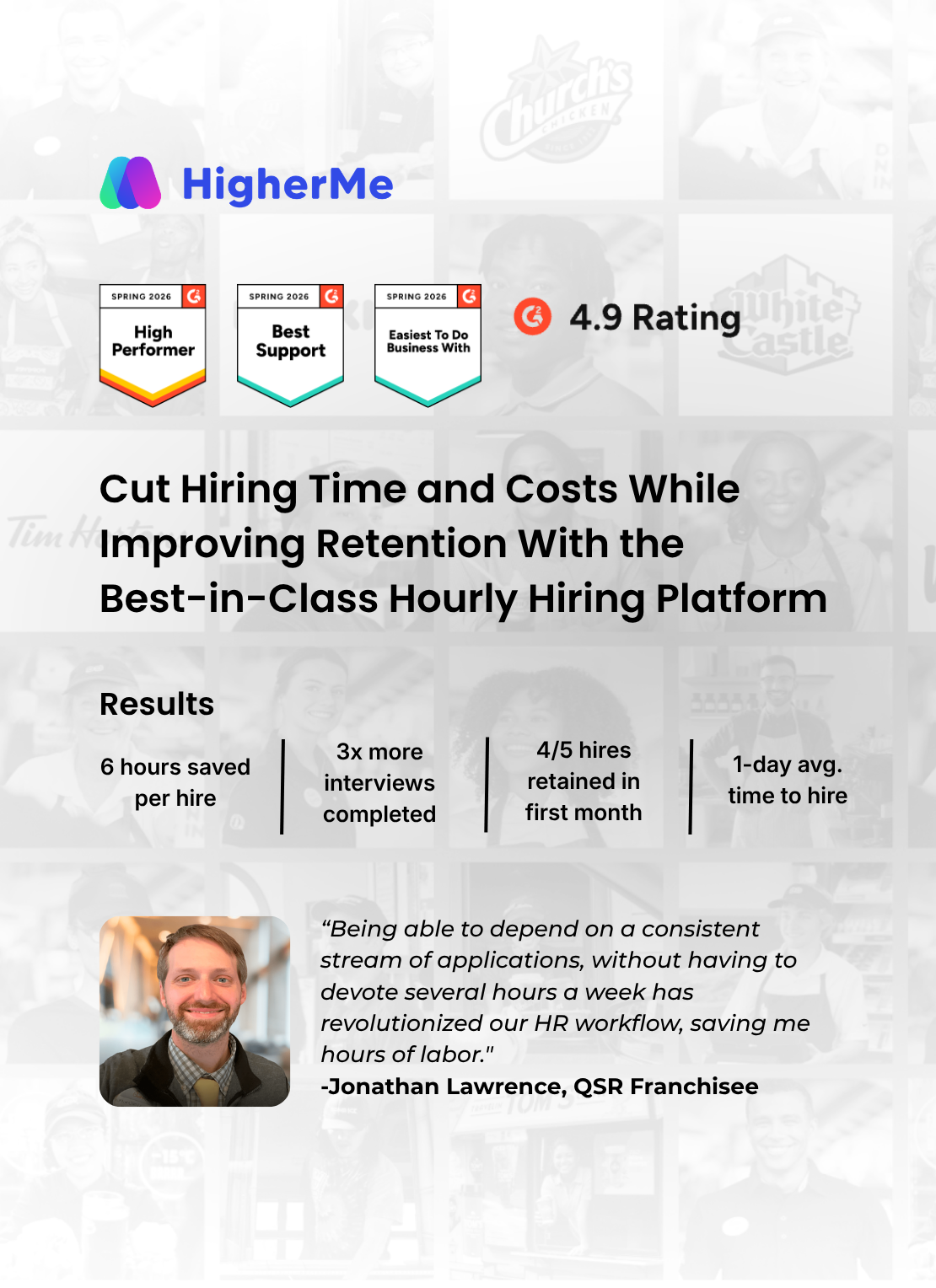
Customers report 3x more completed interviews, 67% fewer no-shows, and an average time-to-hire of two days. Learn more!
2. Paradox (now Workday)
Paradox built real credibility in conversational AI for high-volume hiring. Its Olivia assistant ran candidate engagement, screening, and scheduling entirely through text, and it worked well enough that a lot of QSR operators were seriously evaluating it. Then Workday acquired Paradox in October 2025. Since then, the product has been repackaged as part of the Workday enterprise HCM ecosystem. For franchise operators who aren't already on Workday, the pricing, implementation timeline, and overall positioning have shifted significantly upmarket. It's still a capable tool. It's just no longer competing for the same operators it used to.
3. Fountain
Fountain’s AI capabilities are better described as workflow automation than as conversational AI. Candidates progress through automated stages and the system filters based on responses to screening questions. It performs well in very high volume workloads where the focus is on throughput. The candidate interaction feels more transactional than conversational, which matters less in some contexts than in others. No native payroll or back-end onboarding, so whatever Fountain captures still needs to flow somewhere else.
4. Harri
Harri has added candidate messaging and some automated hiring workflows to its hospitality workforce platform. The AI hiring capabilities are there, but they're not where Harri invests its development focus. The platform's core is scheduling and labor management, and the hiring tools sit around that. For operators who want conversational AI as a primary capability, Harri is not the right starting point. For operators already on Harri who want automated messaging layered in, it's a reasonable add.
5. Hireology
Hireology includes AI-assisted screening as part of its franchise-focused ATS. Structured screening questions, fit scoring, and multi-location reporting are all there. The experience is more rules-based than genuinely conversational. It works well for franchise groups that want consistent screening templates enforced across locations, less well for operators who need real-time candidate engagement that feels human.
6. SmartRecruiters
SmartRecruiters launched its Winston AI assistant in late 2024, and it covers candidate matching, screening communications, and workflow automation across the hiring process. The reported results from Winston users include meaningful increases in candidate conversion and mobile application completion. The catch is the same one that applies to SmartRecruiters broadly: it was built for enterprise corporate hiring teams, not hourly franchise operators. The implementation, the pricing, and the feature set all reflect that.
7. Homebase
Homebase added basic AI hiring features to its small business platform, mainly around job description generation and some automated screening prompts. It's not a conversational AI tool in any real sense. The platform is a scheduling product. The AI hiring features are an entry-level add-on that works for very small operators who want something simple, not for QSR operators who need to screen dozens of candidates a week.
8. GetHired
GetHired offers automated candidate filtering through knockout questions rather than conversational AI. If a candidate doesn't meet a basic criterion, they're filtered out. That's useful but it's not the same category as a tool like Amelia that engages candidates in a real back-and-forth. Works for single-location operators on a limited budget who want basic filtering without a big investment.
9. JazzHR
In late 2025, JazzHR added an AI Screening Companion to its SMB hiring platform to bring rudimentary AI candidate evaluation. Designed for small teams with structured professional hiring needs. It is early stage for high volume hourly operations versus purpose-built tools. JazzHR is designed, priced and built for a professional candidate experience, not the speed of QSR hiring.
10. PeopleMatter
PeopleMatter has served the restaurant and hospitality segment for years and has automated screening questions built into its platform. The AI capabilities are more limited than newer tools, and the platform has not invested as heavily in conversational AI as competitors have. It's a functional option for existing customers who know the product well. For operators evaluating fresh, the gap in AI capability is noticeable.
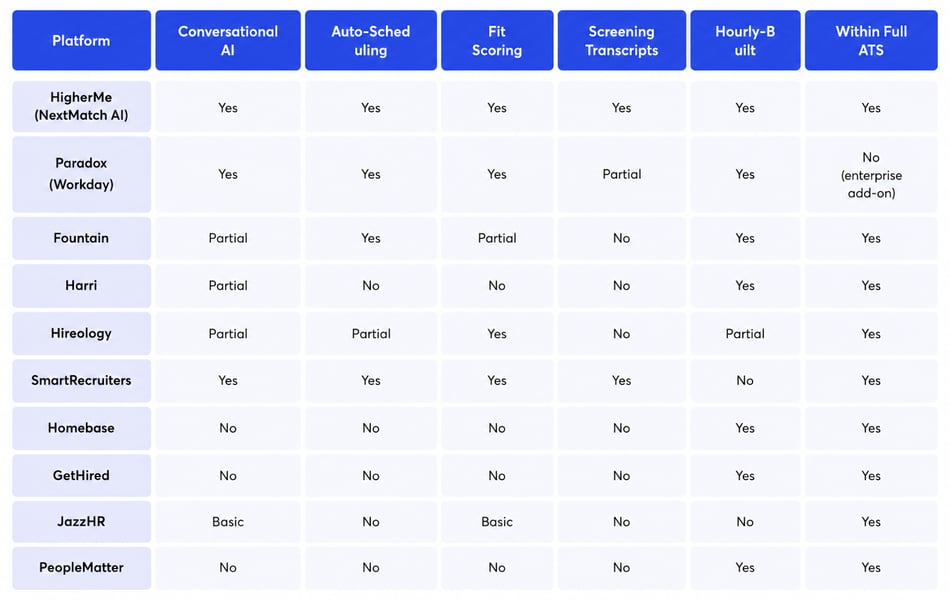
Quick Comparison Table
The Bottom Line
Voice and conversational AI in hiring is not about replacing the hiring manager. It's about making sure every applicant gets a fast response, every qualified candidate gets surfaced, and managers spend their time on the conversation that actually matters instead of the screening call that doesn't need a human on one end.
The tool that does this best for QSR and franchise operators is HigherMe, because the AI is embedded in the full hiring stack rather than sitting outside it. When Amelia finishes, the next step is already connected.
Visit higherme.com to see NextMatch AI in action.
Frequently Asked Questions
1. What is Voice AI Hiring Software, and how does it work for hourly employers?
These tools automatically engage, screen and score job candidates without requiring a manager to initiate every interaction. A candidate applies, and the AI starts a conversation, gathering role-relevant information and scoring them against your criteria. The manager gets a ranked shortlist with context.
2. Does AI make the hiring decision, or does a human still decide?
In HigherMe's system, humans always decide. Amelia pre-screens and transcribes. No automated pass or fail is issued. The manager reviews the results and makes the call. The tool removes the volume problem. The judgment stays with the person.
3. Will hourly candidates actually respond to an AI screening?
Yes, especially when it happens via SMS and feels conversational rather than like a form. HigherMe customers report 3x more completed interviews compared to managing job boards manually.
4. Is AI hiring software expensive for smaller franchise operators?
Enterprise tools like Paradox have moved upmarket since the Workday acquisition. HigherMe is built and priced for franchise operators at every scale, from a single location to large multi-unit groups.
5. Can AI screening reduce interview no-shows?
Yes. Faster follow-up, automated scheduling, and ongoing text communication shrink the window between application and confirmed interview. Less time means less opportunity to lose a candidate to a competing offer. HigherMe customers report 67% fewer no-shows.
6. How is HigherMe's AI different from enterprise tools like Paradox?
Enterprise tools are powerful but require dedicated HR teams, long implementations, and enterprise budgets. HigherMe's AI is built for store-level managers who need accurate screening without complexity. It goes live fast, requires no technical setup, and is designed around the way hourly hiring actually works.
Book a Demo
We'll contact you as soon as possible to better understand how we can help you!